
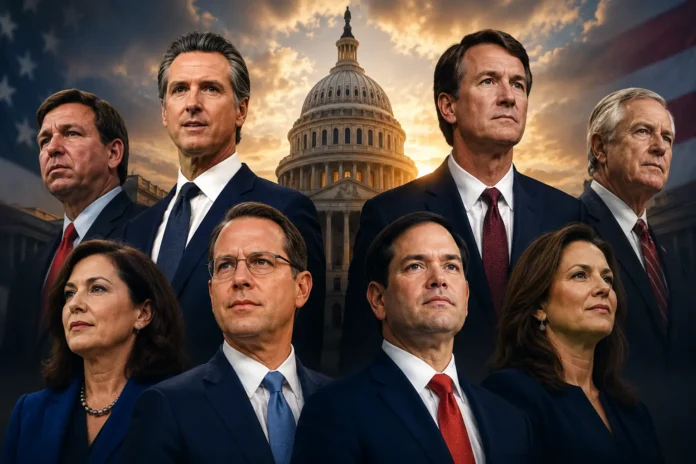
How State Leaders Are Shaping the Future of the United States
In Washington, political battles often dominate headlines. The White House commands global attention, Congress drives national debates, and the Supreme Court delivers decisions that shape American life. Yet some of the most significant policy innovations and political movements in the United States are happening far from Capitol Hill.
Across the country, governors are emerging as some of the most influential figures in American politics.
From managing economic growth and public safety to addressing immigration, healthcare, education, and climate policy, governors increasingly serve as laboratories of leadership. Their decisions affect millions of residents and often influence national conversations. In many cases, state policies become blueprints for future federal action.
As the United States navigates political polarization, economic uncertainty, technological transformation, and demographic change, governors are playing a larger role than ever before.
Here are some of the most influential governors in America right now and why their leadership matters far beyond their state borders.
Why Governors Matter More Than Ever
The office of governor has always been important, but its influence has expanded significantly in recent years.
During the COVID-19 pandemic, governors became the primary decision-makers on lockdowns, school closures, vaccine distribution, and economic reopening plans. Since then, state leaders have continued to wield enormous power over issues ranging from abortion laws to artificial intelligence regulations.
Many political analysts now view governorships as testing grounds for future presidential candidates.
Unlike members of Congress, governors oversee entire executive branches, manage massive budgets, respond to emergencies, and implement policy directly. Their records provide voters with tangible examples of leadership.
As a result, influential governors often become national political figures regardless of whether they seek higher office.
Gavin Newsom: California’s National Voice
California Governor Gavin Newsom has become one of the most recognizable political leaders in America.
Leading the nation’s most populous state and the world’s fifth-largest economy, Newsom oversees policies that often set trends for the rest of the country.
His administration has focused heavily on climate initiatives, renewable energy investments, healthcare expansion, housing challenges, and technology regulation.
Newsom has also emerged as one of the Democratic Party’s most visible communicators. Through media appearances, policy debates, and interstate political campaigns, he has positioned himself as a prominent defender of progressive governance.
Because California’s economy rivals that of many nations, decisions made in Sacramento frequently influence corporate strategies and public policy discussions across the United States.
Ron DeSantis: Conservative Influence Beyond Florida
Florida Governor Ron DeSantis remains one of the most influential Republican leaders in America.
During and after the pandemic, Florida became a focal point for debates surrounding public health policies, education, parental rights, and government regulation.
DeSantis has built a national profile through initiatives targeting curriculum reforms, immigration enforcement measures, and business regulations.
Supporters view him as a champion of limited government and conservative values. Critics argue that some policies expand government involvement in cultural issues.
Regardless of political perspective, few dispute DeSantis’ impact on national political conversations. Florida’s growing population and economic strength have amplified his influence well beyond state borders.
Greg Abbott: Texas and the Power of Economic Growth
Texas Governor Greg Abbott leads one of America’s fastest-growing states.
Texas has attracted major corporations, manufacturing investments, and technology companies seeking lower taxes and business-friendly regulations.
Abbott’s administration has emphasized border security, energy production, infrastructure investment, and economic development.
As Texas continues to gain population and political significance, policies implemented in Austin increasingly shape national debates.
The state’s role in energy production alone gives Abbott substantial influence over conversations involving electricity reliability, oil and gas development, renewable energy, and national energy security.
His handling of immigration issues has also placed Texas at the center of federal-state policy disputes.
Josh Shapiro: Pennsylvania’s Rising Political Star
Pennsylvania Governor Josh Shapiro has quickly gained attention as one of the Democratic Party’s emerging leaders.
Known for his pragmatic style and focus on bipartisan governance, Shapiro has earned praise for crisis management, infrastructure projects, and economic development initiatives.
Pennsylvania occupies a unique position in American politics as a critical swing state.
Success in Pennsylvania often serves as a political bellwether, making Shapiro’s leadership particularly influential.
Many observers believe his ability to appeal to both moderate and progressive voters could elevate his national profile in future election cycles.
Gretchen Whitmer: Shaping the Midwest
Michigan Governor Gretchen Whitmer has become one of the most influential Democratic governors in the country.
Her administration has focused on infrastructure modernization, manufacturing investment, clean energy development, and workforce training.
Michigan’s importance in the automotive industry gives Whitmer a significant platform in discussions surrounding electric vehicles, advanced manufacturing, and industrial policy.
She has also gained national recognition for her communication style and ability to navigate politically divided environments.
As manufacturing becomes increasingly important to America’s economic strategy, Whitmer’s policies continue attracting national attention.
JB Pritzker: Leading America’s Economic Crossroads
Illinois Governor JB Pritzker oversees one of America’s largest and most economically diverse states.
His administration has pursued investments in infrastructure, technology, clean energy, healthcare, and workforce development.
Chicago’s role as a major financial, transportation, and logistics hub gives Illinois substantial influence on national economic trends.
Pritzker has emerged as a prominent voice within the Democratic Party, frequently engaging in debates over economic policy, social issues, and federal-state relations.
His growing national visibility has fueled speculation about future leadership ambitions.
Glenn Youngkin: A Different Republican Blueprint
Virginia Governor Glenn Youngkin has drawn national attention by presenting a different model of Republican leadership.
His electoral success demonstrated how Republicans could appeal to suburban voters while maintaining support among traditional conservative constituencies.
Youngkin’s administration has emphasized education reform, economic growth, public safety, and workforce development.
Because Virginia sits at the intersection of Southern, Mid-Atlantic, and federal politics, policy developments in the state often receive outsized national attention.
Many political strategists continue to study Youngkin’s approach as a potential template for future campaigns.
Sarah Huckabee Sanders: Influencing Conservative Politics
Arkansas Governor Sarah Huckabee Sanders remains a highly influential figure within Republican circles.
Her administration has prioritized education reform, tax reductions, workforce development, and parental rights initiatives.
As a former White House Press Secretary, Sanders entered office with significant national recognition.
She has used that platform to advocate conservative policy priorities and shape broader Republican messaging.
While Arkansas is smaller than states like California or Texas, Sanders’ national profile gives her influence that extends beyond state boundaries.
Andy Beshear: Bipartisan Leadership in Kentucky
Kentucky Governor Andy Beshear has earned attention for his ability to win support in a politically conservative state while maintaining Democratic leadership.
His administration has focused on disaster recovery, healthcare access, economic development, and infrastructure improvements.
Beshear’s bipartisan appeal makes him an interesting figure in an era of increasing political polarization.
Many analysts view his success as evidence that practical governance and local priorities can still transcend partisan divisions.
His leadership style continues attracting attention from political observers nationwide.
The Growing Importance of State-Level Leadership
The increasing influence of governors reflects broader changes in American governance.
Political gridlock in Washington has encouraged states to take greater responsibility for solving complex problems.
Today, governors are addressing issues such as:
- Artificial intelligence regulation
- Cybersecurity preparedness
- Climate adaptation
- Housing affordability
- Workforce development
- Public health infrastructure
- Education modernization
- Energy transition strategies
These challenges require practical solutions that often emerge first at the state level.
As a result, governors frequently become policy innovators whose ideas eventually shape national legislation.
Governors as Future Presidential Candidates
Historically, governors have enjoyed considerable success in presidential politics.
Former governors such as Ronald Reagan, Bill Clinton, George W. Bush, Jimmy Carter, and others leveraged executive leadership experience into successful White House campaigns.
The reason is simple: voters often prefer candidates with demonstrated management experience.
Governors oversee agencies, manage budgets, respond to emergencies, and make decisions with immediate consequences.
Several of today’s influential governors are already viewed as potential future presidential contenders.
Their performance in state office may ultimately shape the next generation of national leadership.
Economic Influence Beyond State Borders
One reason governors have gained influence is the growing economic significance of states.
California, Texas, Florida, New York, and other states possess economies larger than many countries.
When governors introduce new regulations, tax policies, workforce programs, or environmental standards, businesses often adjust strategies nationwide.
Technology firms, manufacturers, healthcare providers, and financial institutions closely monitor state-level policy changes because those decisions can affect national operations.
This economic reality gives governors a powerful role in shaping America’s future.
The Media Factor
Modern media has also expanded gubernatorial influence.
Social media platforms, streaming services, podcasts, and digital news outlets allow governors to communicate directly with national audiences.
A governor’s speech in Austin, Sacramento, Tallahassee, or Lansing can instantly become a national news story.
This direct access to voters has transformed governors from regional leaders into influential national voices.
As traditional political institutions evolve, governors increasingly operate on a national stage.
Challenges Facing Today’s Governors
Despite their growing influence, governors face significant challenges.
States must address:
- Rising healthcare costs
- Infrastructure demands
- Housing shortages
- Workforce gaps
- Budget pressures
- Natural disasters
- Public safety concerns
- Rapid technological change
Balancing competing priorities while maintaining economic growth requires effective leadership and long-term planning.
How governors respond to these challenges will influence not only their states but also the broader direction of the country.
Conclusion
The most influential governors in America today are doing far more than managing state governments. They are shaping economic policy, driving national debates, testing new ideas, and influencing the future of American politics.
Whether through California’s climate initiatives, Texas’ economic expansion, Florida’s policy battles, Michigan’s manufacturing investments, or Pennsylvania’s bipartisan governance efforts, governors have become central figures in the nation’s political landscape.
As Americans continue to look for solutions to complex challenges, state leaders will likely play an even larger role in determining the country’s direction.
In many ways, the future of American policy may be written not only in Washington, D.C., but also in state capitols across the nation.