
When millions of students spend years preparing for one of India’s toughest examinations, they expect a fair contest. What they don’t expect is that the examination itself may be compromised, forcing them to relive months of stress because someone somewhere managed to leak confidential papers.
That is exactly what happened with NEET-UG 2026.
And instead of confronting the people and institutions responsible for repeatedly allowing these scandals to happen, the Indian government’s latest response has been to temporarily block Telegram and disable some of its features.
The decision has triggered criticism both within India and internationally, with many questioning whether banning a communication platform solves anything at all.
The Latest Crisis: NEET-UG 2026
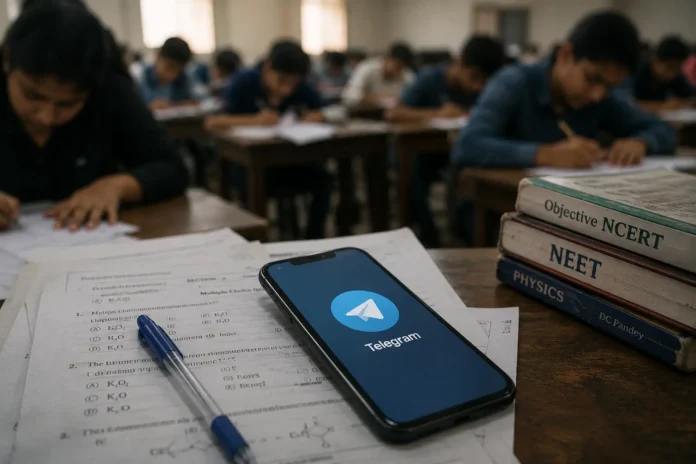
More than 2 million aspiring medical students appeared for the NEET-UG 2026 examination. Soon after, allegations emerged that question papers had been leaked before the test. Investigations by authorities and the CBI uncovered evidence suggesting that cheating networks had been operating through WhatsApp and Telegram channels, while some groups were reportedly selling “100% genuine papers” to desperate students and parents.
The controversy became so serious that authorities cancelled the original examination and scheduled a re-examination for June 21, 2026.
In response, the Ministry of Electronics and Information Technology temporarily blocked Telegram until June 22 and even ordered the platform to disable message editing until June 30. The government argued that these measures were necessary to prevent another leak. Reuters reported that Telegram itself challenged the order in court, arguing that millions of legitimate users were being punished for the actions of a small number of criminals.
Telegram Is Not the Source of the Leak
This is where the logic begins to fall apart.
Telegram did not steal the question papers.
Telegram employees did not gain access to examination material.
Telegram did not force corrupt insiders to sell papers.
The leak originated somewhere within the examination ecosystem itself.
Without insiders, weak security, corruption, or failures in handling confidential papers, there would have been nothing to distribute on Telegram in the first place.
The platform merely became the messenger.
Blaming the messenger while ignoring the source of the message is a convenient distraction.
India Has Seen This Before
The NEET controversy is only the latest chapter in a long history of examination scandals.
Over the years, India has witnessed leaks involving:
- NEET examinations.
- JEE examinations.
- SSC recruitment exams.
- UP Police recruitment examinations.
- Bihar teacher recruitment exams.
- Railway recruitment tests.
- Various state board examinations.
Many of these leaks occurred long before Telegram became widely popular.
The common denominator was never a messaging app.
It was weak systems, corruption, and organized cheating rackets.
Criminals Simply Move Elsewhere
Suppose Telegram disappears completely tomorrow.
Will paper leaks stop?
Almost certainly not.
Cheating syndicates would move to:
- WhatsApp.
- Signal.
- Discord.
- Private forums.
- Email groups.
- Dark web channels.
- Even physical photocopies and traditional methods.
Technology changes.
Human corruption does not.
Experts have repeatedly pointed out that once a paper is leaked, restricting one app does little to stop distribution. Information spreads rapidly across multiple channels within minutes.
Millions of Innocent Users Become Collateral Damage
India has around 150 million Telegram users.
Students use Telegram to share notes.
Teachers run educational groups.
Businesses coordinate teams.
Journalists communicate with sources.
Developers and researchers rely on communities hosted on Telegram.
A blanket ban punishes millions of ordinary users because a handful of criminals abused the platform.
By that standard, should telephones be banned because scammers use them?
Should email be prohibited because phishing attacks exist?
Should roads be closed because criminals drive cars?
The logic simply does not hold.
Critics Say India Is Becoming Too Comfortable With Bans
India already leads the world in internet shutdowns.
Human rights organizations and digital freedom advocates have repeatedly criticized the country’s tendency to restrict online platforms instead of targeting offenders.
International observers have increasingly questioned why the world’s largest democracy and an aspiring technology superpower often resorts to blocking websites, apps, and internet access whenever problems emerge.
Rather than admiration, these moves frequently invite criticism and disbelief.
Many commentators abroad see such actions as signs of administrative failure rather than technological strength.
Even Telegram’s Founder Called The Ban Ineffective
Telegram founder Pavel Durov criticized the move, saying that blocking the platform would not stop paper leaks because those responsible would simply migrate to other services.
His argument was simple:
If the papers have already leaked, criminals will find another way to share them.
And history suggests he may be right.
The Real Questions Nobody Wants to Answer
How did confidential examination papers leave secure custody?
Who had access to them?
How many insiders were involved?
Why do these leaks keep happening despite repeated promises of reform?
Why are organized exam mafias still operating?
These questions are far more uncomfortable than banning an app.
Because answering them would require accountability.
India Deserves Better Than Symbolic Solutions
Students preparing for NEET sacrifice years of their lives.
Families spend their savings on coaching institutes.
Dreams are built around a single examination.
Those dreams deserve institutions capable of protecting the integrity of the process.
Blocking Telegram may create headlines.
It may create the appearance of action.
But appearances are not solutions.
Unless India addresses corruption, strengthens exam security, modernizes paper handling systems, and dismantles the networks behind these leaks, another scandal is only a matter of time.
And when that happens, another app will become the villain.
While the real problem remains untouched.