
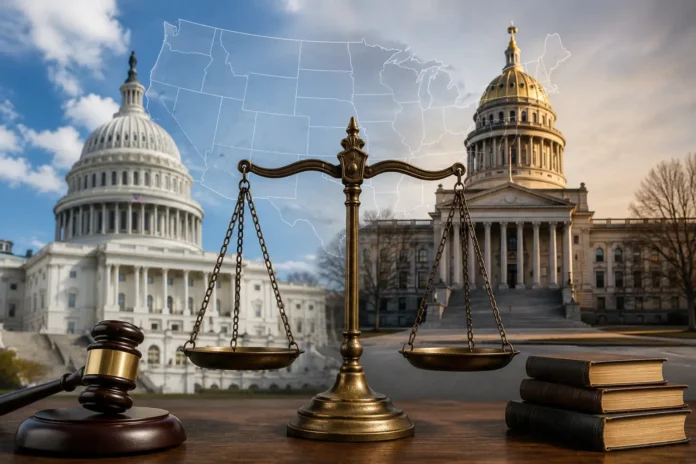
Few debates have shaped American politics more profoundly than the question of who should hold power: the federal government or the states.
From healthcare and immigration to education and environmental regulations, disagreements over authority continue to influence nearly every major political issue in the United States. While many Americans hear politicians talk about “states’ rights” or “federal authority,” the reality is often far more complex.
The United States operates under a unique system known as federalism, where power is divided between the national government and state governments. This balance has helped define the country since its founding and remains one of the most important features of American democracy.
In 2026, as political debates intensify over everything from election laws to artificial intelligence regulation, understanding state vs federal power is more important than ever.
So who really controls what?
The answer lies deep within the Constitution, centuries of legal battles, and an ongoing struggle to balance local control with national unity.
The Founders Faced a Difficult Problem
When America gained independence from Britain, the newly formed states were cautious about creating a powerful central government.
Many leaders feared replacing one distant authority with another.
The first governing framework, known as the Articles of Confederation, gave most power to the states and left the national government relatively weak.
That system quickly revealed its weaknesses.
The federal government struggled to collect taxes, regulate commerce, and coordinate national policies.
As economic and political challenges mounted, leaders gathered in Philadelphia in 1787 to create a stronger system.
The result was the U.S. Constitution.
Rather than concentrating power in one place, the Constitution established a federal system that divided authority between national and state governments.
This compromise remains the foundation of American governance today.
What Is Federalism?
Federalism is the principle that government power is shared between different levels of government.
In the United States, this means:
- The federal government has certain powers.
- State governments have certain powers.
- Some powers are shared by both.
The goal is to prevent excessive concentration of authority while allowing government to function effectively.
Federalism recognizes that a country as large and diverse as the United States cannot always be governed efficiently from a single location.
States often face different challenges and may require different solutions.
At the same time, certain issues demand national coordination.
The Constitution attempts to balance these competing needs.
Powers Reserved for the Federal Government
The Constitution specifically grants certain powers to the federal government.
These are known as enumerated powers.
Some of the most important include:
National Defense
Only the federal government can maintain the nation’s military forces and conduct war-related activities.
The Army, Navy, Air Force, Marine Corps, and Space Force all operate under federal authority.
Foreign Policy
The federal government manages diplomatic relations with other countries.
It negotiates treaties, establishes embassies, and represents the United States internationally.
Immigration
While states can influence certain aspects of immigration enforcement, immigration policy itself remains primarily a federal responsibility.
Currency and Monetary Policy
Only the federal government can issue currency and regulate the nation’s monetary system.
Interstate Commerce
Congress has authority to regulate commerce that crosses state lines.
This power has expanded significantly throughout American history.
Without federal oversight, economic activity between states could become fragmented and inconsistent.
Powers Reserved for the States
The Constitution also protects state authority.
The Tenth Amendment explicitly states that powers not delegated to the federal government are reserved to the states or the people.
State governments generally oversee:
Education
Most decisions regarding public schools are made at the state and local levels.
States establish educational standards, graduation requirements, and funding structures.
Public Safety
State and local governments manage police departments, emergency services, and criminal justice systems.
Elections
States play a major role in administering elections, including voter registration, polling locations, and ballot procedures.
Licensing and Professional Regulation
States regulate professions such as doctors, lawyers, teachers, and contractors.
Local Infrastructure
Road maintenance, zoning decisions, and many transportation projects are primarily state and local responsibilities.
This allows states to tailor policies to local needs and priorities.
Shared Powers: Where Things Get Complicated
Not every responsibility falls neatly into one category.
Many powers are shared.
Examples include:
- Taxation
- Law enforcement
- Transportation
- Environmental protection
- Healthcare administration
This overlap often creates conflicts.
For instance, both state and federal governments collect taxes.
Both enforce laws.
Both regulate aspects of healthcare.
Determining where federal authority ends and state authority begins is often the source of political and legal disputes.
The Supremacy Clause: Federal Law Usually Wins
One of the most important constitutional provisions is the Supremacy Clause.
It establishes that federal law generally takes precedence over conflicting state laws.
If Congress passes a law within its constitutional authority, states cannot simply ignore it.
For example:
A state cannot create its own foreign policy.
A state cannot issue its own currency.
A state cannot establish immigration rules that directly conflict with federal law.
The Supremacy Clause helps maintain national consistency while preserving the federal system.
Without it, the country could face significant legal and administrative confusion.
Why States Sometimes Challenge Washington
Despite federal supremacy, states frequently challenge federal policies.
This is not unusual.
In fact, it has been a recurring feature of American politics for more than two centuries.
States may argue that:
- Federal agencies exceeded their authority.
- Congress overstepped constitutional limits.
- Local interests are being ignored.
- National policies create burdens on states.
These disputes often end up in federal courts, where judges interpret constitutional boundaries.
The courts play a crucial role in maintaining the balance between state and federal power.
Healthcare: A Constant Power Struggle
Healthcare provides a clear example of shared authority.
The federal government influences healthcare through:
- Medicare
- Medicaid funding
- Drug regulation
- Public health programs
States oversee:
- Medical licensing
- Insurance regulation
- Public health implementation
- Hospital oversight
This division creates a complex system where cooperation is often necessary.
When healthcare reforms are proposed, debates frequently emerge over how much authority should remain in Washington versus state capitals.
Education: Mostly Local, But Not Entirely
Education is often cited as a state responsibility.
And for the most part, it is.
States determine curriculum standards, graduation requirements, and funding formulas.
However, the federal government still plays a significant role.
Federal involvement includes:
- Student financial aid
- Civil rights enforcement
- Educational research funding
- Support for disadvantaged schools
This hybrid system illustrates how federalism often functions in practice.
Authority is rarely absolute.
Instead, responsibilities are frequently shared.
Environmental Policy Creates Frequent Tensions
Environmental issues often spark intense debates about federal versus state authority.
Some environmental challenges cross state borders.
Air pollution, water quality, and climate-related concerns can affect multiple states simultaneously.
Supporters of federal oversight argue that national standards are necessary.
Others believe states should have greater flexibility to address environmental issues according to local conditions.
The result is an ongoing tug-of-war over regulations, enforcement, and policy priorities.
Immigration Remains One of the Biggest Battlegrounds
Immigration consistently generates disputes between state and federal governments.
The Constitution places immigration policy under federal authority.
However, states often bear the practical consequences of immigration decisions.
This can lead to disagreements over:
- Border security
- Law enforcement cooperation
- Public services
- Employment regulations
Some states seek more involvement in immigration enforcement, while others resist federal policies they view as harmful.
These conflicts highlight the challenges of governing a diverse nation with varying regional priorities.
Technology and Artificial Intelligence Raise New Questions
The rise of artificial intelligence, data privacy concerns, and digital technologies is creating new federalism debates.
Questions include:
- Should states create their own AI regulations?
- Should privacy laws vary by state?
- Is a national framework necessary?
Businesses often prefer consistent national standards.
State leaders frequently argue for flexibility and innovation.
As technology evolves, federalism debates will likely expand into areas that previous generations never imagined.
Why Americans Experience Different Laws in Different States
One of the most visible consequences of federalism is legal variation.
Residents of different states often encounter different rules regarding:
- Taxes
- Education policies
- Business regulations
- Healthcare programs
- Criminal justice policies
This diversity reflects the principle that states serve as policy laboratories.
Supporters argue that states can experiment with different solutions and learn from one another.
Critics contend that varying laws can create confusion and inequality.
Both perspectives continue influencing political discussions.
The Supreme Court’s Powerful Role
When state and federal governments disagree, the courts often become the final referee.
The Supreme Court has issued numerous landmark decisions defining the limits of government authority.
Throughout American history, court rulings have shaped:
- Civil rights protections
- Voting rights
- Healthcare policy
- Environmental regulations
- Interstate commerce
- Religious freedom
Because constitutional language can be interpreted differently, judicial decisions often determine how federalism functions in practice.
The Supreme Court remains one of the most influential actors in the federal-state relationship.
Why Some Americans Prefer More State Control
Supporters of stronger state authority often argue that local governments better understand local needs.
Their arguments include:
Greater Accountability
State officials are often closer to the communities they serve.
Policy Innovation
States can experiment with new ideas without imposing them nationwide.
Regional Flexibility
Different regions face different challenges.
Reduced Federal Bureaucracy
Local decision-making can sometimes move more quickly than national systems.
These arguments have remained influential throughout American history.
Why Others Prefer Strong Federal Leadership
Advocates for stronger federal authority emphasize national consistency.
Their arguments include:
Equal Rights Protections
Federal standards can help ensure rights are protected regardless of location.
National Coordination
Large-scale challenges often require unified responses.
Economic Consistency
Businesses benefit from predictable national regulations.
Crisis Response
National emergencies may demand centralized leadership.
These perspectives also have deep historical roots.
The Future of Federalism
The balance between state and federal power is unlikely to be settled anytime soon.
Emerging issues continue creating new questions.
Future debates may focus on:
- Artificial intelligence
- Data privacy
- Climate adaptation
- Public health emergencies
- Election administration
- Cybersecurity
- Economic regulation
As technology and society evolve, federalism will continue adapting alongside them.
The Constitution provides a framework, but each generation must determine how that framework applies to modern challenges.
Conclusion
The debate over state vs federal power is not simply a legal argument—it is one of the defining features of American democracy.
The federal government oversees national priorities such as defense, foreign policy, immigration, and interstate commerce. States maintain authority over education, public safety, elections, and many aspects of daily governance.
Yet much of modern government exists in the space between these categories, where authority overlaps and cooperation becomes essential.
The tension between state and federal power has shaped America since its founding and continues to influence nearly every major policy debate.
Far from being a flaw, this ongoing balance is part of how the American system was designed to function—ensuring that no single level of government holds all the power while allowing the nation to remain united.
As new challenges emerge in the years ahead, the question of who controls what will remain at the center of American political life.