
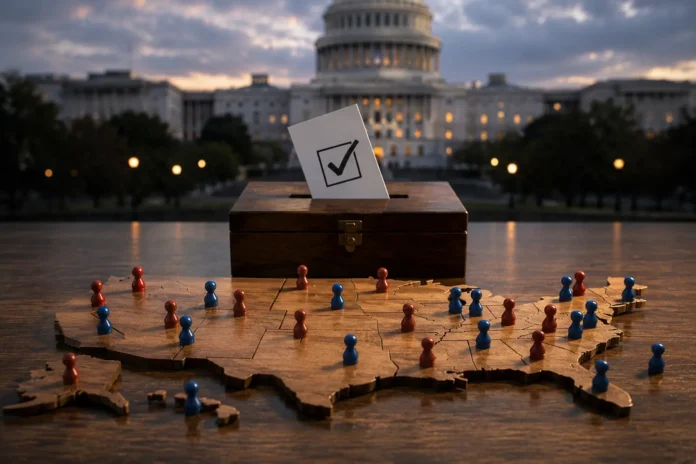
Every four years, millions of Americans head to the polls believing they are voting directly for the next President of the United States.
Technically, they are not.
While voters cast ballots for their preferred candidate, the official mechanism that determines who becomes president is a system known as the Electoral College.
For many Americans—and even many international observers—the Electoral College remains one of the most misunderstood aspects of U.S. democracy. It is a system that has survived for more than two centuries, influenced numerous presidential elections, sparked countless debates, and continues to shape modern political strategy.
As the United States looks toward future elections beyond 2024, understanding how this unique system works is more important than ever.
So what exactly is the Electoral College, why does it exist, and why does it continue to generate so much controversy in 2026?
Let’s take a closer look.
What Is the Electoral College?
The Electoral College is the constitutional system used to elect the President and Vice President of the United States.
Rather than electing a president through a direct national popular vote, Americans vote for a slate of electors who then formally cast votes for president.
These electors make up the Electoral College.
To win the presidency, a candidate must secure a majority of electoral votes.
Currently, that number is 270 out of 538 electoral votes.
The candidate who reaches that threshold becomes president, regardless of whether they won the national popular vote.
This distinction remains one of the most debated aspects of American elections.
Why Was the Electoral College Created?
To understand the Electoral College, it’s important to understand the concerns of America’s founders.
When delegates gathered during the Constitutional Convention in 1787, they faced a difficult question:
How should a president be chosen?
Several ideas were proposed.
Some delegates favored direct elections by the people.
Others believed Congress should select the president.
Some argued that state legislatures should have the final say.
The Electoral College emerged as a compromise between competing viewpoints.
At the time, concerns included:
- The limited flow of information across states
- Protecting smaller states from being overshadowed by larger states
- Balancing state and federal power
- Preventing excessive concentration of political influence
The result was a system designed specifically for the unique political realities of the late eighteenth century.
More than 200 years later, it remains largely intact.
How Electoral Votes Are Assigned
Every state receives a certain number of electoral votes.
That number is based on congressional representation.
Each state receives:
- One electoral vote for each member of the House of Representatives
- Two electoral votes representing its Senate seats
Because every state has two senators regardless of population, smaller states receive slightly greater representation relative to their population.
For example:
- California has 54 electoral votes
- Texas has 40 electoral votes
- Florida has 30 electoral votes
- Wyoming has 3 electoral votes
- Vermont has 3 electoral votes
The District of Columbia also receives three electoral votes under the 23rd Amendment.
Together, the total reaches 538 electoral votes.
The Winner-Take-All Rule
One of the most important features of the Electoral College is the winner-take-all system.
In nearly every state, the candidate who wins the statewide popular vote receives all of that state’s electoral votes.
For example:
If a candidate wins Pennsylvania by one vote, they receive all of Pennsylvania’s electoral votes.
If a candidate wins Florida by one percent, they still receive every electoral vote from Florida.
Only two states use a different approach:
- Maine
- Nebraska
These states allocate some electoral votes based on congressional district results rather than awarding all votes to the statewide winner.
This creates occasional opportunities for electoral vote splits.
Why Swing States Matter So Much
Because of the winner-take-all system, presidential campaigns focus heavily on competitive states known as swing states.
These are states where neither major party consistently dominates.
Instead of campaigning equally across all fifty states, candidates concentrate resources where electoral outcomes remain uncertain.
Swing states often receive:
- More campaign visits
- More advertising
- Greater media attention
- Increased voter outreach efforts
In recent election cycles, states frequently considered battlegrounds have included:
- Pennsylvania
- Michigan
- Wisconsin
- Georgia
- Arizona
- Nevada
- North Carolina
The importance of these states stems directly from the Electoral College structure.
A few thousand votes in a swing state can dramatically affect the national outcome.
Winning the Popular Vote Isn’t Always Enough
Perhaps the most controversial aspect of the Electoral College is that a candidate can lose the national popular vote and still become president.
This has happened multiple times in American history.
The most recent examples occurred in:
- 2000
- 2016
In both cases, the winning candidate secured an Electoral College majority despite receiving fewer total votes nationwide than their opponent.
Supporters of the Electoral College argue that presidential elections are contests between states rather than individuals.
Critics argue that every vote should carry equal weight regardless of geography.
This debate remains central to discussions about electoral reform.
The Electoral College and Campaign Strategy
The Electoral College profoundly shapes how campaigns operate.
Candidates do not simply seek the most votes nationwide.
Instead, they seek electoral votes.
As a result, campaign strategies often prioritize:
Geographic Targeting
Campaigns identify key battleground states and invest heavily in those areas.
Coalition Building
Candidates must appeal to diverse regions and demographic groups.
Resource Allocation
Advertising budgets and campaign visits are concentrated where electoral gains appear achievable.
Voter Mobilization
Campaigns focus heavily on turnout efforts in competitive states.
Without the Electoral College, presidential campaigns might look very different.
National popular vote elections could encourage candidates to concentrate more heavily on large metropolitan areas and population centers.
Arguments in Favor of the Electoral College
Supporters believe the Electoral College continues to provide important benefits.
Protecting Smaller States
Advocates argue that smaller states would receive less attention under a pure popular vote system.
The Electoral College ensures every state plays a role.
Encouraging National Coalitions
Candidates must build broad geographic support rather than focusing exclusively on densely populated regions.
Maintaining Federalism
The system reflects America’s structure as a union of states rather than a single national electorate.
Promoting Political Stability
Supporters argue that the Electoral College helps produce clear outcomes and reduces the likelihood of nationwide recounts.
These arguments continue to resonate with many voters and policymakers.
Arguments Against the Electoral College
Critics believe the system no longer reflects modern democratic principles.
Unequal Voting Influence
Votes in smaller states can carry more weight than votes in larger states due to electoral vote allocation formulas.
Focus on Swing States
Most campaign attention concentrates on a handful of battleground states while safe states receive little attention.
Popular Vote Discrepancies
Candidates can win the presidency without winning the most votes nationally.
Voter Disengagement
Some voters in heavily partisan states may feel their votes matter less because outcomes are considered predictable.
These concerns fuel ongoing reform discussions.
Could the Electoral College Be Abolished?
Technically, yes.
Practically, it would be extremely difficult.
Eliminating the Electoral College would require a constitutional amendment.
The amendment process demands:
- Approval by two-thirds of Congress
- Ratification by three-fourths of the states
Given the political divisions surrounding electoral reform, achieving that level of agreement would be extraordinarily challenging.
As a result, most experts believe the Electoral College is unlikely to disappear in the near future.
The National Popular Vote Movement
Rather than pursuing a constitutional amendment, some reform advocates support an alternative approach known as the National Popular Vote Interstate Compact.
Under this agreement, participating states pledge to award their electoral votes to the candidate who wins the national popular vote.
The compact would only take effect once participating states collectively represent at least 270 electoral votes.
Supporters view it as a way to ensure the national popular vote winner becomes president.
Opponents argue it could create legal and constitutional challenges.
As of 2026, the debate remains active.
Technology and Modern Elections
The Electoral College was created in a vastly different era.
In 1787:
- News traveled slowly.
- Most citizens never met presidential candidates.
- Communication was limited.
- Population distribution was dramatically different.
Today, Americans receive instant information through television, smartphones, social media, and online platforms.
This technological transformation has prompted renewed questions about whether the Electoral College still serves its original purpose.
Supporters argue that the system continues providing stability.
Critics contend that modern communication makes some historical justifications less relevant.
The discussion is likely to continue for years.
The Electoral College’s Impact on Political Polarization
Some analysts argue that the Electoral College contributes to political polarization.
Because campaigns focus on competitive states, political messaging often targets narrow voter segments rather than the broader national electorate.
Others argue the opposite.
They believe candidates must build wider coalitions to win enough states and electoral votes.
Whether the Electoral College reduces or increases polarization remains a subject of ongoing debate among political scientists.
What Happens If No Candidate Gets 270 Electoral Votes?
Although rare, the Constitution provides procedures if no candidate secures an Electoral College majority.
In that situation:
- The House of Representatives elects the president.
- The Senate elects the vice president.
Importantly, House members vote by state delegation rather than individual representatives.
Each state receives one vote.
This process has occurred only a few times in American history but remains part of the constitutional framework.
Why Understanding the Electoral College Matters in 2026
The Electoral College remains one of the most influential institutions in American politics.
It affects:
- Campaign strategies
- Voter turnout efforts
- Political advertising
- Policy priorities
- Election outcomes
Understanding how the system works helps citizens make sense of why presidential campaigns focus on certain states, why close elections receive intense scrutiny, and why the popular vote is not always the deciding factor.
Whether someone supports or opposes the Electoral College, its importance cannot be ignored.
Looking Ahead
As America continues debating election reform, the Electoral College remains at the center of discussions about democracy, representation, and political fairness.
Future elections will likely renew questions about:
- Electoral vote allocation
- Swing state influence
- Popular vote legitimacy
- Constitutional reform
- Federalism and state power
Yet despite recurring controversy, the Electoral College has proven remarkably durable.
It has survived wars, economic crises, political realignments, demographic changes, and technological revolutions.
That resilience suggests it will continue shaping presidential elections for the foreseeable future.
Conclusion
Understanding the Electoral College in 2026 means understanding one of the most distinctive features of American democracy.
Created as a constitutional compromise more than two centuries ago, the Electoral College remains the system through which the United States elects its president.
Supporters view it as a safeguard that protects states and encourages broad national coalitions. Critics see it as an outdated structure that can produce outcomes inconsistent with the national popular vote.
Regardless of where Americans stand in the debate, the Electoral College continues to influence every presidential election, shape campaign strategies, and define the path to the White House.
As future elections approach, understanding this system remains essential for anyone seeking to understand how political power is won in the United States.