
This Content Is Only For Subscribers
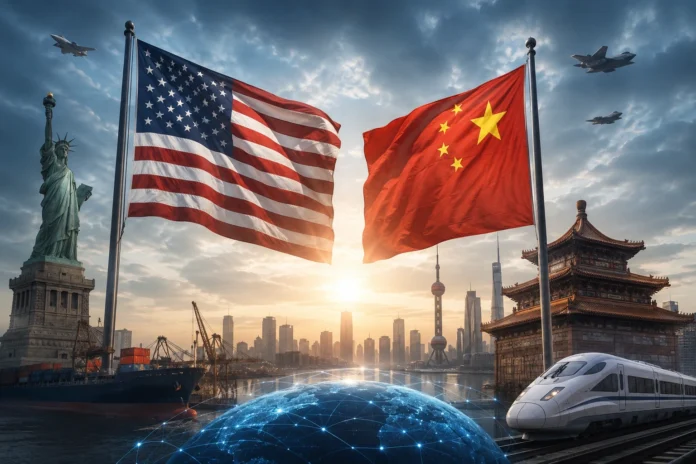
For more than four decades, the relationship between the United States and China has shaped the global economy, influenced international security, and affected the lives of billions of people. From booming trade partnerships to fierce geopolitical competition, the world’s two largest economies have become deeply connected while simultaneously growing further apart.
Today, policymakers, investors, businesses, and ordinary citizens are asking the same question: What comes next for U.S.–China relations?
The answer is complicated. The relationship is no longer defined by simple cooperation or outright hostility. Instead, it exists in a gray area where competition, interdependence, diplomacy, and strategic rivalry all coexist.
As both nations navigate economic uncertainty, technological competition, military tensions, and shifting global alliances, the future of U.S.–China relations could become one of the defining stories of the 21st century.
From Partnership to Strategic Rivalry
The modern relationship between Washington and Beijing was built on economic cooperation.
After China opened its economy in the late 1970s, American companies poured billions into manufacturing, supply chains, and investment opportunities. Consumers in the United States benefited from lower-priced goods, while China’s economy experienced unprecedented growth.
For years, many policymakers believed economic integration would eventually bring greater political alignment.
That never fully happened.
Instead, China emerged as a global economic powerhouse while maintaining its own political and strategic model. As China’s influence expanded, concerns in Washington grew regarding trade imbalances, intellectual property, military modernization, and regional ambitions.
The result was a gradual shift from engagement to competition.
Today, leaders in both countries increasingly describe the relationship as one defined by strategic rivalry rather than partnership.
Trade Wars May Fade, But Economic Competition Will Remain
The trade disputes that began during the Trump administration fundamentally changed how both nations viewed economic dependence.
Tariffs imposed on hundreds of billions of dollars worth of goods highlighted vulnerabilities within global supply chains and exposed deep disagreements over trade practices.
Although some tariffs may eventually be reduced or modified, economic competition is unlikely to disappear.
Several trends suggest that both countries are preparing for a future where economic security becomes just as important as economic growth:
- Diversification of supply chains
- Reduced dependence on foreign manufacturing
- Strategic stockpiling of critical materials
- Increased domestic industrial investment
- Stronger export controls on sensitive technologies
Businesses that once viewed globalization as inevitable are now reconsidering where they manufacture products and source components.
Rather than complete economic separation, experts increasingly expect a process often called “de-risking”—reducing vulnerabilities without entirely severing ties.
This means the U.S. and China will likely remain major trading partners while simultaneously competing for economic influence.
The Technology Race Could Define the Future
If trade was the central issue of the last decade, technology may become the defining issue of the next.
The competition extends far beyond smartphones and consumer electronics.
It now includes:
- Artificial Intelligence (AI)
- Quantum computing
- Semiconductor manufacturing
- Biotechnology
- Advanced robotics
- Space technology
- Cybersecurity
Both Washington and Beijing view technological leadership as essential to national security and economic prosperity.
The semiconductor industry illustrates this perfectly.
Advanced chips power everything from smartphones and cloud computing systems to military equipment and artificial intelligence platforms. As a result, restrictions on semiconductor exports have become a major point of contention between the two countries.
The technological race is no longer simply about innovation.
It is about who will set the rules, standards, and infrastructure that shape the future global economy.
Taiwan Remains the Most Sensitive Flashpoint
No issue carries greater potential risk than Taiwan.
China considers Taiwan part of its territory and has repeatedly stated that reunification remains a long-term objective.
The United States maintains a policy that intentionally leaves some ambiguity regarding how it would respond to a conflict while continuing to support Taiwan’s defensive capabilities.
Military activity around the Taiwan Strait has increased significantly in recent years.
Chinese military exercises, naval patrols, and air operations have drawn international attention, while the United States and its allies continue conducting operations aimed at maintaining regional stability.
Many analysts believe that managing tensions around Taiwan will be one of the greatest diplomatic challenges facing both countries.
Even minor incidents could escalate rapidly if communication channels fail or political pressures intensify.
Fortunately, leaders on both sides understand the enormous economic and human costs that a military conflict would bring.
This shared understanding remains one of the strongest incentives for avoiding direct confrontation.
The South China Sea Is Still a Strategic Battleground
Another major source of friction lies in the South China Sea.
This region serves as one of the world’s most important shipping corridors, carrying trillions of dollars in annual trade.
China has expanded its presence through island-building projects, military installations, and maritime patrols. Meanwhile, the United States continues freedom-of-navigation operations designed to challenge what it views as excessive territorial claims.
Several Southeast Asian nations also have competing claims in the region, making the situation even more complex.
The South China Sea highlights a broader reality:
The competition between the United States and China is not limited to economics. It increasingly involves questions about regional influence, military power, and international norms.
Climate Change Creates an Unavoidable Need for Cooperation
Despite growing tensions, some challenges simply cannot be addressed by one country alone.
Climate change is perhaps the most obvious example.
The United States and China are the world’s two largest economies and among the largest contributors to global greenhouse gas emissions.
Without cooperation between them, global climate goals become significantly harder to achieve.
Areas where collaboration remains possible include:
- Clean energy development
- Carbon reduction technologies
- Electric vehicle innovation
- Renewable energy deployment
- Environmental monitoring
Even during periods of heightened political tension, climate cooperation often remains one of the few areas where dialogue continues.
This demonstrates an important reality of modern geopolitics: competition and cooperation can occur simultaneously.
Artificial Intelligence Could Reshape the Relationship
Artificial intelligence is rapidly emerging as a strategic issue with profound implications.
Both nations are investing heavily in AI research and development.
The stakes extend beyond economics.
AI could influence:
- Military decision-making
- Cybersecurity operations
- Healthcare innovation
- Financial systems
- Scientific discovery
- National productivity
The challenge for policymakers is balancing competition with risk management.
Without clear international standards, AI development could become another area where misunderstandings and mistrust increase.
Some experts argue that future U.S.–China dialogues may increasingly resemble Cold War-era arms control discussions, focusing not on nuclear weapons but on advanced technologies.
Whether such frameworks emerge remains uncertain.
Global Alliances Are Being Recalibrated
As U.S.–China competition intensifies, other countries are adapting.
Many nations face difficult choices.
They may depend economically on China while relying on security partnerships with the United States.
Countries across Europe, Asia, Africa, and Latin America are increasingly pursuing flexible strategies designed to maintain relationships with both powers.
Rather than choosing sides outright, many governments are attempting to maximize economic opportunities while protecting their strategic interests.
This balancing act is likely to become a defining feature of international relations in the coming years.
The world is not dividing neatly into two opposing camps.
Instead, a more complex and multipolar system appears to be emerging.
Can Diplomacy Prevent a New Cold War?
One of the most frequently asked questions is whether the world is entering a new Cold War.
There are certainly similarities:
- Strategic competition
- Military modernization
- Technological rivalry
- Ideological differences
- Global influence campaigns
However, there is one critical difference.
The United States and China remain deeply economically connected.
Unlike the United States and the Soviet Union during the Cold War, today’s superpowers are linked through trade, finance, investment, education, and supply chains.
This interconnectedness creates both risks and opportunities.
It raises the costs of confrontation while providing incentives for continued engagement.
Diplomatic communication channels have become increasingly important as tensions rise.
Regular meetings between military officials, diplomats, and political leaders help reduce the risk of miscalculation.
Even when disagreements persist, dialogue itself can help prevent crises from escalating.
The Economic Impact on Ordinary People
For many Americans and Chinese citizens, geopolitical competition may seem distant.
Yet the effects are often felt directly.
Changes in U.S.–China relations can influence:
- Consumer prices
- Employment opportunities
- Technology access
- Investment markets
- Energy costs
- Supply chain reliability
When tariffs increase, consumers may pay more for goods.
When technology restrictions expand, companies may face higher costs.
When tensions rise, markets often react with increased volatility.
The relationship between the two nations is not merely a diplomatic issue.
It affects households, businesses, and communities around the world.
What Businesses Are Watching Closely
Corporate leaders are preparing for a future where geopolitical risk becomes a permanent business consideration.
Many companies are focusing on:
Supply Chain Resilience
Firms are building alternative manufacturing networks to reduce dependence on any single country.
Regulatory Compliance
Businesses must navigate increasingly complex trade restrictions and export controls.
Technology Security
Cybersecurity and data protection have become critical strategic priorities.
Market Access
Companies continue evaluating how changing political conditions may affect access to major consumer markets.
Business decisions once driven primarily by cost and efficiency are now increasingly shaped by national security concerns.
The Most Likely Scenario: Competitive Coexistence
Despite dramatic headlines, the most likely future is neither complete cooperation nor open conflict.
Instead, many analysts expect a period of competitive coexistence.
Under this scenario:
- Economic ties continue but become more selective.
- Technological competition intensifies.
- Military tensions remain manageable.
- Diplomatic engagement continues.
- Global institutions adapt to new power realities.
This approach recognizes that neither country can fully isolate the other without significant consequences.
Competition will remain intense, but both sides have strong incentives to avoid direct confrontation.
The Decade Ahead
The next ten years could determine whether U.S.–China relations stabilize or become increasingly volatile.
Several factors will shape the outcome:
- Leadership decisions in Washington and Beijing
- Economic growth trends
- Technological breakthroughs
- Taiwan Strait developments
- Regional security dynamics
- Global crises requiring cooperation
History suggests that transitions between major powers are rarely simple.
Yet history also shows that conflict is not inevitable.
The choices made by policymakers, businesses, and international partners in the coming years will influence not only bilateral relations but the broader global order.
Final Thoughts
The future of U.S.–China relations will not be defined by a single summit, trade deal, or military exercise. It will be shaped by thousands of decisions made across governments, corporations, universities, and international institutions.
The relationship has entered a new era—one marked by strategic competition, technological rivalry, and shifting global power dynamics. Yet cooperation remains possible in areas where mutual interests overlap, particularly climate change, economic stability, and crisis management.
What comes next is unlikely to resemble either the optimism of the globalization era or the rigid divisions of the Cold War. Instead, the world may witness a complex relationship where rivalry and cooperation exist side by side.
For investors, businesses, policymakers, and ordinary citizens alike, understanding this evolving dynamic will be essential. Because when the world’s two largest powers move, the rest of the world inevitably feels the impact.