













Project Anchor and the “7 Seconds Without Gravity” Claim — Separating Fear From Reality
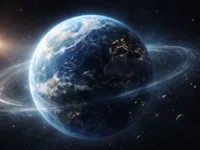
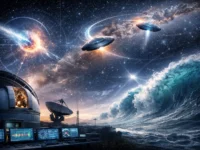
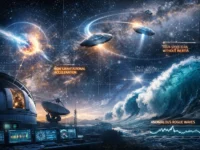
In recent weeks, a dramatic idea has been spreading across the internet. According to viral posts and videos, something called Project Anchor will cause Earth to lose gravity for seven seconds on August 12, 2026. The claim is frightening, cinematic, and powerful. It paints a picture of people floating into the air, oceans lifting, and the planet briefly losing its invisible force that holds everything together.
However, when examined through science, astronomy, and real-world data, the story begins to fall apart. There is no verified evidence that Earth will lose gravity for even a fraction of a second, and there is no confirmed scientific or government program capable of doing such a thing. What follows is a careful, clear explanation written in simple language so the truth becomes easy to understand.
Can Gravity Actually Turn Off?
Gravity is not a machine, a switch, or a system that can be paused and restarted. It exists because Earth has mass. The enormous mass of our planet bends space itself, creating the force we experience as gravity. This idea was explained by the famous physicist Albert Einstein through the theory of general relativity.
For gravity to suddenly disappear, Earth would need to lose its mass instantly, or the laws of physics would need to change. Neither of these events is possible under known science. Gravity cannot simply shut down and then resume a few seconds later like electricity returning after a power cut. The claim that gravity will stop for seven seconds does not match any known physical mechanism in the universe.
Where Did the Project Anchor Story Come From?
The story appears to have started from viral social media discussions, speculative posts, and misunderstood scientific ideas. Some people connected the name “Project Anchor” with the concept of stabilizing or controlling physical forces, while others added dramatic predictions about a temporary loss of gravity. Over time, repetition turned speculation into something that sounded real.
There is no official announcement of a program called Project Anchor from major scientific or space institutions such as NASA, European Space Agency, or CERN. If an event capable of affecting Earth’s gravity were real, it would be detected globally and publicly discussed by scientists around the world. No such warning exists.
What Would Happen If Gravity Really Disappeared?
Understanding this helps reveal why the claim is unrealistic. If gravity suddenly stopped, even briefly, Earth would not behave normally afterward. The atmosphere would begin drifting into space, oceans would start expanding outward, and objects on the surface would lose their weight instantly. The Moon would no longer orbit Earth correctly, and the planet’s path around the Sun would change.
Most importantly, gravity does not travel instantly but at the speed of light. Even if something extreme occurred deep inside Earth, the effect would not behave like a quick pause and restart. Physics has no known process that could remove gravity and then restore it perfectly after exactly seven seconds. Such a scenario belongs to fiction, not science.
Could the Sun or Space Activity Cause This?
Some versions of the story suggest that solar activity or magnetic disturbances might trigger the event. Solar flares and magnetic storms can indeed affect satellites, radio signals, and power systems, but they do not influence gravity. Gravity comes from mass, not magnetism or radiation. The Sun itself holds Earth in orbit through gravity, and if gravitational forces changed, planetary motion would show measurable differences long before any dramatic event occurred. Astronomical monitoring has detected no such changes.
Could Particle Experiments Alter Gravity?
Another variation of the claim connects Project Anchor with advanced physics experiments. Facilities like CERN do study fundamental forces, but their experiments occur at microscopic levels. These experiments cannot affect planetary mass or gravitational stability. Even the most powerful particle collisions ever produced are tiny compared to the energy required to influence Earth’s gravitational field. The idea that a laboratory experiment could switch off gravity across the entire planet is not supported by science.
Why August 12, 2026?
The specific date appears frequently in viral content but without scientific reference. Often, dramatic claims include a precise date to create urgency and attention. In real science, predictions come with data, observation, and measurable processes. The gravity claim offers none of these. There is no astrophysical alert, no published research, and no monitoring system reporting unusual gravitational behavior tied to this date.
Why Stories Like This Spread So Fast
Human curiosity is naturally drawn to powerful cosmic ideas. The thought of gravity vanishing, even briefly, is both terrifying and fascinating. Complex scientific concepts are sometimes misunderstood, and when combined with secrecy themes and dramatic storytelling, they spread rapidly across online platforms. Repetition can make an unsupported claim feel believable, even when no evidence exists.
Science, however, depends on measurement, verification, and reproducible observation. Extraordinary claims require extraordinary proof, and in this case, no such proof has been presented.
The Scientific Reality
There is currently no warning from the global scientific community about gravity instability. Measurements of Earth’s gravitational constant remain stable. No astronomical observation suggests a disturbance capable of affecting gravity in 2026. If such a phenomenon were real, it would dominate scientific discussion worldwide and be impossible to hide.
Gravity is not weakening, not fluctuating, and not predicted to stop. The planet continues to behave exactly as physics expects.
Careful Disclaimer
This article is based on established physics, astronomical observation, and publicly available scientific understanding. The “Project Anchor” gravity claim remains an unverified viral narrative with no confirmed scientific support. Readers are encouraged to rely on verified scientific institutions and evidence-based research when evaluating extraordinary claims.
Frequently Asked Questions
Many people wonder whether gravity is slowly weakening, but current measurements show no unusual change. Others ask if secret technology could affect gravity, yet no known technology exists that can alter planetary gravitational force. Some question whether gravity has ever stopped in history, and the answer is no, not even briefly. A few ask whether this could be a simulation glitch, but there is no scientific evidence supporting that idea. Finally, people ask whether they should prepare for August 12, 2026, and the scientific answer is clear: there is no reason for concern.
Final Words
Earth’s gravity comes from the immense mass of the planet, not from a controllable system. It cannot be unplugged, paused, or restarted. The idea that gravity will disappear for seven seconds and then calmly return does not align with physics, astronomy, or observed reality.
The Project Anchor story is an example of how mystery, fear, and imagination can combine into a powerful narrative. Yet when examined carefully, the foundation is missing. As of today, gravity remains exactly where it has always been — holding oceans, atmosphere, and life firmly to the surface of our world.
Reference Sources
https://www.nasa.gov
https://www.esa.int
https://home.cern
https://physics.nist.gov
https://www.space.com

0 Comments