












For nearly a century, astronomers have been staring at something they cannot see.
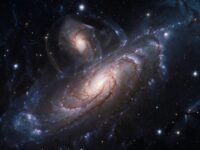
Galaxies spin too fast. Stars move in ways that defy gravity. Massive galaxy clusters bend light more than visible matter allows. Something unseen is holding the universe together. Scientists call it dark matter.
But what if dark matter is not a particle drifting through space?
What if it is the faint gravitational shadow of another universe brushing against our own?
That question may sound dramatic, but it is being discussed in serious scientific circles. Physicists exploring higher dimensions, mirror worlds, and cosmic inflation have raised the possibility that what we call dark matter could be evidence of something far bigger than our observable universe.
This article explores that idea carefully, based on published scientific research and theoretical models. It does not claim proof. It examines a possibility.
And if that possibility is true, reality is much stranger than we imagined.
First, What Exactly Is Dark Matter?
Dark matter is not science fiction. It is a measurable problem.
In the 1930s, Swiss astronomer Fritz Zwicky noticed that galaxies inside clusters were moving too fast. According to gravity, they should have flown apart. Something unseen was providing extra mass.
Decades later, astronomer Vera Rubin studied how galaxies rotate. She found stars at the edges were moving just as fast as those near the center. That should not happen unless a large amount of invisible mass surrounds the galaxy.
Today, measurements suggest about 85 percent of all matter in the universe is dark matter. It does not emit light. It does not reflect light. It does not absorb light. It reveals itself only through gravity.
Despite decades of experiments, scientists have not directly detected a dark matter particle.
That silence has opened the door to bold ideas.
The Multiverse Enters the Conversation
The idea of multiple universes was once philosophical. Now it appears in serious cosmology.
Certain models of cosmic inflation suggest our universe may be one bubble in a vast cosmic foam. Other versions come from string theory, where extra dimensions may exist beyond the three dimensions of space and one of time that we experience.
If other universes exist close to ours in higher-dimensional space, their gravity might leak into our universe.
And if gravity can leak across dimensions, we might detect it as unseen mass.
In simple terms, dark matter could be gravity from somewhere else.
The “Shadow Universe” Hypothesis
Some physicists have proposed mirror matter models. In these theories, a parallel universe exists with particles similar to ours but interacting very weakly with our world.
Imagine two sheets of paper lying almost on top of each other. We live on one sheet. Another universe exists on the second. We cannot see or touch it directly. But gravity may pass between them.
If large structures exist in that neighboring universe, their gravitational pull might influence our galaxies.
That pull could appear as dark matter.
This idea does not violate known physics outright. Gravity is already the weakest known force and behaves differently from electromagnetic or nuclear forces. Some models suggest it may naturally extend into extra dimensions.
The result would look exactly like what we observe — invisible mass shaping galaxies.
Clues From Cosmic Collisions
One of the strongest pieces of evidence for dark matter comes from galaxy cluster collisions, especially observations like the Bullet Cluster.
In these collisions, visible matter such as gas slows down due to friction. But gravitational lensing shows most of the mass passes straight through without slowing.
That behavior suggests dark matter interacts very weakly with normal matter.
Supporters of the shadow universe idea argue that if dark matter is gravitational influence from another universe, it would also pass through normal matter without friction.
The observation does not prove the theory. But it does not rule it out either.
Could Dark Matter Be Extra-Dimensional Gravity?
Some theoretical physicists studying higher-dimensional gravity suggest our universe may exist on a three-dimensional “brane” inside a higher-dimensional space.
In these models, other branes could exist nearby.
Matter in those branes would not interact electromagnetically with ours. But gravity might extend across dimensions.
If that is happening, the gravitational effects we measure as dark matter could actually be matter in a neighboring brane universe.
This idea connects dark matter with string theory and brane cosmology.
It is not confirmed. But it is mathematically possible within certain frameworks.
Why Haven’t We Detected Dark Matter Particles?
For decades, experiments deep underground have searched for weakly interacting massive particles, often called WIMPs.
So far, nothing conclusive.
Large detectors using liquid xenon, germanium crystals, and other advanced methods have reported no confirmed dark matter particle.
That absence has pushed some scientists to rethink assumptions.
Maybe dark matter is not a particle at all.
Maybe it is geometry.
If gravity behaves differently at cosmic scales due to higher dimensions, what we interpret as missing mass could be a misunderstanding of gravity itself.
Or it could be influence from something beyond our universe.
A Word of Scientific Caution
It is important to stay grounded.
The shadow universe idea is speculative. It is based on theoretical physics, not confirmed detection.
Most mainstream cosmologists still consider particle dark matter the leading explanation. Experiments continue. New detectors are being built. Data is still coming in.
The multiverse concept also remains theoretical. There is no direct observational proof of another universe.
This article explores a possibility under discussion, not an established fact.
Science advances by testing bold ideas. Some survive. Many do not.
What Would It Mean If This Is True?
If dark matter is a gravitational shadow of another universe, several profound implications follow.
First, our universe would not be alone. It would exist within a larger cosmic structure.
Second, reality would extend beyond observable space and time.
Third, physics would require expansion to include cross-dimensional gravity.
The philosophical consequences would be enormous.
Humanity would shift from living in a vast universe to living in one layer of something even larger.
Are There Experimental Tests?
Testing this idea is challenging, but not impossible.
Physicists look for subtle deviations in gravity at short distances.
They examine cosmic background radiation patterns.
They analyze galaxy distributions for unusual signatures.
If dark matter behaves differently from predicted particle models, it could support alternative theories.
Future observatories and space telescopes may offer clearer data.
Until then, the shadow universe remains an open question.
The Mystery That Refuses to Go Away
Dark matter is not a fringe topic. It is central to modern cosmology.
Without it, galaxies would not hold together.
Without it, cosmic structure formation does not match observations.
Yet we still do not know what it is.
When a mystery survives this long, science becomes creative.
The shadow universe idea is bold. It challenges how we define reality.
And even if it turns out to be wrong, asking the question pushes physics forward.
Sometimes the search is as important as the answer.
Final Thoughts
The universe has surprised us before.
It surprised us with quantum mechanics.
It surprised us with cosmic expansion.
It surprised us with black holes.
Dark matter may deliver another surprise.
Whether it is a new particle, modified gravity, or a gravitational echo from another universe, the answer will reshape cosmology.
For now, the possibility remains open.
And somewhere in the darkness between galaxies, gravity continues to whisper that something is there.
Frequently Asked Questions
Q1: Is there proof that dark matter is another universe?
No. This is a theoretical possibility discussed in physics. There is currently no direct evidence supporting it.
Q2: Do most scientists believe in the shadow universe idea?
No. The dominant view remains that dark matter is made of undiscovered particles. The shadow universe idea is speculative.
Q3: Has dark matter been directly detected?
Not yet. Its existence is inferred from gravitational effects.
Q4: What percentage of the universe is dark matter?
Current measurements suggest about 27 percent of the universe’s total energy content is dark matter.
Q5: Could this theory ever be tested?
Possibly, through improved gravity experiments, cosmic surveys, and future particle physics discoveries.

0 Comments