



















By Ronald Kapper
Disclaimer (must read): This article summarizes publicly available studies, government reports, and independent analyses. It does not claim that any unexplained event is extraterrestrial. Instead, it examines patterns in reporting and sensor data to explain why most UAP reports occur away from dense urban centers. Readers should treat unresolved cases as open questions requiring more data and rigorous study.
The surprising pattern
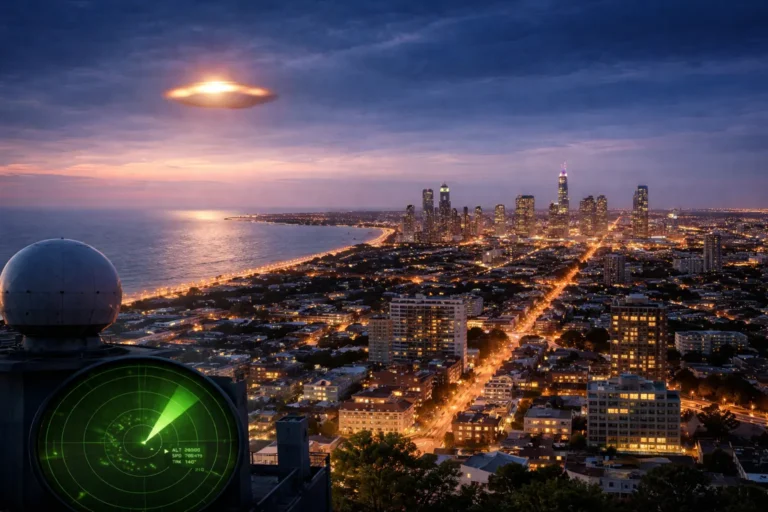
If you follow the UAP conversation closely, one pattern keeps popping up: public and official data sets show far fewer sighting reports inside densely populated city centers than in rural or less populated areas. That may seem odd — more people and more cameras in cities should mean more reports, right? The short answer: the data say otherwise, and the reasons are part technical, part human, and part procedural. Below we unpack those reasons using large-scale studies and official reviews, and explain what they mean for safety, research, and public interest. AARO
What the big data say
Several large analyses of sighting reports have used tens of thousands of records to map where people report unknown phenomena. Two independent efforts stand out:
- A national-scale statistical study that analyzed more than 98,000 public reports across the continental United States found clear correlations between sighting reports and environmental and human factors. That study concluded that opportunities to observe the sky — like unobstructed skies and lower light pollution — strongly shape where reports are made.
- A RAND Corporation geographic analysis of over 100,000 public reports found that reported sightings were less likely within 30 kilometers of weather stations, 60 kilometers of civilian airports, and in more densely populated areas. The models showed higher rates of reports in rural regions and near some military operation areas. RAND Corporation
Put simply: large, peer-reviewed analyses and government summaries both show fewer public UAP reports in dense urban spaces and more reports in less populated or restricted areas.
How reporting bias shapes the map
There are three linked human factors that skew where sightings are reported:
1. Opportunity to see. People living in open-country environments often have wide, clear views of the sky with fewer tall buildings, less street lighting, and fewer visual distractions. That makes it easier to notice an unusual object against a dark, clear background. The national-scale study explicitly models these “sky view” factors as a major predictor.
2. Culture and reporting behavior. City residents may assume unusual lights are drones, aircraft, or advertising, and often do not report them. By contrast, rural observers may be more likely to report something they cannot explain. This cultural difference in reporting practices inflates the rural signal.
3. Data collection channels and gatekeeping. Many official reports come from military or aviation personnel operating in controlled airspace or training ranges — areas usually not inside urban cores. Agencies that collect UAP reports receive more submissions from those communities, which tilts the official portfolio toward non-urban locations. Recent official reporting offices have highlighted a “collection bias” tied to the source of reports.
Sensors, surveillance, and why cities show fewer radar anomalies
Cities are crowded with radio frequency sources, fixed structures, and busy flight corridors. That combination actually makes it harder for a radar system to report an anomalous, isolated target with confidence:
- High clutter environment. Urban radar returns are full of reflections from buildings, vehicles, and other infrastructure. Those reflections make it difficult to pick out faint, small, or transient targets, and they increase false positives from ground clutter. Radar systems and air-traffic control software are tuned to filter this noise aggressively, which can suppress unusual returns that might otherwise stand out in a quieter environment.
- Dense air traffic and transponders. Civilian aircraft, helicopters, and drones populate city skies. These craft usually carry transponders and file flight plans, so any unknown radar return in urban airspace is quickly cross-checked with expected traffic. That rapid cross-check reduces the number of unresolved returns recorded as “mysteries.”
- Regulatory and legal constraints. Urban airspace is heavily regulated. Many behaviors that might generate an unusual return — loitering drones, low-flying test aircraft, or experimental systems — are restricted or conducted under controlled permissions in non-urban ranges, further decreasing chances of unexplained urban returns being recorded.
Because of these factors, an isolated radar return that would be striking over open ocean or rural terrain can be invisible, dismissed, or explained in a city. Official investigators have pointed to these sensor and reporting differences as a reason why many compelling multi-sensor incidents occur in restricted or less populated airspace.
Case patterns: where the most puzzling multi-sensor incidents happen
The most widely discussed, tightly documented incidents — those with pilots, radar, infrared video, and trained observers — often happen over or near military ranges and open ocean. That’s not because UAPs “prefer” those areas; it is because military and naval training zones combine three crucial elements:
- High-quality sensors (primary radar, FLIR, airborne radar, and wide-area surveillance).
- Trained observers (fighter pilots, radar operators, and controllers).
- Sparse civilian clutter, making unusual returns clearer.
The famous carrier strike-group encounters and several infrared-video cases involved this mix: advanced sensors, trained crews, and low background clutter — exactly the conditions that make a genuinely anomalous track hard to dismiss and more likely to be recorded by multiple systems. Government case collections acknowledge that the concentration of military-sourced reports biases the public data set.
Could UAPs be avoiding cities intentionally?
This is the tempting headline, but the available evidence does not support a conclusion that UAPs exercise deliberate avoidance of cities. The observed distribution is better explained by detection probability and reporting bias. In other words, UAPs may not be present less often in cities — they may simply be less often noticed, less often recorded by high-grade sensors, and more easily explained there. Analysts and authors stress caution: an absence of reports is not proof of absence of phenomena.
The role of cameras and smartphones — why more people doesn’t mean more valid sightings
Cities are full of cameras and phones. Yet smartphone footage from dense urban centers rarely produces the kind of high-quality, corroborated sensor package needed to turn a sighting into a rigorous case. Why?
- Short clips and shaky framing. Phone videos are typically brief and lack precise timing or geolocation metadata that investigators need.
- Optical distractions. Street lights, reflections, building signage, and grounded light sources confuse viewers and algorithms.
- Crowd noise and assumptions. When a crowd sees a light, viral attention often creates a swirl of speculation before analysis. That doesn’t help analysts who need raw sensor logs, timestamps, and cross-checking.
Big-data studies therefore weigh reliable, multi-sensor reports more heavily. Those reports are still more likely to come from non-urban settings where clean sensors and trained witnesses coincide.
Why this distribution matters for safety and science
The fact that more “serious” unresolved cases come from non-urban airspace has practical consequences:
- Aviation safety. Military and civilian aviators flying over open water or restricted ranges report encounters that sometimes show worrying performance characteristics. These incidents deserve attention because they could indicate unknown air safety risks. Official reports and analyses emphasize safety-of-flight concerns in their public filings.
- Evidence collection. Scientists want raw data: radar logs, time-synced video, environmental readings, and air-traffic records. The conditions that produce the clearest raw evidence — open skies, multiple sensors, trained observers — are less common in dense cities. That means we have fewer high-quality urban cases to analyze.
- Policy and public trust. Agencies that study UAPs now emphasize data sharing and sensor modernization precisely because detection biases limit what we can learn from the current record. Improving urban sensor networks could reduce the reporting gap, but it would also raise privacy and legal questions.
How researchers and agencies are fixing the blind spots
Several steps are underway or recommended by experts and agencies:
- Standardized reporting channels. Encouraging consistent data submission formats and protocols for both civilian and military witnesses improves cross-checking. The establishment of dedicated offices and reporting paths has already increased data flow from trained sources. NASA
- Sensor fusion and transparency. Analysts favor raw multisensor sets — radar logs, FLIR video, and flight-tracking overlays — released in a way that preserves privacy and operational security but allows independent analysis. Agencies have started publishing sanitized imagery and summaries to let outside researchers test claims.
- Targeted urban monitoring studies. Scientists propose controlled urban monitoring projects that balance privacy with scientific need: deploy calibrated cameras, lidars, and radar in select urban testbeds to measure the true rate of anomalous returns where people live. The current literature recommends more of this systematic monitoring.
FAQs
Q: Do UAPs actually avoid cities?
A: No strong evidence shows deliberate avoidance. The pattern is better explained by detection, reporting, and sensor factors.
Q: Why are military sightings taken more seriously?
A: They often include multiple, high-quality sensors and trained observers, which makes cross-checking and calibration easier.
Q: Could urban sensors be improved to catch UAPs more often?
A: Yes, but there are trade-offs with cost, privacy, and the technical challenge of filtering urban clutter from meaningful signals.
Q: Are unresolved cases proof of alien craft?
A: Unresolved means not yet explained with available data. It is not proof of extraterrestrial origin. Scientific rigor requires replicable data and careful elimination of known causes.
Q: Where can I find the data used in these studies?
A: Several government reports and scientific papers publish summaries, sanitized imagery, and analysis. See the reference list at the end for key starting points.
What we should expect next
The map of UAP reports is partly a mirror: it reflects not only where phenomena may occur but where we watch, how we watch, and who reports what they see. If the goal is to move from curiosity to understanding, the path is clear: better, standardized data; greater sensor diversity across environments (including urban testbeds); and open analysis practices that let independent teams verify results. Until then, the lower rate of urban reports should be read as an artifact of detection and reporting — not as a cosmic rule.
Key references (for verification and further reading)
- Medina, R. M., et al., An environmental analysis of public UAP sightings and sky view potential — Scientific Reports (2023).
https://www.ncbi.nlm.nih.gov/pmc/articles/PMC10721628/ - RAND Corporation — Mapping Public Reports of Unidentified Aerial Phenomena: A Geographic Analysis (2023).
https://www.rand.org/pubs/research_reports/RRA2475-1.html - AARO — Consolidated Annual Report on UAP (FY2023.)
https://www.aaro.mil/Portals/136/PDFs/UNCLASSIFIED-FY23_Consolidated_Annual_Report_on_UAP-Oct_25_2023_1236.pdf - Office of the Director of National Intelligence — 2024 Unclassified UAP Report Summary.
https://www.dni.gov/index.php/newsroom/reports-publications/reports-publications-2024/4020-uap-2024 - NASA — UAP Study and scientific engagement.
https://science.nasa.gov/uap/

0 Comments