



















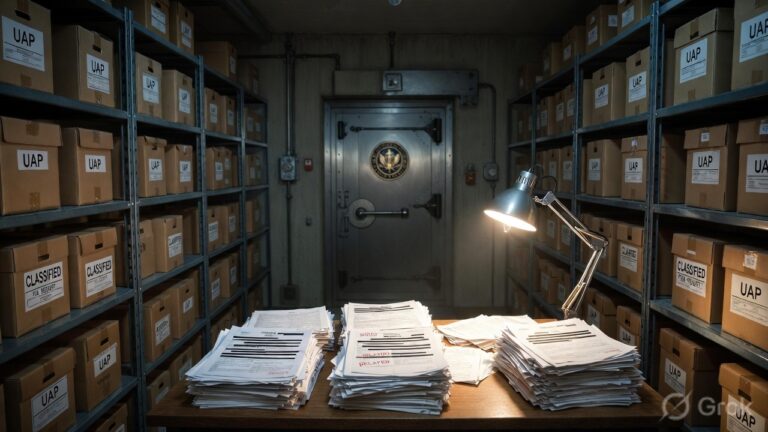
DISCLAIMER: This article reports on FOIA filings, public records, congressional actions, and reporting about Unidentified Anomalous Phenomena (UAP). Many claims remain subject to classification or redaction. Where possible, this piece cites official documents and reputable reporting. It does not assert unproven extraordinary claims. Read the source list at the end to verify primary documents.
Introduction — the records that never arrive
You file a request. You click submit. Weeks go by. Months. Sometimes a year or more. For many journalists, researchers, and citizens asking for UAP records, this is the pattern. Public interest in UAP matters rose sharply after high-profile hearings and whistleblower testimony. But rising demand collided with old rules, modern backlogs, and genuine national-security concerns. The result: files that often arrive late, come heavily redacted, or don’t arrive at all.
This is not just annoying. Delayed or blocked records shape the story the public gets to read. They affect what lawmakers can verify behind closed doors. They influence what investigators can test. So understanding why records stall is not a bureaucratic side story — it is central to whether the public will ever get clear answers.
Why FOIA exists — and why it wasn’t built for today’s crush of requests
The Freedom of Information Act was born to pry open government records. It set a simple rule: the default is disclosure, with narrow exceptions for national security, privacy, and other protections. The law expects agencies to respond within 20 working days.
That was the promise. The reality today is very different. Agencies are swamped. Technology in many offices is outdated. Staffing for public records units has been cut in many places. And FOIA requests have exploded — both in raw number and in complexity. A record number of requests in 2024 and 2025 pushed backlogs higher, and agencies increasingly log a rising number of appeals and denials. The result: even straightforward, non-sensitive queries can take far longer than the law intends. (See government oversight reviews and FOIA reports for fiscal years 2023–2024.)
UAP is a special case: demand + sensitivity = slow lanes
Not all FOIA requests are equal. UAP records sit at the intersection of public interest and potential national security. Three features make UAP requests uniquely slow.
First, demand is huge. After televised hearings and big headlines, ordinary citizens, hobby groups, academics, and journalists all filed requests to see the same sets of materials. Agencies saw a surge in volume.
Second, the files that might interest requesters often touch classified systems, sensor logs, or operational details. Those items can be legitimately sensitive: revealing exact capabilities, sensor locations, or collection methods can harm operations. Agencies therefore route these cases through extra review steps.
Third, the records are often scattered. Reports about UAP can live with the Department of Defense, the Office of the Director of National Intelligence, the National Archives, NASA, and even local military commands. Coordination across offices takes time and eats up limited FOIA staff resources.
Layers of review: the many hands a UAP file passes through
When an agency gets a FOIA request for UAP materials, the request will typically trigger multiple reviews.
A FOIA officer first searches holdings. If documents are found and include classified material, the case must move up to security and classification review. Classified lines trigger involvement from other agencies and sometimes from the classification owner — the office that originally controlled the file. That adds weeks or months, because offices must determine whether any portion of a document can be released without harming operations.
If the document includes third-party information (for example, a contractor report), agencies may have to coordinate release decisions with outside firms. If the document mentions privacy or personal data, another review follows to see what to redact.
All these steps are sensible on paper. In practice they create a slow conveyor belt — each step adding delay and often producing heavily redacted pages by the time the requester sees them.
Redactions: why the documents look shredded
One reason delayed documents arrive in poor shape is simple: redactions. When agencies release records, they black out lines that fall into FOIA exemptions: classified information, personal privacy, law enforcement sensitivities, and so on. For UAP records, the most commonly cited reasons for redaction are national security and sources and methods — the legal protections that keep certain techniques and collection platforms secret.
That prompts an obvious reaction: why not just release more? Agencies argue that revealing certain sensor details, telemetry, or exact tracking methods could allow adversaries to exploit gaps or spoof systems. The public answer is often a dance between operational caution and the desire for transparency.
Backlog dynamics: technology, staff, and the paperwork spiral
Agencies face a three-part bottleneck: a flood of requests, insufficient staff, and antiquated processing systems. FOIA offices still rely in many cases on manual review. Digital search helps find documents, but human reviewers still read millions of pages to decide exemptions. Budget cycles add another complication: FOIA offices rarely get immediate extra funding to match sudden surges in public interest.
Meanwhile, appeals and litigation create a cyclical drag. When a requester appeals a denial, the case climbs to an internal or external appeal process, adding months. If the requester takes the agency to court, the timeline extends further. All this contributes to the visible backlog numbers that watchdogs and reporters track.
Classification as a gatekeeper — legitimate protection or overused shield?
One of the most contentious questions is whether classification is being used properly.
On the one hand, some information genuinely needs to stay secret. Details about intelligence collection, active sensor performance, or armed operations can, if public, harm safety or national security.
On the other hand, watchdogs and some lawmakers argue classification is sometimes broad and reflexive — applied to entire documents because parts are sensitive, rather than separating and declassifying safe fragments. That practice multiplies delay and increases redactions. Critics say better rules would let agencies declassify what is safe to release and keep sensitive bits under tight wraps without blocking entire files.
Politics and politics of timing
Timing matters. FOIA clocks run their own course, but political pressure can change priorities. High-profile hearings, whistleblower complaints, and media attention can push an agency to prioritize certain requests. Conversely, political friction between Congress and an administration can slow cooperation.
The result is uneven: some requesters get quick responses if a congressional office intercedes; others can wait years. That unevenness drives suspicion: when certain documents appear publicly in advance of oversight scrutiny, skeptics ask whether politics, not transparency rules, drove the release.
Whistleblowers, classified briefings, and the problem of “need to know”
When witnesses testify in hearings but say that key evidence exists only in classified formats, the tension deepens. Whistleblowers may assert that documents prove claims, while agencies counter that those materials are legitimately classified or that the witness’s account is incomplete.
Congress can review classified materials in secure settings — the SCIFs — but that process itself takes time. Committees often have to negotiate the scope of what they may see and who can be present. Those negotiations, plus the classification review required to prepare documents for broader release, all layer up to produce the delays we see.
The role of courts and litigation
When public pressure grows, litigants sometimes take agencies to court. Courts can compel agencies to produce records, or they can uphold exemptions. Litigation can break stalemates but adds delay too: discovery, motions, and rulings stretch timelines. Yet court rulings also produce precedents that can improve future transparency if judges rebuke overly broad redactions or demand more careful classification justification.
Small fixes, big effects: how transparency advocates want to change the system
Reform advocates suggest practical steps:
• Increase FOIA staffing and modernize processing tools so agencies can handle surges.
• Improve inter-agency coordination so scattered records are found faster.
• Require more granular classification reviews so safe content is released quickly.
• Strengthen whistleblower protections so insiders can raise issues without fear.
• Create clearer timelines and enforceable penalties for unjustified delays.
Many of these fixes are technical and budgetary, but they would reduce human bottlenecks and make agencies more responsive.
What delays tell us — three clear signals
- This issue matters now. The flood of requests shows intense public interest, meaning the topic is not going away.
- Structures are old. Agencies built FOIA systems for smaller workloads and different tech environments. The mismatch is exposed when demand spikes.
- Secrecy and oversight are still balancing acts. Some delays reflect real operational concerns; others reflect institutional caution or policy choices about how and when to declassify.
Timeline snapshot — key public moments that increased FOIA pressure
- Mid-2023 through 2024: High-profile testimony and media coverage sharply raised public interest in UAP records.
- 2024–2025: FOIA requests for UAP-related files surged; government FOIA offices reported record volumes and rising backlogs.
- 2024–2025: AARO and the National Archives began rolling releases and catalog uploads of UAP records while many requester appeals continued.
- Ongoing: Litigation and congressional oversight actions added pressure and highlighted the need for clearer declassification rules.
(For details and primary documents, consult the source list below.)
FAQs — short, direct answers
Q: How long should FOIA take?
A: By law, agencies should respond within 20 working days. In practice, complex or classified requests can take months to years because of searches, interagency review, and classification checks.
Q: Are agencies allowed to redact almost everything?
A: Agencies may redact information that falls under FOIA exemptions. However, courts can require agencies to justify broad redactions or release more material.
Q: Can Congress force agencies to release records?
A: Congress has oversight tools and can demand briefings or require documents for committees. But some material remains classified and can only be reviewed in secure settings or after declassification steps.
Q: Do delays prove a cover-up?
A: Delays are not proof by themselves. They can result from genuine sensitivity, staff shortages, or bureaucratic hurdles. They can also hide missteps. Each case needs independent verification through documents and oversight.
Q: How can I track FOIA requests for UAP files?
A: Track agency FOIA logs and the National Archives catalog, and watch for congressional hearing notices that reference requested files. When litigation occurs, court dockets also provide updates.
What readers should watch for next
Watch for three things. First, releases of files to the National Archives or agency FOIA libraries. Second, congressional letters or subpoenas demanding records — those often indicate escalation. Third, court rulings ordering release. Each will significantly change what is publicly available and will test whether agencies can adapt to public demand without risking sensitive operations.
Conclusion — transparency in slow motion
Delays in UAP FOIA responses are the product of modern demand colliding with old systems and genuine sensitivity. The result is not always sinister, but delays do carry consequences: they shape public understanding, complicate oversight, and fuel speculation. Fixes are available but require funding, political will, and better classification habits. Until then, the public will keep knocking on the government’s locked filing cabinet — and waiting to be let in.
Sources & further reading (verify primary documents and reporting)
• Government Accountability Office — FOIA backlogs and transparency analysis. https://www.gao.gov/blog/foia-backlogs-hinder-government-transparency-and-accountability.
• All-Domain Anomaly Resolution Office — UAP records portal and official documentation. https://www.aaro.mil/UAP-Records/.
• Office of the Director of National Intelligence — FOIA disclosures including requests related to whistleblower materials. https://www.dni.gov/files/documents/FOIA/2023/June_2023.pdf.
• Reporting on FOIA backlogs and trends — Inside Investigator (summary of 2024 backlog issues). https://insideinvestigator.org/2024-saw-foia-backlogs-and-continued-delays/.
• Time magazine — coverage of congressional hearings and public testimony that increased FOIA interest. https://time.com/6298287/congress-ufo-hearing/.
• Federal News Network — record number of FOIA requests filed in 2024. https://federalnewsnetwork.com/federal-newscast/2025/04/record-number-of-foia-requests-filed-in-2024/.
• National Archives press release — releases of UAP records and holdings. https://www.archives.gov/press/press-releases/2025/nr25-07.
• AARO information paper — declassification process overview. https://www.aaro.mil/Portals/136/PDFs/Information%20Papers/AARO_Declassification_Info_Paper_2025.pdf.

0 Comments