
















By Ronald Kapper
There are moments in history when a nation feels like it is holding its breath, when uncertainty spreads faster than facts and fear begins to shape public emotion, and in those moments something remarkable almost always happens—leaders who were once under intense scrutiny suddenly appear stronger, more decisive, and more trusted, as if crisis itself has the power to reshape perception overnight.
This pattern has repeated itself across decades, across continents, and across very different political systems, raising a question that is both uncomfortable and deeply fascinating: do wars and conflicts unintentionally strengthen those in power, or is there a deeper relationship between leadership and crisis that we are only beginning to understand?
The answer is not simple, and it does not lie in conspiracy or certainty, but in patterns, psychology, and the way societies respond when they feel threatened.
The Surge of Unity in Times of Conflict
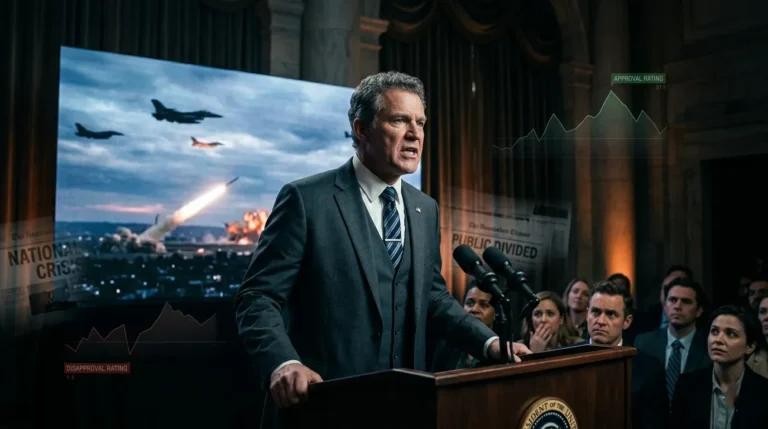
When a country enters a period of conflict, whether it is war, military tension, or even the threat of external aggression, something shifts almost immediately within the public mindset, and that shift is often described by political scientists as the “rally around the flag” effect, a phenomenon where citizens temporarily put aside political differences and unite behind their leader.
This is not just theory—it is a repeatedly observed behavior backed by decades of research, where approval ratings rise, criticism softens, and opposition voices become quieter, not necessarily because problems disappear, but because national survival feels more urgent than political disagreement.
In such moments, leadership becomes less about policy debates and more about symbolism, strength, and reassurance, and the leader becomes the central figure representing stability in a world that suddenly feels unstable.
This psychological shift alone can dramatically reshape the political landscape, even if only for a short period of time.
When Crisis Changes the Narrative
In normal circumstances, political leadership is judged heavily on domestic issues—economic performance, healthcare systems, inflation, unemployment, and social stability—but during conflict, these priorities often take a backseat as public attention moves outward toward external threats.
The result is a powerful shift in narrative.
Issues that once dominated headlines begin to fade, replaced by discussions of national security, military strategy, and international alliances, and in that transition, the pressure on leadership changes direction rather than disappearing entirely.
It is not that domestic problems are solved—they are simply no longer the immediate focus of public concern.
This shift in attention can create an environment where leaders are evaluated less on past shortcomings and more on their ability to handle the current crisis, effectively resetting the political conversation without formally addressing earlier failures.
A Pattern Seen Across History
Throughout modern history, there have been multiple moments where leadership approval rose significantly during times of conflict, and while each situation is unique, the broader pattern remains difficult to ignore.
During military engagements or national security crises, leaders often experience a surge in public support, sometimes even reversing declining approval trends that existed before the conflict began, and while this does not prove intention, it does demonstrate how powerful the relationship between crisis and political strength can be.
Historians and political analysts have long debated these patterns, with some suggesting that the timing of certain conflicts appears politically advantageous, while others strongly argue that such interpretations oversimplify complex geopolitical realities.
The truth likely lies somewhere in between, where genuine security concerns intersect with political consequences that may not have been fully predictable—but are nonetheless significant.
The Timing Question No One Can Ignore
One of the most debated aspects of this topic is timing, and it is here that the discussion becomes more complex and, at times, more controversial.
There have been instances where conflicts emerged during periods of political difficulty—economic downturns, declining approval ratings, or growing public dissatisfaction—and while correlation does not equal causation, these moments naturally invite questions.
Is it possible that conflict can reshape political narratives at critical moments?
Can external threats redirect public attention in ways that benefit leadership?
And perhaps most importantly, do these outcomes occur purely by chance, or are they influenced, even indirectly, by the political environment in which decisions are made?
There are no definitive answers, but the questions themselves continue to fuel debate among scholars, journalists, and observers of global politics.
The Role of Media in Shaping Perception
Modern media plays a crucial role in how conflicts are perceived, and during times of war or crisis, coverage often becomes more focused, more urgent, and more centered on leadership decisions.
Press briefings, national addresses, and real-time updates place leaders at the center of the narrative, reinforcing their role as the primary decision-makers during uncertain times.
This visibility alone can strengthen the perception of authority, as constant exposure creates familiarity, and familiarity often translates into trust, especially when audiences are searching for clarity in a chaotic environment.
At the same time, critical coverage does not disappear, but it often becomes less dominant, as media outlets prioritize immediate developments over long-term analysis, further contributing to the shift in public focus.
Power, Psychology, and Political Survival
Beyond media and timing, there is a deeper psychological dimension to how conflict influences political power, rooted in human behavior and collective emotion.
In times of fear or uncertainty, people naturally gravitate toward strong, decisive leadership, not necessarily because it guarantees better outcomes, but because it provides a sense of direction and control.
This instinct can create a temporary alignment between public expectation and leadership style, where assertiveness is valued more highly than debate, and quick decisions are seen as necessary rather than risky.
For leaders, this environment can be both an opportunity and a responsibility, as the same conditions that increase public support also raise the stakes of every decision made.
The balance between political survival and national interest becomes more delicate, and the consequences of miscalculation become far more severe.
The Counterargument: Complexity Over Conspiracy
While the patterns discussed in this article are real and widely observed, it is essential to approach the topic with caution and balance, because wars and conflicts are rarely driven by a single factor or decision.
Geopolitical tensions, historical disputes, economic interests, intelligence assessments, and international alliances all play significant roles in shaping the path toward conflict, and reducing these complex dynamics to purely political motives risks oversimplifying reality.
Many decisions made during times of crisis involve multiple institutions, advisors, and global pressures that extend far beyond the control of any single leader, making it difficult to attribute intent with certainty.
Critics of the “power through conflict” theory argue that while leaders may benefit politically from war, this does not mean that such outcomes are planned or desired, and that the risks involved—both human and economic—are far too great to be used as strategic tools.
This perspective serves as an important reminder that correlation should not be mistaken for causation, even when patterns appear compelling.
Where Perception Meets Reality
What makes this topic so compelling is not just the patterns themselves, but the space between perception and reality, where public interpretation can differ significantly from actual intent.
A leader may gain power during conflict without ever seeking that outcome, just as a nation may unite in ways that temporarily reshape its political landscape without fully understanding why.
At the same time, the possibility that political advantages can emerge from crisis cannot be entirely dismissed, especially when history continues to show similar outcomes across different contexts.
This tension between what is known and what is suspected is what keeps the debate alive, and it is what makes the subject both fascinating and difficult to resolve.
A Pattern Without a Clear Answer
In the end, the relationship between war and political power is not defined by simple explanations or definitive conclusions, but by a series of recurring patterns that raise more questions than answers.
Wars do not automatically make leaders stronger, and not all leaders benefit from conflict, but time and again, moments of crisis have shown the ability to reshape public perception, shift political narratives, and consolidate authority in ways that are difficult to ignore.
Whether these outcomes are accidental, inevitable, or influenced by deeper strategic thinking remains a subject of ongoing debate, one that continues to evolve as new conflicts emerge and new leaders navigate the challenges of power.
What history does make clear, however, is that in times of uncertainty, the balance between leadership, perception, and reality becomes more fragile—and more powerful—than ever before.
And in that fragile space, where fear meets trust and crisis meets control, the true nature of political power is often revealed not in what is said, but in what unfolds.
FAQs
Do wars always increase a president’s popularity?
No, while many leaders experience a temporary boost in approval during conflict, this effect is not guaranteed and often depends on how the situation develops over time.
What is the “rally around the flag” effect?
It is a political science concept where public support for leaders increases during national crises or conflicts due to a sense of unity and shared purpose.
Do leaders intentionally start wars for political gain?
There is no definitive evidence proving this as a general rule, and most experts agree that conflicts are driven by complex geopolitical factors rather than single motivations.
Why do domestic issues receive less attention during war?
Because public focus shifts toward national security and external threats, making internal problems seem less urgent in comparison.

0 Comments