



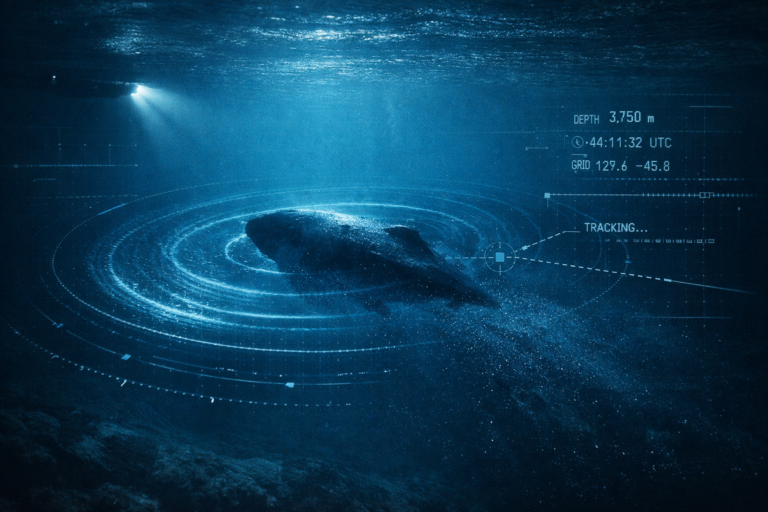

On June 3, 2024, at approximately 04:11 UTC, a naval surveillance system monitoring the Pacific seabed registered something unusual. A fast-moving object entered the detection field, crossed multiple sonar layers, then abruptly vanished — not by slowing down, not by surfacing, but by dropping out of measurable reality.
No wreckage.
No acoustic decay.
No explanation.
The incident was logged, classified, and quietly closed.
But it was not an isolated case.
Across the last 18 months, the United States Navy has repeatedly lost contact with underwater objects that defy known ocean physics. These events are not discussed in press briefings. They don’t appear in public incident reports. Yet internal records show a pattern that is becoming increasingly difficult to ignore.
Something is moving through the ocean — and it doesn’t behave like anything humans have ever built.
The Sonar Gap No One Can Explain
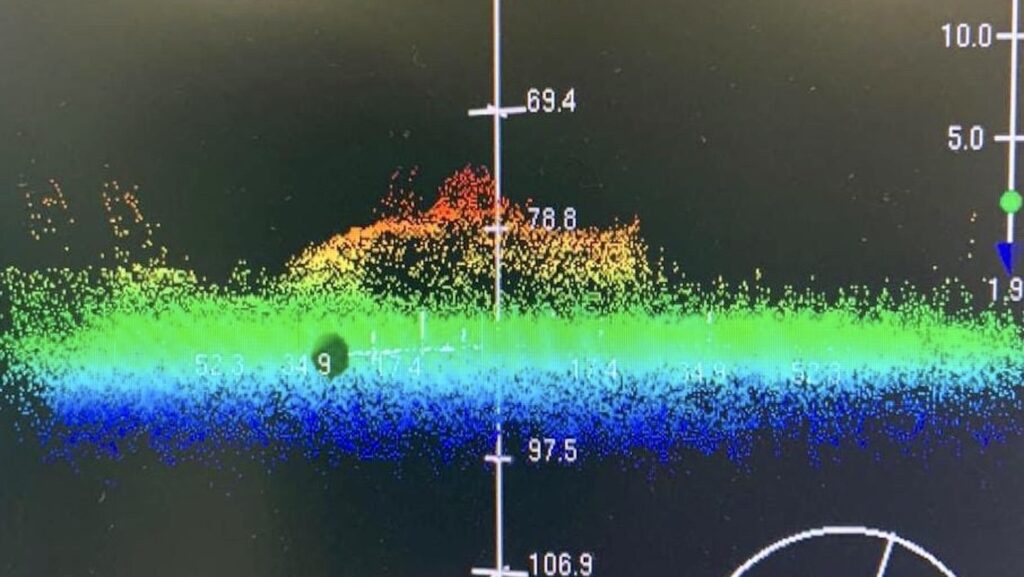
Modern naval sonar is brutally precise. It can track submarines from hundreds of kilometers away. It can distinguish between whales, thermal layers, debris, and drifting wreckage. It is designed to never lose a target without a reason.
And yet, targets are being lost.
According to defense logs reviewed by oversight panels in September 2024, multiple objects were observed traveling underwater at sustained speeds exceeding 150 knots, far beyond the limits of propeller-based propulsion. More unsettling was what happened next.
Instead of slowing, surfacing, or colliding with terrain, the objects simply ceased to exist on sonar.
Not faded.
Not scrambled.
Gone.
Incidents Spread Across Multiple Oceans
These events are not limited to one region.
- March 12, 2024 – North Atlantic, 22:48 UTC
A fast-moving contact tracked for 96 seconds performed a sharp vertical descent before disappearing below sonar depth limits — without generating pressure signatures consistent with extreme depth travel. - August 19, 2024 – Philippine Sea, 09:32 UTC
A contact split into two distinct returns, then both vanished simultaneously, despite being tracked by separate sensor arrays. - January 27, 2025 – Southern Pacific, 17:06 UTC
A submerged object transitioned from deep water to near-surface detection and then dropped off all sensors within less than a second.
In every case, system diagnostics confirmed the sensors were functioning normally.

Not Submarines. Not Drones. Not Nature.
Initial assumptions pointed to foreign technology. That theory collapsed under scrutiny.
No known navy possesses underwater platforms capable of sustained hypersonic-equivalent movement. Autonomous drones cannot survive the pressure changes involved. Even experimental craft leave acoustic fingerprints.
These objects leave none.
Marine biologists were consulted. So were geophysicists. Internal reviews ruled out seismic activity, gas plumes, and rare marine life behaviors.
One classified assessment dated November 2024 states plainly:
“Observed motion characteristics do not align with any known biological, mechanical, or geological process.”
That sentence has never been made public.
A Quiet Change in How the Navy Describes the Ocean
Perhaps the most telling development isn’t technological — it’s linguistic.
Earlier reports referred to these events as “unidentified submerged contacts.” Newer documents use a different phrase: “non-persistent undersea presences.”
That wording matters.
It suggests the Navy no longer assumes these are objects that remain in the ocean. Instead, they may be interacting with it temporarily.
Not traveling through water — but intersecting it.
The Boundary Beneath the Waves
Several physicists advising naval research units have raised a theory that remains unofficial, yet persistent.
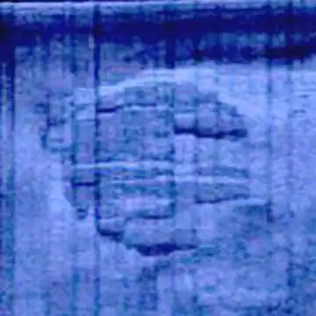
What if certain regions of extreme pressure and electromagnetic complexity — like deep ocean trenches — act as interfaces rather than barriers?
In this view, the ocean is not just a volume of water. It is a boundary layer, where different physical states can briefly overlap. Under specific conditions, phenomena could appear, move, and vanish without obeying conventional hydrodynamics.
This would explain why sonar sees them — until it doesn’t.
Why they displace water — but not consistently.
Why they vanish without noise, debris, or wake.
Not another universe.
Just another rule set brushing against ours.
Why the Navy Stays Silent
Public acknowledgment would raise questions no institution is prepared to answer.
Are these phenomena predictable?
Can they interact with vessels?
Do they pose a risk to submarines, cables, or seabed infrastructure?
Without clear answers, silence becomes policy.
A risk memo circulated internally on February 8, 2025, warned that public disclosure could undermine confidence in maritime security and escalate geopolitical tensions if misattributed to rival states.
So the incidents remain buried — logged, classified, and discussed only in secure rooms.
Detection Is Improving — And That’s the Real Problem
There is growing consensus among analysts that these phenomena are not new.
What’s new is our ability to notice them.
Advances in low-frequency sonar, AI-driven pattern recognition, and multi-sensor fusion have narrowed the gap between signal and noise. The ocean hasn’t changed — but our perception has sharpened.
Between 2023 and early 2025, the number of recorded unexplained undersea disappearances increased sharply. Not because more events occurred — but because fewer went unnoticed.
The ocean has always been deep.
Now it’s becoming revealing.
The Question That Refuses to Go Away
Are these things aware of us?
There is no evidence of communication. No response to active sonar pings. No interaction attempts. No signs of intent.
But intent isn’t required for consequence.
A fault line doesn’t choose to move — yet it reshapes continents.
If these undersea phenomena represent intersections between physical states, their existence alone forces a rethink of how reality behaves under extreme conditions.
Why This Story Explodes
This isn’t a story about monsters or machines.
It’s about limits — of physics, detection, and disclosure.
The Navy keeps losing contact because, in some cases, there may be nothing left to track in our frame of reality.
The ocean didn’t become stranger.
We finally started listening closely enough to notice.
And once you realize parts of the world don’t always stay where you expect them to — the silence becomes far louder than any sonar ping.

0 Comments