

















The Radar That Wouldn’t Lie: Inside the UAP Incident Military Pilots Still Won’t Forget
For decades, stories about mysterious objects in the sky were usually dismissed as misidentified aircraft, weather balloons, or optical illusions. Many reports depended on eyewitness accounts that could easily be questioned or explained away. However, one particular incident changed the conversation in a way that even experienced military personnel found difficult to ignore.
This case did not involve a shaky smartphone video or a single observer looking up at strange lights in the night sky. Instead, it involved some of the most advanced radar systems in the world, trained naval aviators, and multiple layers of sensor confirmation. When all of those systems detected the same object performing movements that seemed impossible, the story quickly moved beyond speculation.
The event has since become one of the most discussed unidentified aerial phenomenon encounters in modern military history.
Even years later, the pilots who were involved in the encounter continue to speak about the incident with a mixture of disbelief and curiosity. What made the situation extraordinary was not just what they saw with their own eyes, but the fact that the radar systems aboard naval vessels and aircraft were also tracking the same unknown object.
The technology did not show a glitch.
The radar did not fail.
The sensors simply reported something that no one expected to see.
A Routine Training Exercise That Suddenly Changed
On the morning of November 14, 2004, the USS Nimitz Carrier Strike Group was conducting training exercises in the Pacific Ocean off the coast of Southern California. The operation was part of a standard military readiness program in which fighter pilots practiced combat scenarios and radar operators monitored airspace around the fleet.
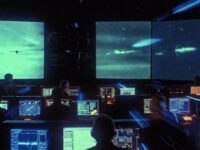
The strike group included several ships equipped with powerful radar systems designed to detect aircraft, missiles, and other aerial threats hundreds of miles away. Among those vessels was the guided missile cruiser USS Princeton, which had recently upgraded its radar system.
Shortly after the new radar equipment became operational, something unusual began appearing on the screens.
Radar operators started noticing objects appearing at extremely high altitudes, sometimes above 80,000 feet, before rapidly descending toward the ocean. These objects were not behaving like conventional aircraft, and they did not follow typical flight patterns.
Even more puzzling was the way the objects seemed to disappear and reappear.
At first, some operators believed the radar system might be malfunctioning. It is not unusual for newly installed equipment to require adjustments or calibration. However, as the contacts continued appearing day after day, the crew realized the signals were consistent and repeatable.
In other words, the radar was tracking something real.
Radar Operators Begin Tracking Unidentified Objects
The radar operators aboard the USS Princeton continued monitoring the mysterious contacts for several days. According to their reports, the objects appeared at extremely high altitudes before descending rapidly to just above sea level.
What truly alarmed the crew was the speed at which the objects moved.
The unknown targets could drop from tens of thousands of feet to the surface of the ocean in a matter of seconds. After hovering or moving slowly for a short period, they would suddenly accelerate and disappear from radar coverage.
These movements did not resemble the flight patterns of known aircraft or missiles.
Eventually, the radar team decided to alert the pilots who were already flying training missions nearby. They asked the pilots if they would be willing to investigate one of the radar contacts.
Two fighter jets were redirected to intercept the mysterious object.
What happened next would later become one of the most discussed military aviation encounters in modern history.
Military Pilots See Something They Could Not Explain
Commander David Fravor, an experienced U.S. Navy pilot, was leading one of the fighter jets assigned to investigate the radar contact. Fravor had logged thousands of flight hours and was familiar with nearly every type of aircraft that could appear in the region.
However, what he encountered that day did not resemble any aircraft he had ever seen.
As the pilots approached the location provided by radar operators, they noticed unusual disturbances on the surface of the ocean. The water appeared to be churning as if something large had just submerged beneath it.
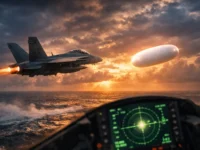
Hovering above the disturbed water was a strange white object.
The object had no wings, no visible propulsion system, and no exhaust trail. Pilots later described its shape as resembling a smooth white capsule or a large “Tic Tac” mint.
The craft appeared to be approximately forty feet long.
Commander Fravor began descending toward the object to take a closer look. As he approached, the craft suddenly reacted.
It accelerated away with extraordinary speed.
Within seconds, the object had disappeared from sight.
Radar Confirmation Adds Another Layer to the Mystery
Shortly after the visual encounter ended, radar operators aboard the USS Princeton reported something even more unusual.
The unknown object had reappeared on radar at a location approximately 60 miles away.
What made this astonishing was the time it took to reach that location. According to the radar data, the object had traveled the distance almost instantly.
For comparison, even the fastest fighter jets in the world cannot perform such maneuvers without extreme stress on the aircraft and the pilot.
Later that day, another fighter jet equipped with an advanced infrared targeting system managed to record video footage of a similar object.
The footage, which later became known publicly as the Tic Tac video, showed a small object moving rapidly while being tracked by military sensors.
Years later, the U.S. Department of Defense confirmed that the video was authentic and taken by Navy personnel.
Government Reports Begin Addressing the Encounters
For many years, the incident remained largely unknown outside military circles. However, public interest increased dramatically after several UAP videos were officially released.
In response to growing attention, the U.S. government began conducting formal reviews of unidentified aerial phenomenon reports.
Reports published by defense agencies acknowledged that many encounters involve objects that cannot be easily explained using currently available data.
Importantly, these reports did not conclude that the objects were extraterrestrial. Instead, officials emphasized that many incidents remain unresolved due to insufficient information.
However, the Nimitz encounter continues to stand out because of the combination of radar data, pilot testimony, and sensor recordings.
Few cases include all three forms of evidence.
Why Radar Data Makes This Case Different
Eyewitness accounts alone can sometimes be unreliable because human perception can be affected by distance, lighting, and environmental conditions.
Radar systems, however, operate using electromagnetic signals that measure distance, speed, and direction.
When multiple radar systems detect the same object simultaneously, the data becomes significantly harder to dismiss.
In the Nimitz encounter, radar operators observed the objects before pilots were sent to investigate them. After the pilots reported visual contact, radar systems continued tracking the targets as they moved across the training area.
This combination of visual observation and sensor data makes the case unusually strong compared with many other unexplained sightings.
A Careful Note on What Is Still Unknown
It is important to approach this topic with caution and careful analysis.
Although the incident remains unexplained, it does not automatically confirm the existence of extraterrestrial technology or unknown civilizations visiting Earth.
Defense analysts and scientists continue to explore a variety of possibilities, including advanced experimental aircraft, sensor anomalies, atmospheric effects, and other natural explanations.
The purpose of studying these incidents is not to promote speculation, but to better understand unknown objects that appear in controlled military airspace.
As government investigations continue, researchers hope that improved sensor technology and data sharing will eventually provide clearer answers.
Why Military Pilots Still Talk About This Event
Many of the pilots involved in the encounter have spoken publicly about their experiences years after the event.
Their main message is surprisingly consistent.
They do not claim to know what the object was.
However, they insist that the encounter was real and that the data recorded by military systems accurately reflected what occurred.
Commander David Fravor has repeatedly stated that the craft demonstrated performance capabilities far beyond known aircraft technology.
For trained pilots who spend their careers studying aircraft behavior, that conclusion carries significant weight.
The Larger UAP Conversation
In recent years, governments and scientific institutions have begun taking unidentified aerial phenomenon reports more seriously than in the past.
Several countries now maintain official programs dedicated to studying unexplained aerial encounters.
The focus is not on proving alien visitation but on understanding unknown objects that appear in restricted airspace.
From a national security perspective, any unidentified craft operating near military assets deserves careful investigation.
For now, the Nimitz encounter remains one of the most compelling cases because it combines radar confirmation, visual sightings, and sensor recordings.
And in this particular case, the radar operators were certain of one thing.
The system did not malfunction.
The radar showed exactly what was there.
Frequently Asked Questions
What was the Nimitz UAP incident?
The Nimitz incident refers to a 2004 encounter in which U.S. Navy pilots observed and tracked an unidentified aerial phenomenon during training exercises near Southern California.
Why is this case considered credible?
The event included radar tracking, pilot testimony, and infrared sensor recordings, which together provide multiple sources of evidence.
Did the government confirm the incident?
Yes. The U.S. Department of Defense later confirmed the authenticity of videos recorded during the encounter and acknowledged that the objects remain unidentified.
Does this prove extraterrestrial technology exists?
No. Government reports state that the objects are unidentified, but no official conclusion has confirmed extraterrestrial origins.
Why do radar systems matter in such cases?
Radar provides measurable data about an object’s speed, altitude, and direction, making it more reliable than eyewitness accounts alone.
Disclaimer
This article discusses documented military encounters with unidentified aerial phenomena based on publicly available reports and statements from officials and witnesses. The term UAP refers to objects that have not yet been fully explained. Their origin or nature has not been confirmed.
References and Source Material
U.S. Department of Defense UAP Report
https://www.defense.gov
Office of the Director of National Intelligence UAP Assessment
https://www.dni.gov
Pentagon confirmation of Navy UAP videos
https://www.navy.mil
Congressional UAP hearing documentation
https://www.congress.gov
Pilot testimony interviews and reports (publicly available)

0 Comments