













By Ronald Kapper
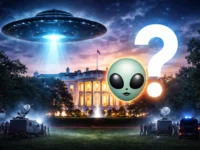
There is a moment humanity has quietly imagined for decades, whispered about in late-night conversations, debated in government corridors, and studied in classified reports — the moment when authorities step forward and confirm that unidentified aerial phenomena are real, not fully understood, and possibly not human.
And then comes the real story.
Not the announcement itself, but the day after.
Because disclosure would not end the mystery — it would begin a chain reaction across economies, religions, governments, and human psychology that could reshape the world within hours.
This is a grounded, carefully framed, hour-by-hour walkthrough of what could realistically happen next, based on historical precedents, government reports, and expert analysis.
A Necessary Disclaimer Before We Begin
No government has officially confirmed extraterrestrial origin of UAPs as of today. In fact, multiple investigations, including the Pentagon’s All-domain Anomaly Resolution Office (AARO), have stated that there is no confirmed evidence of extraterrestrial technology, even though many cases remain unexplained.
What follows is a scenario-based analysis, not a prediction, built using known patterns of human behavior, past disclosures, and geopolitical responses to major shocks.
Hour 0: The Announcement That Freezes the World
It begins with a press conference.
Calm, controlled, but historic.
A senior government authority confirms that UAPs are real, that some objects display capabilities beyond current known technology, and that full understanding is still incomplete.
Within seconds, the internet fractures into chaos.
News apps crash. Social media surges. Live streams explode in viewership.
Search engines spike to levels never seen before.
This moment mirrors smaller historical shocks — like the release of Pentagon UAP footage in 2017, which marked the first serious shift in public discussion.
But this time, there is no ambiguity.
This time, it is official.
Hour 1–3: Information Overload and Digital Panic
People do not panic in the way movies show.
They refresh.
They search.
They message.
They try to understand.
Within the first few hours, three things happen simultaneously:
- Messaging apps flood with theories
- Old UFO footage resurfaces globally
- Misinformation spreads faster than facts
This phase is known in psychology as “ontological shock” — a deep disruption of how humans understand reality itself.
For many, the question is not “Are we safe?”
It is:
“What else have we been wrong about?”
Hour 3–6: Financial Markets React First
Markets do not wait for clarity.
They react to uncertainty.
Stock futures begin to swing violently.
Key immediate impacts:
- Airline and defense stocks spike or crash unpredictably
- Gold and safe-haven assets surge
- Tech companies tied to aerospace and AI see speculative buying
Why?
Because disclosure introduces a completely new variable into global risk calculations.
Even without confirmed extraterrestrial origin, the idea of unknown advanced technology changes everything.
Historically, even rumors of technological breakthroughs have triggered market volatility — and this would be on an entirely different scale.
Hour 6–12: Governments Go Silent, Then Strategic
Behind closed doors, emergency meetings begin.
National security councils assemble.
Military communication channels activate.
Because even today, governments already treat UAPs as a potential airspace and security concern, not just a scientific mystery.
Now imagine that concern becoming public reality.
Immediate geopolitical responses may include:
- Airspace monitoring intensifies worldwide
- Intelligence agencies reassess threat frameworks
- Rival nations begin internal briefings
At the same time, something quieter but more important begins.
A race.
If advanced technology is even remotely implied, nations will compete to understand it first.
As highlighted in recent discussions and documentaries, officials have already warned that whoever masters such technology could dominate globally.
Disclosure would accelerate that race overnight.
Hour 12–18: Religious Shockwaves Begin
This is where the story becomes deeply human.
Religion does not collapse.
It responds.
Across the world:
- Some believers interpret UAPs as part of divine creation
- Others see it as a test of faith
- A few fringe reactions may frame it as apocalyptic
Historically, belief systems adapt rather than disappear.
Even discussions within religious circles have already explored how non-human intelligence could fit within theological frameworks.
The real shift is not loss of faith.
It is reinterpretation.
Hour 18–24: Society Stabilizes — But the Questions Deepen
By the end of the first day, something surprising happens.
People go back to routines.
Work continues.
Shops remain open.
But underneath, everything feels different.
Because now there is a permanent question hanging over humanity:
We are not alone in the skies — or at least, we do not fully understand what is there.
The Economic Domino Effect (Days to Weeks After)
The first 24 hours are only the beginning.
In the following days, deeper economic shifts may unfold:
- Increased funding for aerospace and defense sectors
- Surge in scientific research investment
- New industries focused on detection and analysis
At the same time, some sectors could struggle:
- Tourism disruptions due to fear or curiosity-driven travel
- Insurance markets recalculating risk models
- Short-term instability in global trade
Economic systems are built on predictability.
Disclosure introduces uncertainty at the highest level.
The Geopolitical Domino Effect
Perhaps the most critical long-term impact is geopolitical.
Disclosure would not unite the world overnight.
It may actually increase tension.
Why?
Because uncertainty creates competition.
Possible outcomes include:
- Increased military surveillance programs
- Secretive research initiatives across major powers
- Strategic alliances forming around technological intelligence
The Cold War was driven by nuclear capability.
The post-disclosure world could be driven by unknown technology capability.
The Psychological Domino Effect
This is the least discussed, but most powerful.
Humans define themselves by their place in the universe.
Disclosure changes that instantly.
Short-term effects:
- Anxiety and curiosity spikes
- Increase in conspiracy thinking
- Surge in philosophical and scientific interest
Long-term effects:
- Shift toward space-focused identity
- Increased global perspective among younger generations
- Greater interest in science, physics, and existential questions
The biggest transformation is not fear.
It is perspective.
Would There Be Panic?
Probably not in the way movies show.
Past global shocks — pandemics, financial crises, major conflicts — show that humans adapt quickly.
The first reaction is confusion.
The second is normalization.
And then comes curiosity.
What Governments Are Already Preparing For
Even without full disclosure, governments have already taken steps that hint at preparation:
- Establishment of dedicated UAP investigation offices
- Collection of hundreds of incident reports
- Congressional hearings and testimonies
For example, over 1,600 UAP cases have already been reviewed by official agencies.
This suggests that disclosure, if it happens, will not be sudden chaos.
It will be managed.
The Most Important Question: What If Nothing Changes?
Here is the twist.
The biggest outcome might be this:
Life continues.
People still go to work.
Bills still need to be paid.
Because even the most shocking truth becomes normal faster than expected.
Final Thought
The day after disclosure will not be the end of the world.
It will be the beginning of a new one.
Not defined by fear.
But by questions humanity has never had to answer before.
FAQs
Has any government confirmed aliens exist?
No. Official reports state that while many UAP cases remain unexplained, there is no confirmed evidence of extraterrestrial origin.
Would the stock market crash after disclosure?
It would likely experience volatility, not a permanent crash. Markets react to uncertainty, but stabilize over time.
Will religions collapse?
No. History shows that religions adapt and reinterpret new discoveries rather than disappear.
Could disclosure lead to war?
Not directly, but it could increase geopolitical competition, especially if advanced technology is involved.
Why haven’t governments already disclosed everything?
Officials often cite national security, lack of complete understanding, and the need to verify data before releasing information.

0 Comments