












By Ronald Kapper
The Moment Physics Questioned Time Itself
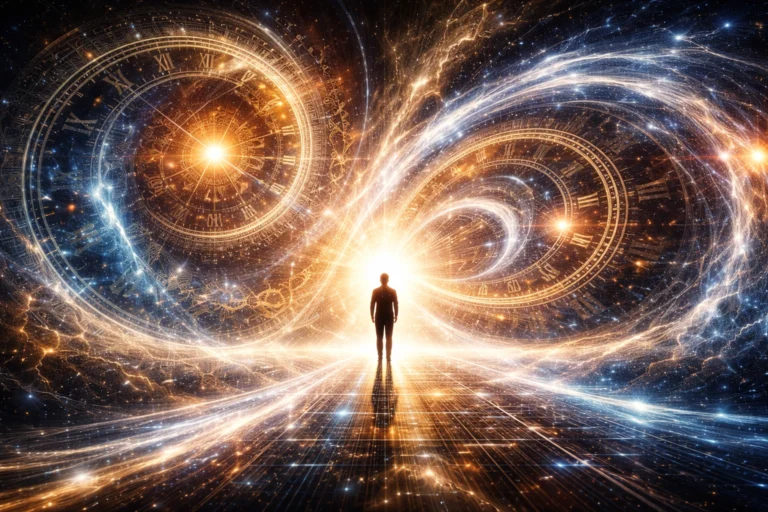
For most of human history, time felt simple. Yesterday is gone, today is happening, tomorrow has not arrived. A straight line — always moving forward. But modern physics has slowly uncovered something deeply unsettling: time may not flow at all.
Some scientists now believe that past, present, and future may all exist together, like different locations in space. This idea does not come from imagination — it emerges from relativity, quantum theory, and modern cosmology.
If true, it would mean the universe is not unfolding moment by moment. Instead, everything that has ever happened — and everything that will happen — may already exist.
Einstein’s Discovery — Time Is Not Absolute
The shift began in the early 20th century when Albert Einstein introduced relativity. He showed that time is not the same for everyone. It can slow down, speed up, and stretch depending on motion and gravity.
Experiments confirmed this repeatedly:
- Time runs slower near massive objects
- Fast-moving clocks tick more slowly than stationary ones
- Astronauts experience tiny differences in time compared to people on Earth
These results revealed something profound: time is not universal. It is part of space itself — forming what scientists call space-time.
This changed the question from “What time is it?” to “How does time exist?”
The Block Universe — All Moments Exist Together
From relativity emerged a concept called the block universe. In this view, the universe is like a four-dimensional structure where time is another dimension — similar to length, width, and height.
In this framework:
- The past still exists
- The present is just one slice of reality
- The future already exists
Time does not move — we move through time.
This idea is widely discussed in physics and philosophy because it naturally follows from Einstein’s equations. Some physicists argue that what we experience as “flowing time” may be a feature of human perception rather than reality itself.
Why We Feel Time Flow
If all moments exist, why do we feel time moving forward?
Scientists believe this may be linked to entropy, the measure of disorder in the universe. Entropy increases over time, giving us the sensation of direction — often called the “arrow of time.”
In simple terms:
- The past has lower entropy
- The future has higher entropy
- Our brains interpret this change as time moving forward
But physics itself does not require time to flow. Many fundamental equations work equally well forward or backward.
Quantum Physics — Time May Be Even Stranger
Quantum theory deepens the mystery. Some quantum experiments suggest that events may not have a definite order until measured. In certain interpretations, the sequence of cause and effect may not be fixed.
This has led some researchers to explore whether:
- Time may emerge from deeper quantum processes
- The present moment may not be uniquely real
- Reality may exist outside conventional time
These ideas remain under investigation, but they challenge everyday assumptions about time.
Evidence from Cosmology
Modern cosmology — the study of the universe — also points toward non-linear time. Space-time is treated as a complete structure rather than a sequence of moments unfolding.
Some models of the universe treat time like a coordinate, not a flowing quantity. In these models, the entire history of the universe — from the Big Bang to the far future — exists as one structure.
This does not mean we can travel freely through time. It means the universe may not evolve in the way we intuitively imagine.
Does This Mean the Future Is Fixed?
One common question is whether the block universe removes free will. If the future already exists, is everything predetermined?
Physicists do not agree on this. Some argue:
- The future exists, but we still experience choice
- Quantum uncertainty may allow multiple possible outcomes
- Determinism and free will may coexist in ways not fully understood
So while physics suggests time may not flow, it does not necessarily remove human agency.
The Illusion of “Now”
Neuroscience adds another layer. Studies suggest the human brain constructs the present moment from sensory information processed over short intervals. What we experience as “now” is actually a tiny window of perception, not a precise instant.
This supports the idea that the feeling of moving through time may arise from consciousness rather than from physical reality itself.
Time Without Time — Emerging Theories
Some modern physicists explore even more radical ideas:
- Time may not be fundamental
- Time could emerge from quantum entanglement
- The universe might exist timelessly at its deepest level
In these views, time is not the base layer of reality but a feature that appears at larger scales.
What This Means for Humanity
If time is not linear and all moments coexist:
- Reality may be far more complex than human perception
- The universe may be a complete structure rather than an unfolding story
- Consciousness may play a role in how we experience time
These ideas do not overturn everyday life — clocks still tick, and we still age — but they reshape how science understands existence itself.
FAQs
Q1: Do scientists really believe past, present, and future coexist?
Some physicists support this interpretation based on relativity and the block universe model. Others remain cautious. It is a serious scientific idea, but not universally accepted.
Q2: Does this mean time travel is possible?
Not necessarily. Even if all moments exist, moving freely through time may not be physically possible.
Q3: Is time an illusion?
Some scientists argue the flow of time may be a perception rather than a fundamental property of the universe.
Q4: If the future exists, do we still have free will?
The relationship between free will and physics remains unresolved. Many scientists believe both can coexist.
Q5: Is this proven science?
Relativity strongly supports non-absolute time, but whether all moments coexist remains an interpretation of physics rather than a confirmed fact.
The Balance Between Mystery and Evidence
Science has not fully solved the nature of time. Yet one conclusion is clear: time is far stranger than our everyday experience suggests.
Whether time flows, emerges, or simply exists — the universe continues to challenge human understanding.
What once seemed simple is now one of the deepest mysteries in physics.
Disclaimer
This article discusses scientific interpretations based on relativity, cosmology, and quantum theory. The concept that past, present, and future coexist is a theoretical framework and not universally accepted as proven fact. Research continues.
Reference Sources and Scientific Evidence
Einstein relativity and nature of time
https://plato.stanford.edu/entries/time/
Block universe theory and space-time interpretation
https://en.wikipedia.org/wiki/Eternalism_(philosophy_of_time)
Arrow of time and entropy research
https://www.sciencedirect.com/topics/physics-and-astronomy/arrow-of-time
Quantum time and causal order studies
https://www.nature.com/articles/s41467-019-11503-2
Is time fundamental or emergent (physics research)
https://www.scientificamerican.com/article/is-time-fundamental/
Cosmology and time structure of universe
https://www.livescience.com/what-is-time.html

0 Comments