














The Day Everything Stops Moving
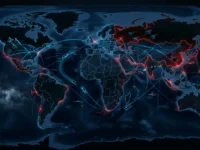
There is a silent system running beneath modern life that most people never think about, and yet it is the very thing holding everything together — the global supply chain — an invisible web of ships, trucks, ports, warehouses, and data systems that quietly moves food, fuel, medicine, and everyday products across continents with almost perfect timing.
Now imagine this system doesn’t slow down gradually, but instead breaks overnight.
No warning, no adjustment period, no slow decline.
Just a sudden stop.
This is not fiction, and it is not impossible, because we have already seen small glimpses of how fragile this system really is.
A Real Warning the World Ignored
In March 2021, a single container ship named Ever Given got stuck in the Suez Canal, one of the most important trade routes on Earth, and within hours, global trade began to choke.
The canal carries a massive share of international shipping, with around 25–30% of global container traffic passing through it, making it one of the most critical arteries of global commerce.
That one incident, lasting just six days, held up billions of dollars in goods every single day and caused a massive backlog of ships waiting to pass.
At least 432 vessels carrying cargo worth tens of billions were delayed, creating ripple effects that lasted for months.
And that was just one ship.
Now imagine multiple failures happening at once.
Hour 0–12: Confusion Begins
If global supply chains stopped overnight, the first few hours would feel almost normal.
People would wake up, go to work, order food online, scroll through their phones, completely unaware that something critical had already broken behind the scenes.
Inside logistics networks, however, alarms would start ringing immediately.
- Ships would stop receiving instructions
- Ports would halt incoming traffic
- Warehouses would freeze outbound shipments
- Digital tracking systems would go dark
At this stage, the crisis is invisible to the public but fully visible to those inside the system.
Companies would scramble to understand what went wrong, because supply chains are not designed to stop — they are designed to flow continuously.
Hour 12–24: The First Signs
By the end of the first day, cracks would begin to show.
Retail stores would not receive scheduled deliveries.
Fuel stations would notice delays in tanker arrivals.
Manufacturing plants operating on “just-in-time” systems would begin running out of components.
Modern supply chains are built for efficiency, not resilience, meaning they depend on constant movement with very little buffer stock.
That is why even short disruptions — like the pandemic or shipping delays — have already caused shortages in recent years.
The system works perfectly — until it doesn’t.
Day 2–3: Panic Starts to Spread
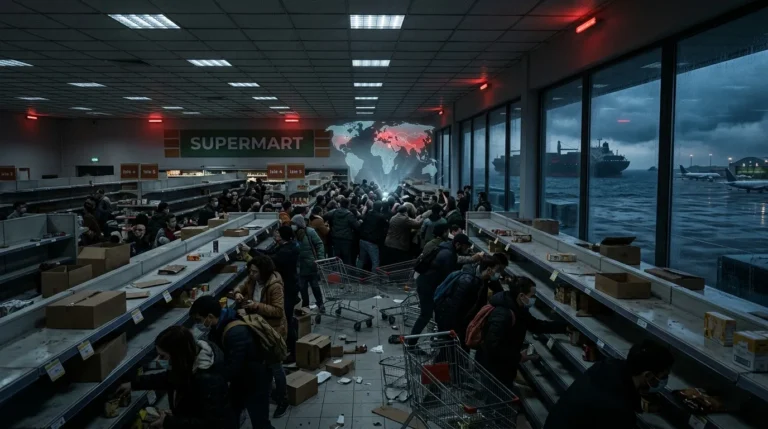
By the second or third day, the situation would become visible to the public.
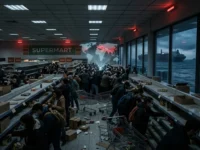
Supermarkets would begin to look different.
Not empty — not yet — but noticeably thinner.
Certain items would disappear first:
- Imported foods
- Electronics
- Packaged goods
- Medical supplies
Fuel shortages would begin in some regions, causing long lines at petrol stations.
News channels would start reporting “temporary disruptions,” trying to prevent panic, but social media would tell a different story.
People would start buying more than usual.
And that is when the real problem begins.
Day 4–7: The Breaking Point
Within a week, the system would start to break down completely.
Supply chains do not fail evenly — they fail unevenly and unpredictably.
Some cities would still have supplies, while others would run dry.
Hospitals could begin facing shortages of critical equipment and medicines.
Factories would shut down because they cannot operate without parts.
Even industries that seem unrelated would collapse together because everything is connected.
For example, during past disruptions:
- Factory shutdowns in one country affected production worldwide
- Weather events disrupted energy and chemical supply chains
- Port congestion created delays across entire continents
Now imagine all of this happening at once.
Week 2: The Economy Freezes
At this stage, the crisis moves from inconvenience to economic shock.
Global trade depends heavily on shipping, with around 90% of goods transported by sea, meaning any major disruption can quickly freeze commerce.
Without movement:
- Businesses cannot sell
- Workers cannot be paid
- Governments lose tax revenue
Stock markets would likely crash or shut down temporarily.
Banks could restrict withdrawals to prevent financial panic.
Currencies might fluctuate wildly.
The system does not collapse slowly — it locks up.
Week 3 and Beyond: Social Impact
If the disruption continues beyond a few weeks, the effects would begin to change daily life in a very real way.
Food supply becomes a concern.
Urban areas, which rely heavily on continuous deliveries, would be the most vulnerable.
Essential services could be disrupted:
- Public transport slows due to fuel shortages
- Power generation faces strain
- Emergency services operate under pressure
This is where the situation becomes unpredictable.
Because once supply chains fail, society does not just pause — it adapts, often in unstable ways.
Why the System Is So Fragile
It might seem surprising that something so important can be so vulnerable, but the reasons are clear.
Modern supply chains are built on:
- Efficiency
- Speed
- Cost reduction
Not redundancy.
There are very few backups.
Very few запас systems.
Very little margin for error.
A disruption anywhere — whether from pandemics, geopolitical conflict, or infrastructure failure — can ripple across the entire system.
And history has already shown us that multiple disruptions can happen at the same time.
The Domino Effect No One Talks About
What makes a supply chain collapse especially dangerous is not just the shortages, but the chain reaction it creates.
When one sector stops, others follow.
For example:
- No fuel → transport stops
- No transport → food cannot move
- No food → panic buying increases
- Panic → system stress multiplies
This feedback loop can escalate faster than most people expect.
And once trust in the system breaks, even temporary disruptions can feel permanent.
Important Disclaimer
This article presents a hypothetical collapse scenario based on real-world vulnerabilities and past disruptions. It is not a prediction of an imminent event but an analysis of how interconnected systems behave under stress. The purpose is to inform and understand risk, not to create fear.
Can This Actually Happen?
A complete overnight collapse is unlikely, but not impossible.
What is more realistic — and already happening — is partial disruption.
We have seen:
- Pandemic-related shutdowns
- Shipping delays and container shortages
- Major trade route blockages
- Geopolitical tensions affecting logistics
Each of these events exposed weaknesses in the system.
And each time, the world managed to recover.
But recovery does not mean immunity.
What This Means for the Future
The biggest lesson is not that collapse is inevitable, but that the system is more fragile than it appears.
Governments and companies are already trying to adapt by:
- Diversifying supply sources
- Increasing local production
- Building strategic reserves
But these changes take time.
And the system remains stretched.
Final Thought
The global supply chain is like a heartbeat — constant, rhythmic, and easy to ignore until it stops.
If it ever stops suddenly, the world would not end overnight, but it would change faster than most people are prepared for.
Not with explosions or dramatic scenes.
But with silence.
Empty shelves.
Delayed shipments.
And a growing realization that the system we depend on is far more delicate than we ever imagined.
❓ FAQs
1. What is a global supply chain collapse?
It refers to a large-scale breakdown in the systems that move goods worldwide, affecting production, transport, and delivery.
2. Has anything like this happened before?
Not a full collapse, but events like the Suez Canal blockage and pandemic disruptions have shown how quickly the system can be affected.
3. How fast would shortages begin?
Some shortages could appear within 2–3 days, especially for fast-moving consumer goods.
4. Which sectors would be affected first?
Retail, fuel, manufacturing, and healthcare would feel the impact early.
5. Can governments prevent this?
They can reduce risk, but preventing every disruption is extremely difficult due to global interdependence.

0 Comments