

















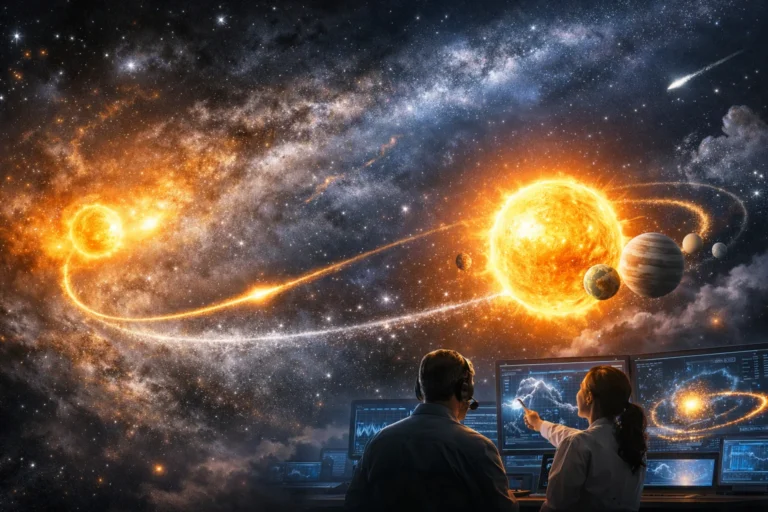
For most of modern scientific history, astronomers believed the Sun formed roughly where it currently sits in the Milky Way and has spent the last 4.6 billion years orbiting the galaxy in a relatively stable path. This long-standing assumption suggested that our solar system remained in the same general neighborhood of space while planets formed and life eventually emerged on Earth. However, recent astrophysical research is beginning to challenge that traditional view by presenting evidence that the Sun may have actually traveled a vast distance across the Milky Way during its lifetime. Scientists studying large datasets of stars similar to our Sun now believe that our star may have originated closer to the galaxy’s center and slowly migrated outward to its present location over billions of years, a process known as stellar migration that is now becoming one of the most fascinating topics in modern astrophysics.
At the same time, another powerful force is transforming how scientists investigate these cosmic mysteries. Artificial intelligence is rapidly becoming one of the most important tools in physics and astronomy, allowing researchers to analyze massive amounts of astronomical data, detect patterns that humans cannot easily see, and reconstruct the complex history of stars moving through the galaxy. The emerging story of the Sun’s migration therefore represents more than just a discovery about our cosmic past; it also illustrates how modern technology and advanced computation are reshaping the way scientists explore the universe.
New Research Suggests the Sun May Have Migrated Across the Galaxy
Recent studies examining data from the European Space Agency’s Gaia space observatory have revealed surprising evidence that the Sun might not have formed in its current position within the Milky Way. Gaia has been mapping the positions, distances, motions, and chemical properties of billions of stars, producing one of the largest and most detailed astronomical datasets ever collected. By analyzing this enormous collection of data, researchers identified thousands of stars known as solar twins, which are stars with nearly identical characteristics to our Sun in terms of temperature, chemical composition, brightness, and age.
Scientists identified more than 6,500 solar twin stars, and when researchers began studying their distribution across the Milky Way they noticed a remarkable pattern. Many of these Sun-like stars appear to have originated in the dense inner regions of the galaxy before gradually moving outward into quieter regions similar to where our solar system is currently located. This observation suggests that billions of years ago a large-scale migration of stars may have taken place across the Milky Way, potentially moving thousands of stars away from the chaotic center of the galaxy toward its outer spiral arms.
Researchers believe that this migration may have occurred between four and six billion years ago, roughly the same period when our Sun was forming and the early solar system was beginning to take shape. If the Sun participated in this migration event, it means that our solar system may have traveled thousands of light-years across the Milky Way before arriving in the relatively calm region where it resides today.
Why the Sun’s Possible Migration Could Explain the Existence of Life
The idea that the Sun may have migrated through the galaxy is not just an interesting astronomical curiosity; it could also help explain why Earth became a planet capable of supporting life. The central regions of galaxies like the Milky Way are extremely violent environments where stars are packed closely together and powerful cosmic events occur frequently. Supernova explosions, intense radiation fields, and strong gravitational disturbances are common near the galactic center, and these conditions can disrupt planetary systems or expose planets to dangerous levels of radiation.
If the Sun had remained close to the center of the Milky Way, Earth might have experienced constant cosmic disturbances that could have prevented stable climates from forming or repeatedly sterilized the planet’s surface. Instead, our solar system currently sits in a relatively calm region of the galaxy sometimes referred to by scientists as the galactic habitable zone, an area where stellar density is lower and catastrophic cosmic events are less frequent.
The possibility that the Sun migrated into this calmer region raises an intriguing idea: the movement of our star across the galaxy may have helped create the stable cosmic environment that allowed life to develop and evolve on Earth over billions of years.
Understanding the Mechanisms Behind Stellar Migration
Stellar migration is not the result of a single dramatic event but rather a slow and gradual process driven by complex gravitational interactions within galaxies. Several mechanisms can influence the movement of stars across the Milky Way over extremely long timescales.
One important factor is the presence of the galactic bar, a large elongated structure of stars located at the center of the Milky Way. This structure can alter the gravitational balance of the galaxy and create forces that gradually push stars outward or inward along their orbits. Another important influence comes from the galaxy’s spiral arms, which rotate through the galactic disk and can change the orbits of stars as they interact with the gravitational waves created by these spiral structures.
In addition to these large-scale effects, occasional encounters with star clusters or gravitational interactions with nearby stars can slightly alter a star’s path. Over billions of years, even very small gravitational changes can accumulate and cause stars to move thousands of light-years away from their original birthplaces. The Sun’s potential migration likely involved a combination of these processes acting slowly but persistently across cosmic time.
How Artificial Intelligence Is Transforming Astrophysics
While the concept of stellar migration is fascinating, uncovering evidence for it would have been nearly impossible without modern data analysis tools. Astronomical surveys like the Gaia mission generate extraordinary volumes of data that include measurements of billions of stars, each with multiple physical properties such as motion, brightness, temperature, and chemical composition.
Processing and interpreting such enormous datasets presents a major challenge for scientists using traditional analysis methods. This is where artificial intelligence has become an essential partner for modern astronomers. Machine learning systems are capable of analyzing huge collections of data in ways that allow them to identify patterns, classify objects, and detect relationships between stars that might otherwise remain hidden.
In the case of solar migration research, AI-assisted data analysis helped scientists identify thousands of solar twin stars and examine how they are distributed across the galaxy. By comparing their motions, chemical signatures, and ages, researchers were able to detect evidence suggesting that many of these stars may have originated in similar regions before spreading outward over billions of years.
Artificial intelligence is therefore becoming a critical tool that allows astrophysicists to transform vast astronomical datasets into meaningful scientific insights.
AI Simulations Are Reconstructing the History of the Milky Way
Beyond analyzing observational data, artificial intelligence is also helping scientists build sophisticated simulations that recreate the evolution of galaxies over billions of years. These simulations use complex physics models to track the movement of stars under the influence of gravity, allowing researchers to test different scenarios about how galaxies develop and how stars migrate within them.
With AI-assisted computational techniques, scientists can simulate entire galaxies containing billions of stars and observe how gravitational interactions change their positions over time. These simulations make it possible to test hypotheses about where the Sun may have formed and how it might have traveled to its present location.
For example, researchers can model the formation of the Milky Way’s central bar and examine whether such a structure could have pushed Sun-like stars outward into the galaxy’s spiral arms. They can also explore how interactions with spiral density waves might gradually shift stellar orbits over billions of years. Artificial intelligence significantly speeds up these simulations, allowing scientists to explore many different possibilities and compare them with real astronomical observations.
The Emerging Era of AI-Driven Physics
The intersection between artificial intelligence and physics is rapidly creating a new era of scientific discovery. AI technologies are already being used across multiple areas of astrophysics and cosmology to analyze data, identify new phenomena, and accelerate theoretical research.
Machine learning systems are now helping astronomers detect distant planets orbiting other stars by identifying subtle patterns in telescope data. AI models are also being used to study gravitational waves produced by merging black holes and neutron stars, enabling scientists to detect these signals more quickly and accurately. In cosmology, artificial intelligence is assisting researchers in mapping the distribution of dark matter by analyzing distortions in the shapes of distant galaxies.
These applications demonstrate that artificial intelligence is not replacing scientists but rather enhancing their ability to explore complex problems. By combining human creativity with powerful computational tools, researchers are gaining new insights into the structure and evolution of the universe.
Future Discoveries May Reveal the Sun’s Full Galactic Journey
The investigation into the Sun’s migration is still ongoing, and scientists expect that future observations will provide even clearer answers about our star’s history. New telescopes and space missions are being designed to map the Milky Way with unprecedented precision, allowing astronomers to study stellar motions in far greater detail than ever before.
Facilities such as the Vera Rubin Observatory and the Nancy Grace Roman Space Telescope will soon collect enormous volumes of astronomical data that could further illuminate the complex dynamics of our galaxy. Artificial intelligence will play a crucial role in analyzing these observations and identifying patterns that reveal how stars move and evolve over cosmic timescales.
With these tools, scientists may eventually reconstruct the entire orbital history of the Sun, tracing its path through the Milky Way across billions of years and revealing the cosmic journey that ultimately led to the formation of our solar system.
Scientific Disclaimer
The hypothesis that the Sun migrated from the inner regions of the Milky Way is based on recent observational studies and statistical modeling using stellar data. While current research provides intriguing evidence supporting this idea, the exact birthplace of the Sun and the details of its orbital history are still under active scientific investigation. Future observations and improved simulations may refine or modify these conclusions as astronomers gather more data about the structure and evolution of our galaxy.
FAQs
Did the Sun really move across the Milky Way?
Recent research suggests that the Sun may have migrated outward from the inner parts of the galaxy billions of years ago, but scientists are still studying this possibility.
How far might the Sun have traveled?
Some models indicate the Sun could have moved several thousand light-years from its original birthplace.
What caused the Sun’s migration?
Gravitational interactions with the Milky Way’s central bar, spiral arms, and nearby stars likely influenced the Sun’s orbital path over billions of years.
How does artificial intelligence help astrophysics?
AI allows scientists to analyze massive astronomical datasets, identify patterns among billions of stars, and run detailed simulations of galaxy evolution.
Could other stars migrate across the galaxy as well?
Yes, stellar migration is believed to be a common process that affects many stars within spiral galaxies like the Milky Way.
Sources and References
https://www.sciencedaily.com/releases/2026/03/260313062543.htm
https://phys.org/news/2026-03-sun-stellar-twins-galaxy-center.html

0 Comments