

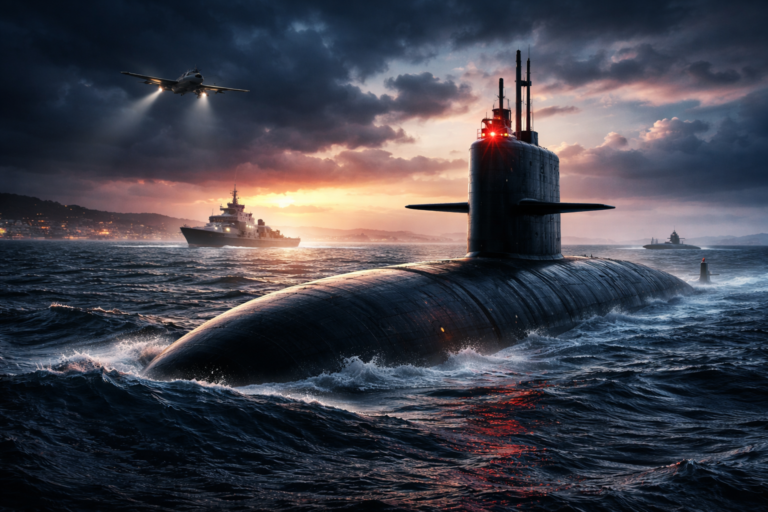

Between late 2024 and mid-2025, U.S. Navy officials quietly acknowledged an increase in foreign submarine patrols operating closer to North American maritime zones than seen in recent years.
These are not accidental drifts or lost vessels.
They are intentional, calculated movements.
A senior U.S. defense official, speaking on background in January 2025, described the situation bluntly:
“We’re seeing more submarines, from more nations, spending longer periods near sensitive areas. This isn’t routine training. It’s signaling.”
During the Cold War, submarines played a psychological role as much as a military one. Their presence alone altered strategy. That playbook appears to be back—updated for the modern age.
Why Now? Timing Is Everything
Several forces are colliding at once.
First, global naval competition has intensified. Major powers are investing heavily in next-generation submarines designed to be nearly invisible to sonar. These vessels can operate for months without surfacing and carry capabilities far beyond traditional weapons.
Second, undersea infrastructure has become a strategic target. Communication cables, energy pipelines, and sensor arrays now form the backbone of modern economies. Monitoring—or threatening—these systems sends a message without firing a single shot.
Third, geopolitical tensions elsewhere are pushing activity closer to home. When pressure builds in one region, navies often respond by flexing power in another.
The ocean allows that pressure to remain unseen.
The Technology That Changed the Game
Modern submarines are no longer just weapons platforms. They are mobile intelligence hubs.
Advanced vessels can:
- Map the seafloor in high resolution
- Intercept underwater communications
- Deploy autonomous drones
- Test detection limits of coastal defenses
In April 2025, U.S. naval analysts confirmed that several tracked underwater contacts displayed movement patterns consistent with surveillance mapping, not transit or patrol.
That distinction matters.
It suggests preparation rather than presence.
A Parallel World Beneath the Waves
What makes submarine activity so unsettling is not just what is happening—but where it’s happening.
The deep ocean operates under different rules. Sound bends. Time stretches. Detection is never certain.
It’s a space where events can unfold alongside everyday life without ever crossing into public awareness.
Cargo ships pass above. Coastal cities sleep. And below, silent machines observe, record, and test boundaries.
It feels like a parallel reality—one that rarely breaks the surface, yet influences decisions made far above it.
How the U.S. Is Responding
The response has been measured, not theatrical.
On May 2, 2025, the U.S. Navy confirmed expanded anti-submarine patrols in both the Atlantic and Pacific regions. Additional sonar-equipped aircraft and unmanned underwater sensors were deployed.
Officials emphasized deterrence, not escalation.
A Navy spokesperson stated during a briefing:
“Our goal is awareness. Knowing what’s out there reduces risk. Silence doesn’t mean absence.”
Behind that statement lies a simple truth: you don’t counter what you can’t see.
Why the Public Rarely Hears About It
Submarine encounters are rarely dramatic in public terms. There are no explosions, no visible confrontations.
Revealing too much also carries risk. Acknowledging detection capabilities can expose limitations. Staying quiet preserves uncertainty—for both sides.
That silence is intentional.
But silence does not mean inactivity.
What This Means Going Forward
The surge in submarine activity near U.S. waters signals a shift toward quiet pressure instead of open confrontation.
It’s about presence without provocation. Testing without crossing lines. Influence without headlines.
As underwater technology advances, the ocean will only become more crowded—and more contested.
The next major security story may not begin with a missile launch or a declaration.
It may begin with a sonar ping that never reaches the public ear.
Frequently Asked Questions (FAQs)
Is the U.S. under immediate threat from these submarines?
No confirmed immediate threat has been announced. Current activity is assessed as surveillance and signaling rather than preparation for attack.
Which countries are responsible for the increased activity?
Officials have not publicly named specific nations. Analysts point to multiple global naval powers expanding underwater operations.
Have there been any close calls or collisions?
As of June 2025, no confirmed collisions near U.S. waters have been disclosed by the Navy.
Why are submarines harder to track now than before?
Modern designs use advanced noise reduction, alternative propulsion methods, and improved hull materials that reduce sonar detection.
Could this activity affect civilian infrastructure?
Indirectly, yes. Undersea cables and pipelines are now considered strategic assets, which increases monitoring around them.
Final Thought
The ocean has always hidden its secrets well. What’s changed is how much now depends on what stays hidden.
As submarine activity rises near U.S. waters, the message isn’t loud—but it’s unmistakable.
The most important moves in modern geopolitics may no longer happen in the sky or on land.
They happen in the dark, deep below—where silence itself becomes a strategy.

0 Comments