


















For more than a hundred years, historians and geologists argued about one of the biggest mysteries surrounding Stonehenge: how its massive stones arrived on an open plain in southern England.
Some researchers believed the answer was simple. They thought glaciers during the Ice Age carried the stones across Britain and dropped them close to where the monument stands today.
But new scientific work has shaken that idea to its core.
Recent mineral studies have revealed something surprising. The geological fingerprints expected from glacier transport are missing. Instead, the evidence suggests that human beings moved the stones deliberately, hauling them across one of the most difficult landscapes in prehistoric Europe.
If true, it changes the story of Stonehenge in a dramatic way.
The ancient monument may not just be a symbol of prehistoric ritual. It may also represent one of the most remarkable engineering achievements of the Stone Age.
The Stones That Built a Mystery
Stonehenge stands on Salisbury Plain in southern England, a landscape of open grasslands and ancient burial sites.
The monument is believed to have been built in stages beginning around 3000 BC, making it more than 5,000 years old.
The structure is famous for its towering sandstone blocks, but another set of stones has puzzled scientists for generations: the bluestones.
These rocks are smaller than the giant sarsen stones but still extremely heavy. Many weigh two to four tons each. What makes them even more intriguing is where they came from.
Geological studies have traced many of the bluestones to the Preseli Hills in western Wales, roughly 140 miles (225 km) from Stonehenge.
That distance raised an obvious question.
How did prehistoric people move stones that heavy across rivers, forests, and hills long before the invention of wheels, metal tools, or modern transport?
For decades, some scientists believed nature did the work.
The Glacier Theory That Dominated History
The idea that glaciers transported Stonehenge’s stones dates back to the early 1900s.
During the Ice Age, vast sheets of ice covered much of northern Europe. These glaciers were capable of carrying enormous rocks over long distances. When the ice melted, the rocks were left behind as glacial erratics.
According to the theory, glaciers might have moved the bluestones from Wales toward southern England. Later, prehistoric builders would simply have collected them nearby and arranged them into the monument.
For many researchers, this explanation made sense.
Moving multi-ton stones across 140 miles of rough terrain seemed almost impossible for Neolithic communities. The glacier theory allowed scientists to avoid imagining prehistoric engineers hauling giant rocks across an entire country.
But a growing number of archaeologists were not convinced.
The Mineral Evidence That Changed Everything
The new turning point came from a detailed geological investigation.
Researchers examined microscopic mineral grains found in rivers and sediments near Stonehenge. These minerals act like tiny geological fingerprints. They can reveal whether glaciers once moved rocks through a region.
If glaciers had transported stones from Wales to Salisbury Plain, scientists expected to find thousands of tiny mineral fragments from Welsh rocks scattered in nearby sediments.
But the evidence simply was not there.
After analyzing hundreds of mineral grains, researchers found that the sediments around Stonehenge matched local geological sources rather than distant Welsh formations.
In other words, the mineral clues glaciers should have left behind were missing.
That result strongly undermines the glacier transport theory.
Instead, the research suggests the stones must have arrived through human effort.
The “Bluestone Scandal”
Within archaeological circles, the findings have triggered intense debate.
Some researchers have begun referring to the shift as a “bluestone scandal” because it challenges a long-accepted explanation that appeared in textbooks and documentaries for decades.
The implications are huge.
If glaciers did not deliver the stones, then prehistoric builders deliberately transported them across Britain.
That would mean Neolithic communities were capable of organizing massive construction projects involving:
- Long-distance travel
- Complex planning
- Large labor forces
- Advanced knowledge of landscape routes
It would also suggest that the builders placed special cultural importance on the stones themselves.
After all, people rarely move multi-ton rocks hundreds of miles without a very good reason.
Why the Bluestones Were So Important
One of the most fascinating aspects of Stonehenge is that the builders did not simply use nearby rocks.
The bluestones appear to have been chosen deliberately.
Scientists have suggested several possible reasons:
Sacred origins
The Preseli Hills in Wales may have been considered a sacred landscape. Transporting stones from that location could have been part of a ceremonial tradition.
Symbolic migration
Another idea suggests that people moving into southern Britain brought the stones with them as a symbol of identity or ancestry.
Acoustic properties
Some bluestones produce ringing tones when struck. Researchers have suggested these acoustic qualities may have made them spiritually significant in ancient rituals.
Whatever the reason, the effort involved suggests the stones were far more than simple building materials.
The Ancient Quarry Sites
Archaeological discoveries in Wales have strengthened the case for human transport.
Researchers have identified prehistoric quarries in the Preseli Hills where some of the bluestones were extracted.
Evidence at these sites shows:
- Stone extraction pits
- Hammerstones used to shape rock
- Platforms where stones were likely prepared for transport
These findings strongly suggest that the stones were deliberately quarried and prepared for movement.
That means ancient builders did not simply collect rocks lying on the ground. They actively mined them.
The Route Across Britain
If humans transported the stones, the next question becomes even more fascinating.
How did they move them?
The journey from the Preseli Hills to Salisbury Plain crosses rivers, hills, and forests. Even today, transporting multi-ton stones across such terrain would be a major logistical task.
Several theories have emerged.
Some archaeologists believe the stones were moved partly by boat along rivers and coastlines, reducing the amount of overland travel.
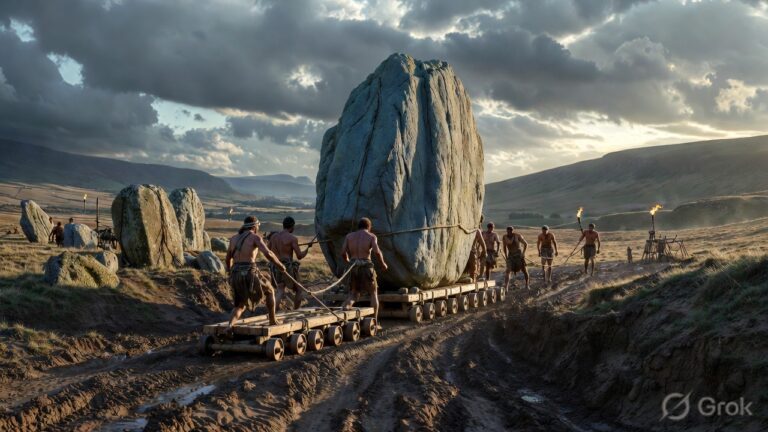
Others think the stones were hauled on wooden sledges or rollers, pulled by large teams of people.
Experimental archaeology has shown that with enough workers and wooden frameworks, even massive stones can be moved surprisingly efficiently.
Still, the journey would have been incredibly demanding.
The Human Effort Behind the Monument
Imagine a group of Neolithic workers standing in the hills of Wales more than 5,000 years ago.
They quarry a massive stone weighing several tons.
Using simple tools made from wood and stone, they shape the rock, secure it onto a wooden sledge, and begin the slow journey east.
The trip could have taken months or even years.
Entire communities may have participated, turning the transport of each stone into a ceremonial procession across the landscape.
By the time the stones arrived on Salisbury Plain, they were no longer just building materials.
They had become symbols of shared effort, belief, and identity.
What This Means for Stonehenge History
The new mineral evidence does not answer every question about Stonehenge.
But it does reshape the way historians view the monument.
Instead of seeing it as a structure partly created by natural forces, researchers now see it as an example of astonishing human ambition.
The builders of Stonehenge were not simply arranging stones that happened to be nearby.
They were organizing long-distance engineering projects thousands of years before modern construction techniques existed.
That realization has changed how archaeologists view the societies that built the monument.
These communities were far more sophisticated than many earlier theories suggested.
The Mystery That Remains
Even with new evidence, one major mystery remains unsolved.
Exactly how the stones were transported is still unclear.
Researchers continue to explore possibilities including:
- River transport using wooden boats
- Rolling stones on wooden logs
- Dragging stones on sledges over prepared tracks
The truth may involve a combination of methods.
Some experts believe we may never know the precise technique used.
But one thing now seems far more likely.
The builders themselves did the work.
A Reminder About Ancient Human Capability
For decades, some scientists preferred the glacier explanation because it seemed easier than imagining prehistoric engineering on such a scale.
But archaeology has repeatedly shown that ancient societies were capable of astonishing feats.
From the pyramids of Egypt to the megalithic temples of Malta, ancient builders achieved extraordinary things with simple tools.
Stonehenge may belong on that same list.
The new mineral evidence does not diminish the monument’s mystery.
Instead, it makes the story even more impressive.
Important Disclaimer
The findings discussed in this article are based on recently published geological and archaeological research. While the mineral analysis strongly challenges the glacier transport theory, scientific debate continues regarding the exact methods used to move the stones. New discoveries may further refine or expand our understanding of Stonehenge’s construction.
FAQs
What are the bluestones at Stonehenge?
Bluestones are smaller stones used in the monument that originate mainly from the Preseli Hills in Wales.
How far were the stones moved?
Many bluestones traveled around 140 miles from western Wales to Salisbury Plain.
What theory was recently challenged?
The glacial transport theory suggested Ice Age glaciers carried the stones near the site. New mineral evidence challenges that idea.
How did scientists test the glacier theory?
Researchers analyzed microscopic mineral grains in sediments around Stonehenge to see whether glaciers had deposited materials there.
Do scientists know exactly how the stones were moved?
No. Possible methods include sledges, rollers, and boat transport, but the precise technique remains uncertain.
Reference Sources and Incident Coverage
https://phys.org/news/2026-01-grains-sand-people-glaciers-stonehenge.html
https://www.popularmechanics.com/science/archaeology/a70192167/stonehenge-movement

0 Comments