





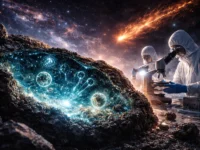










For more than a century scientists asked the same bold question: must life always be built from carbon? New papers and growing laboratory work show the answer may be more open than we thought. Researchers now map out realistic chemistry where silicon — the metal-like element that builds our computer chips and rocks — could play the central role in alien biology. This is not science fiction spun from thin air. It’s careful chemistry, computer models, and lab work nudging open a door to an entirely different kind of life.
(Why this matters: if life can arise from silicon, worlds we thought dead suddenly look alive. And the hunt for life beyond Earth must widen its rules.)
What does “silicon-based life” mean?
On Earth, every living thing is woven from carbon. Carbon atoms link into long chains and rings, forming proteins, fats, sugars and DNA. Carbon is a chemical superstar: small, flexible, and able to form many kinds of stable bonds in water at ordinary temperatures.
Silicon sits below carbon on the periodic table. Like carbon, silicon can bond to four partners. But silicon’s chemistry behaves differently. Silicon prefers to form strong bonds with oxygen (think of rocks and silica) and its silicon–silicon bonds are weaker than carbon–carbon ones. That’s why Earth’s silicon usually ends up in solid minerals rather than oily, flexible molecules.
“Silicon-based life” is the idea that, in the right environment, organisms could use silicon (or silicon-containing compounds) for the structural and chemical tasks that carbon handles on Earth. That could mean liquids other than water, hotter or drier worlds, or entirely exotic chemistries that let silicon form stable, information-bearing molecules.
Why scientists are revisiting silicon now
Several reasons push silicon back into the spotlight:
- Better chemistry models. Modern computational chemistry gives clearer answers about which silicon molecules could be stable and reactive in different conditions. These models show more possible silicon chemistries than older, simpler analyses suggested.
- Lab breakthroughs in organosilicon chemistry. Chemists have made many silicon-containing organic compounds and learned how silicon behaves inside complex molecules. Directed evolution and enzyme engineering have even begun to manipulate silicon–carbon chemistry in the lab, narrowing gaps between inert rock and living chemistry. Recent synthetic-biology work hypothesizes paths to incorporate silicon more deeply into biology.
- Looking beyond watery Earth-like worlds. Telescopes and probes reveal environments very different from Earth — hot moons, sulfur-rich surfaces, and hydrocarbon seas. Some of these places might favor silicon chemistry over carbon chemistry. Papers now explore moons and exoplanets where silicon compounds are more mobile and reactive.
Taken together, this research doesn’t prove silicon life exists — but it makes the idea scientifically respectable again.
Two clear scenarios where silicon life might work
1. Hot, dry worlds with silane chemistry
On a hot, low-oxygen planet, silicon atoms could form chains analogous to carbon chains — called silanes. In very high temperatures or in non-water solvents, such molecules might stay stable long enough to evolve complexity. Recent analyses and reviews map how silanes could replace hydrocarbons under the right conditions.
2. Surface or subsurface worlds rich in silicon and unusual solvents
On worlds with little free oxygen but abundant silicon compounds — or places with solvents other than water — silicon could do things carbon does on Earth. For example, mineral surfaces can catalyze reactions and provide templates for molecular assembly. Some researchers point to volcanic, sulfur-rich moons as interesting test cases.
What silicon life would likely look like (not Hollywood)
If life used silicon as its backbone, expect major differences:
- Stiffer structures: Silicon bonds with oxygen form strong crystalline frameworks. Organisms might be tougher and slower-moving, with hard, glassy tissues rather than soft flesh.
- Different metabolisms: Silicon organisms may exchange gases and minerals very differently. Their “breathing” could involve silicon oxidation, sulfur compounds, or exotic electron carriers instead of oxygen and carbon dioxide.
- Slow chemistry or high heat: Silicon reactions are often slower at Earth temperatures. Silicon life might be adapted to slow, patient metabolism, or it could thrive in hotter environments where silicon chemistry becomes faster and more versatile.
- Alternative solvents and information molecules: Rather than water and DNA, silicon life might use non-water solvents (e.g., molten salts, supercritical fluids) and other molecules to store information and catalyze reactions.
Limits and the big challenges
Why is carbon so dominant on Earth? Because it’s uniquely suited to form many stable, varied molecules in water at moderate temperatures. Silicon struggles to make the same diversity of durable molecules under these conditions. Two major hurdles are:
- Silicon–silicon and silicon–hydrogen bonds are weaker or less convenient for building flexible, information-carrying polymers.
- Silicon locks into silica (rock) when oxygen is present, making it less available in liquid form on rocky planets with oxygenated atmospheres.
Recent studies make clever counterarguments, however: in oxygen-poor settings, or with different solvents and temperature ranges, some of those hurdles shrink. Computational chemistry shows pathways where silicon-based polymers could carry out complex chemistry, and lab work shows enzymes can sometimes handle silicon chemistry when evolved or engineered carefully.
Why this view changes where we look for life
Most life-search missions focus on Earth-like biosignatures: oxygen, methane out of balance, organic molecules. If silicon-based life is plausible, we should also search for:
- Unusual mineral patterns or crystalline growths that suggest structured, repeating complexity not explained by geology.
- Gas mixtures outside expected chemical equilibria, especially on hot moons or exoplanets.
- Silicon-containing organics visible in plume samples or atmospheric spectra.
In short, we must broaden our toolbox and open our minds to new signatures when examining alien worlds.
How scientists test these ideas today
- Computer modeling: Modern quantum chemistry evaluates candidate silicon molecules and their likely reactions in alternative solvents and temperatures. These models started the recent revival.
- Lab synthesis: Chemists produce organosilicon molecules and study their stability and reactivity under controlled conditions. Synthetic-biology teams are experimenting with enzymes that interact with silicon bonds.
- Planetary studies: Scientists study moons and exoplanets with conditions that could favor silicon chemistry, such as sulfur-rich atmospheres, high heat, or low oxygen.
All three paths feed one another: models suggest molecules to try in the lab; lab results refine models; planetary data says where such chemistry might matter.
Disclaimer
This article presents current scientific thinking and credible studies that explore silicon-based biochemistry. It does not claim that silicon life has been found. The research is speculative but grounded in real chemistry, modeling, and laboratory experiments. Any real discovery would require direct, repeatable evidence from samples or telescopic spectra, plus careful elimination of geological and chemical explanations.
FAQs
Q: Has silicon life been discovered?
A: No. Scientists have not found silicon-based life. Current work explores whether it could be possible and where to look.
Q: Could silicon life exist on Mars?
A: Mars has a lot of silica and oxidized minerals, and oxygen makes silicon lock into rock. That makes Mars a less likely host for silicon-based life than some very hot or oxygen-poor worlds.
Q: Where would scientists expect silicon life if it existed?
A: On hot, oxygen-poor planets or moons rich in silicon compounds, or in environments with unusual solvents and high temperatures where silicon chemistry is more active.
Q: Would silicon life look like robots or crystals?
A: Not like machines, but likely more mineral-like and slower than Earth life. Think hardy, crystalline, or semi-solid organisms rather than soft animals.
Q: Will this change the search for alien life?
A: Yes. It means looking for new kinds of chemical signatures and being open to non-organic patterns that might signal life.
What to watch for next (how this field may move)
- More targeted lab experiments that attempt to build stable silicon polymers or enzymes that work with silicon–carbon bonds.
- Planetary missions sampling plumes or atmospheres (for example of icy moons or exoplanet spectroscopy) that can seek silicon-rich organics.
- Refined computer models predicting clear spectral or mineral signatures that telescopes can test. Recent reviews and papers make these predictions more concrete.
How this affects the big picture
If silicon life is possible, it expands the number of worlds where life could arise. Habitability is no longer a narrow checklist of Earth-like conditions. It becomes a broad field where geology, chemistry, temperature and solvents play together to make life in many strange forms. The discovery of a silicon-based organism would be one of the most profound moments in human history — a total rewrite of biology textbooks and a deepening of the sense that life is a robust, cosmic process.
Final, plain-language take
Silicon-based life remains a distant idea — but one worth taking seriously. Modern chemistry, computing power, and synthetic-biology experiments show pathways that are scientifically plausible under certain conditions. The search for life should be flexible: more eyes on more kinds of signals, more clever lab tests, and an open mind about what “life” can be. The universe may be stranger — and more exciting — than we’ve given it credit for.
Sources and further reading (reference URLs)
Below are accessible sources used to prepare this article. They explain the chemistry, modeling, and recent scholarly thinking that make silicon-based life a live scientific question.
- Petkowski, J. J., et al., On the Potential of Silicon as a Building Block for Life — review of silicon biochemistry possibilities. PMC (open access).
https://www.ncbi.nlm.nih.gov/pmc/articles/PMC7345352/ - ResearchGate — Challenges and possibilities of silicon-based life (January 2024).
https://www.researchgate.net/publication/377266623_Challenges_and_possibilities_of_silicon-based_life_Exploring_an_alternative_to_carbon - MDPI / ArXiv — Silicon Is the Next Frontier in Plant Synthetic Biology (2025), hypotheses for silicon integration in biology.
https://www.mdpi.com/2674-0583/3/3/12
https://arxiv.org/pdf/2503.09979.pdf - Journal article / papers on silane and silicon-based life concepts (2025 preprints and model studies). Example discussion of silanes replacing hydrocarbons.
https://www.researchgate.net/publication/391901919_Evaluating_Silicon-Based_Life_Could_Silanes_Replace_Hydrocarbons_in_Extraterrestrial_Organisms - Papers and articles exploring moons and environments where silicon chemistry might be favored (examples and reviews).
https://journals.le.ac.uk/index.php/jist/article/view/4953

0 Comments