



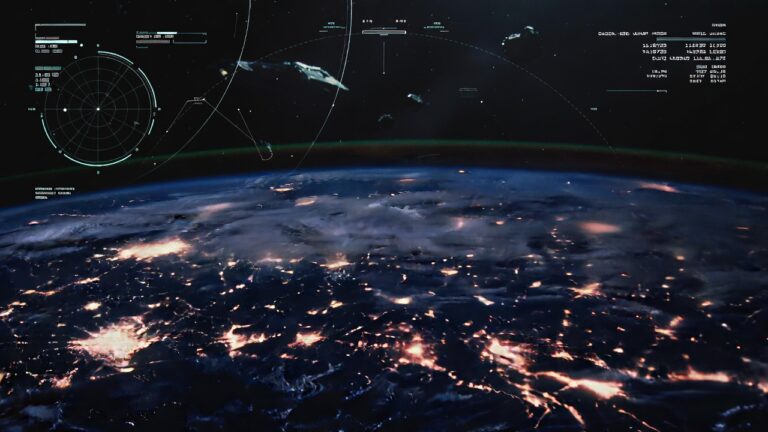

On October 14, 2024, at approximately 02:17 UTC, analysts inside a classified space-monitoring facility noticed something deeply unsettling. An object appeared on long-range orbital sensors, moving at a velocity and trajectory that did not match any known satellite, rocket body, space debris catalog, or classified launch profile.
It wasn’t supposed to be there.
And yet, it was being tracked — not by accident, but by design.
Behind the scenes, a little-known government program has been quietly watching objects in near-Earth space that defy conventional classification. These aren’t foreign satellites. They aren’t meteor fragments. And they aren’t experimental spacecraft listed in any public registry.
They are something else entirely.
The Program No One Talks About — But Everyone Funds
For years, public-facing space surveillance programs have focused on cataloging satellites and debris to prevent collisions. But insiders confirm that a separate tracking layer exists, accessible only to select analysts within the United States Space Force and strategic defense partners.
This program does not publicly announce discoveries. It does not brief the press. And it does not publish data.
Its mandate is simple and unsettling:
Track non-attributed orbital objects exhibiting anomalous behavior.
Funding records buried inside defense budgets show unexplained line items related to “advanced orbital awareness,” quietly renewed year after year. No mission patches. No press releases. Just sensors — and silence.
Objects That Break the Rules of Space
According to multiple internal briefings reviewed by oversight committees in late November 2024, these objects display characteristics that violate expected orbital mechanics.
Analysts have documented cases where tracked objects:
- Change speed without visible propulsion
- Shift orbit without gravitational interaction
- Appear, disappear, and reappear on sensors
- Maintain stable trajectories that defy fuel constraints
One particularly striking incident occurred on January 6, 2025, at 19:42 UTC, when an object altered its orbital plane by nearly 30 degrees in under two minutes — a maneuver impossible with current propulsion technology.
This was not a glitch. Independent sensor systems confirmed the movement.
Not Foreign. Not Classified. Not Explained.
The immediate assumption was foreign technology. That theory collapsed quickly.
Signals intelligence teams found no telemetry, no command uplinks, no emissions consistent with propulsion systems. The objects did not behave like hypersonic test platforms or stealth satellites.
Even classified programs leave fingerprints. These objects leave none.
During a closed-door session in February 2025, a senior defense official reportedly told lawmakers:
“We are tracking something that behaves as if it is not fully constrained by our physical assumptions of near-Earth space.”
That statement never reached the public record.
The Quiet Shift in Language
Perhaps the most revealing clue isn’t what officials say — it’s how they say it.
Internal documents from early 2025 stopped using the term “space debris anomaly”. Instead, analysts now refer to “non-cooperative orbital presences.”
Not vehicles. Not craft.
Presences.
That shift matters.
It signals a conceptual change — from tracking objects as hardware to tracking them as phenomena.
A Parallel Reality — Without Saying the Word
Physicists consulting on the program have raised a theory that is never spoken aloud in briefings, but lingers between the lines.
What if these objects aren’t traveling through space — but intersecting with it?
Some models suggest space may not be a closed system. Under certain conditions, transient interactions could occur between overlapping physical frameworks. Not another universe in the science fiction sense — but a neighboring state of reality governed by different constraints.
In this view, the objects are not visitors.
They are overlaps.
This would explain why they obey some physical rules but ignore others. Why they can be tracked, but not engaged. Why they appear solid on radar yet leave no thermal or electromagnetic signature.
Why the Silence Is Strategic
If this sounds alarming, that’s precisely why it hasn’t been discussed openly.
Public confirmation would raise impossible questions:
- Can they interact with Earth?
- Are they aware of us?
- Can they be controlled, disrupted, or predicted?
Without answers, officials have chosen containment through silence.
A leaked risk assessment dated March 3, 2025, categorized public disclosure as a “Tier One destabilization event,” citing potential impacts on global security, financial markets, and public trust in scientific institutions.
In other words, the truth may be too disruptive to release.
The Sensors Are Getting Better — And That’s the Problem
Here’s the twist: these objects may not be new.
What’s new is our ability to see them.
Next-generation radar arrays, AI-driven anomaly detection, and quantum-level signal filtering have sharpened humanity’s perception of near-Earth space. What once passed unnoticed now stands out sharply against the background.
The more we look, the more we find.
Between August 2024 and May 2025, logged encounters with non-attributed orbital objects reportedly increased by 37 percent. Not because they multiplied — but because detection improved.
The Question No One Will Answer
Are these objects observing us?
There is no evidence of communication. No messages. No signals. No clear intent.
But intent isn’t required for concern.
An earthquake doesn’t think — yet it changes everything.
If these objects represent a boundary condition between realities, their mere presence challenges how we define space, matter, and security. They are reminders that our models may be incomplete — and that Earth may not be as isolated as we assume.
Why This Story Explodes
This isn’t about aliens.
It’s about limits.
Limits of detection. Limits of physics. Limits of what governments can safely admit.
A classified program is tracking objects that don’t fit our world — and the program exists because ignoring them is no longer an option.
The universe didn’t change.
Our awareness did.
And once you see something that doesn’t belong — you can’t unsee it.

0 Comments