



















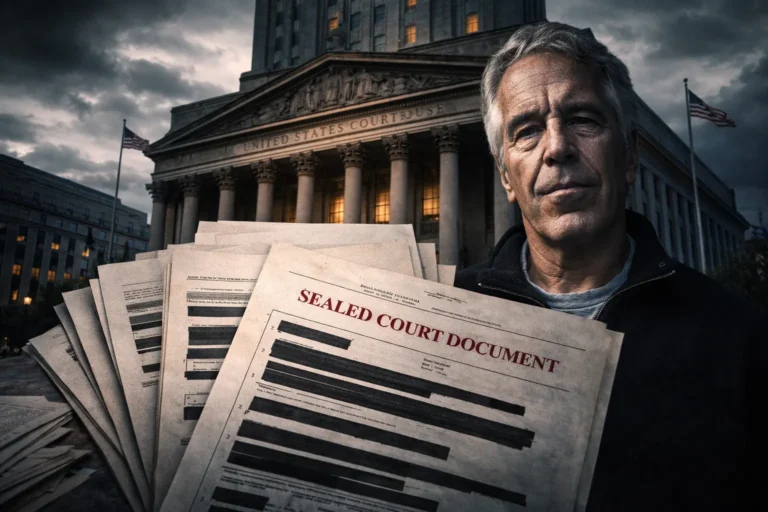
In courtrooms across the United States, paper moves slowly. Motions are filed. Names are redacted. Pages are sealed. And sometimes, entire sections of the record remain hidden from public view.
Few cases in recent memory have generated as much sustained public scrutiny as that of Jeffrey Epstein. Years after his 2019 arrest and subsequent death in federal custody, questions about court documents, sealed filings, and redacted names continue to surface.
But what exactly remains sealed? Why do courts keep certain pages hidden? And what does the law actually say about public access to federal records?
This is not a story about rumors. It is a story about process, transparency, and the legal boundaries that govern what the public can — and cannot — see.
A Case That Refuses to Close

When federal prosecutors in the Southern District of New York unsealed charges against Epstein in 2019, the case immediately reignited public attention around a plea agreement he had reached years earlier in Florida.
After Epstein’s death, the legal spotlight shifted. Focus turned to associated court filings, civil lawsuits, flight logs, and related proceedings involving individuals such as Ghislaine Maxwell, who was later convicted in federal court.
As judges reviewed civil and criminal filings, thousands of pages became part of the public record. But not all of them.
Some pages were redacted. Others were sealed entirely. And in a system built on public accountability, that has fueled ongoing debate.
What Does “Sealed” Actually Mean?
In federal court, documents are generally presumed to be public. The U.S. legal system operates under a tradition of openness. But that presumption is not absolute.
Judges may seal records to:
- Protect the privacy of victims
- Safeguard ongoing investigations
- Prevent disclosure of sensitive personal data
- Shield information that could compromise due process
- Protect minors
- Maintain national security in rare cases
Sealing is not automatic. It requires judicial approval.
In the Epstein-related proceedings, judges in the Southern District of New York weighed competing arguments from media organizations seeking transparency and from attorneys arguing for privacy protections.
This balancing act is common in high-profile cases.
The Timeline of Document Releases
The public first gained significant insight into the broader network surrounding Epstein through civil litigation. One of the most closely watched cases involved a defamation lawsuit connected to earlier allegations.
In early 2024, additional names were unsealed as part of court-ordered disclosures. It is critical to note that being named in court documents does not imply criminal wrongdoing. Courts often include names in filings because individuals were mentioned in testimony, correspondence, or depositions — not because they were charged.
As pages were released in phases, some were heavily redacted. Others remained sealed pending judicial review.
Why the staggered approach?
Because courts must review documents line by line before determining whether privacy interests outweigh public access.
That process takes time.
Why Some Pages Remain Hidden
Several factors continue to influence sealed portions of the record:
1. Victim Protection
Federal courts prioritize protecting the identities of victims, especially in cases involving allegations of sexual exploitation. Even when documents are partially released, identifying details are frequently removed.
2. Third-Party Privacy
Many names appear in filings because they were mentioned during testimony. Courts often consider whether releasing certain names would cause unfair reputational harm.
3. Ongoing Legal Sensitivity
Although major criminal proceedings have concluded, related civil actions and appeals have required careful judicial management of the record.
4. Redaction Standards
Redaction does not necessarily mean concealment of wrongdoing. It often reflects compliance with federal privacy rules covering addresses, birth dates, Social Security numbers, and other identifying details.
Public Access vs. Privacy: The Legal Tension
The U.S. Supreme Court has long recognized a qualified First Amendment right of access to court proceedings. However, that right is not unlimited.
Judges must weigh:
- The public’s right to know
- The defendant’s right to a fair trial
- The privacy rights of victims
- The reputational interests of uncharged individuals
In high-profile cases, that tension intensifies.
Media organizations have repeatedly petitioned courts to unseal additional documents connected to Epstein-related litigation. In several instances, judges agreed in part — but not entirely.
Transparency advocates argue that public trust depends on openness.
Privacy advocates counter that reckless disclosure could cause irreversible harm.
Both arguments carry weight in federal court.
The Impact on Public Trust
The Epstein case unfolded during a period of heightened public skepticism toward institutions. When records remain sealed, suspicion often fills the vacuum.
This dynamic is not unique to this case. In any matter involving powerful individuals, delayed disclosure can amplify speculation.
But speculation is not evidence.
The judiciary operates on procedural timelines, not public demand cycles. Sealing decisions often reflect legal caution rather than concealment.
Still, perception matters.
When documents emerge in waves, it can create the impression that something larger is being withheld — even when judicial reasoning is documented in written orders.
Understanding Federal Sealing Procedures
Here’s how sealing typically works:
- A party files a motion to seal.
- The judge reviews arguments from both sides.
- Media outlets may intervene to challenge sealing.
- The court issues a written order explaining its decision.
In some instances, documents are temporarily sealed pending review. In others, redactions are ordered before release.
Sealing can also be revisited later. Judges retain authority to unseal materials if circumstances change.
This is why document releases sometimes occur years after initial filings.
What Has Been Released So Far?
Publicly available records now include:
- Portions of civil deposition transcripts
- Court rulings and motions
- Lists of individuals mentioned in testimony
- Trial transcripts from Maxwell’s prosecution
It is essential to reiterate: appearing in court records does not mean an individual was charged with a crime.
Many names appear because they were discussed in testimony, not because of proven misconduct.
Why Courts Move Slowly in High-Profile Cases
High-profile cases require heightened scrutiny.
Judges know their decisions will be examined closely. Errors in redaction could expose sensitive information. Premature disclosure could violate privacy laws.
The Southern District of New York, where much of the Epstein-related litigation occurred, is one of the busiest and most scrutinized federal courts in the country.
Judicial caution is often deliberate.
The Broader Transparency Debate
Beyond this specific case lies a larger question: How open should courts be when cases involve powerful individuals?
Open courts are foundational to democracy. Yet the justice system also exists to protect rights — including the rights of those not charged with crimes.
The Epstein filings sit at the center of that debate.
Advocates for transparency argue that sunlight prevents institutional failure.
Defenders of judicial discretion argue that fairness requires restraint.
Both positions shape ongoing sealing decisions.
Where Things Stand Now
As of 2026, no sweeping announcement has indicated that all remaining sealed materials will be released.
Some filings remain under court protection. Others may eventually be unsealed if judges determine that privacy concerns no longer outweigh public interest.
Legal experts note that full transparency is rare in complex federal litigation.
Sealed does not necessarily mean permanent.
But it also does not guarantee eventual release.
The Psychology of Secrecy
When documents remain hidden, human nature tends to assume the worst.
This psychological response is amplified in cases involving wealth, influence, and institutional power.
Yet the legal system does not operate on narrative arcs. It operates on statutes, precedent, and judicial reasoning.
Understanding that distinction is crucial.
What We Know — and What We Don’t
We know that thousands of pages connected to Epstein-related litigation have been released over the past several years.
We know that courts have issued written orders explaining certain redactions.
We know that privacy protections for victims remain a priority.
What we do not know is whether any future court decision will significantly expand public access.
That determination rests with federal judges — not media outlets, not public speculation, and not political pressure.
Frequently Asked Questions
Why are some Epstein court records sealed?
Federal judges may seal documents to protect victims, safeguard privacy, or prevent undue reputational harm to individuals not charged with crimes.
Does being named in court filings mean someone committed a crime?
No. Court filings often include names mentioned during testimony or correspondence. Inclusion does not imply criminal wrongdoing.
Can sealed documents ever be unsealed?
Yes. Courts can revisit sealing decisions. Some documents previously sealed have later been released with redactions.
Why were documents released in phases?
Judges often review filings individually before determining what can be made public. This process can take months or years.
Are all Epstein-related cases closed?
The main criminal case ended following Epstein’s death. Related proceedings, including Maxwell’s conviction and civil litigation, have concluded or moved through appeals, but document management continues.
A Case That Continues to Echo
The mystery surrounding sealed pages is less about hidden narratives and more about legal process.
Federal courts move carefully. They weigh competing interests. They document their reasoning in written orders.
For many observers, the pace feels slow.
For the judiciary, caution is part of the job.
Whether additional pages will eventually be unsealed remains uncertain. What is clear is that the debate over transparency, privacy, and public trust is far from over.
In the end, the sealed pages represent something larger than one case.
They reflect the tension at the heart of democratic justice: how much the public deserves to see — and how much the law requires to remain protected.

0 Comments