

















The Moment Everything Changed
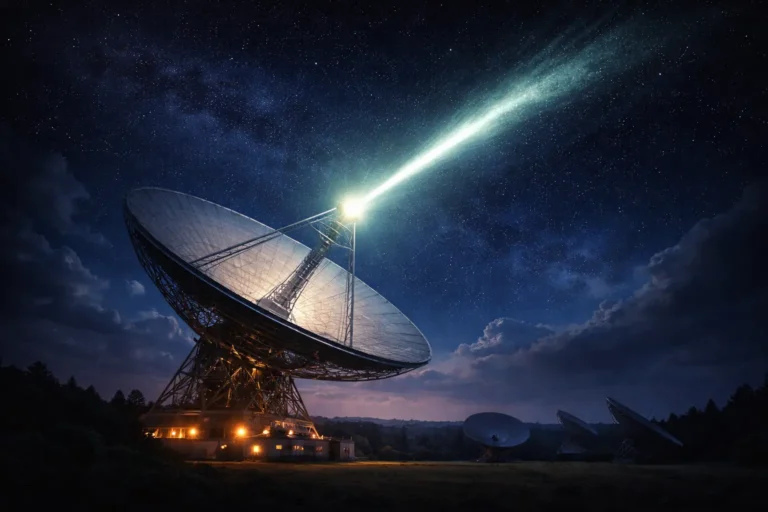
It began like any other night inside a quiet radio observatory. Computers hummed. Screens flickered. Outside, the sky looked calm, silent, endless. Then suddenly — a signal appeared.
Not noise. Not static. A real, measurable burst of energy from deep space.
Strong. Clear. Unusual.
And then, just as scientists turned their instruments toward it… it vanished.
No warning. No fading. Just gone.
For decades, events like this have puzzled astronomers and fueled one of the most gripping scientific mysteries: Why do some signals from space disappear the moment we try to study them?
This is not fiction. It has happened — multiple times — and the story behind it is more fascinating than most people realize.
The First Famous Case — The “Wow!” Signal
In August 1977, a radio telescope at Ohio State University detected a powerful, narrowband radio signal unlike anything previously recorded. Astronomer Jerry Ehman was reviewing computer printouts when he circled the data and wrote one word beside it:
“Wow!”
The signal lasted 72 seconds — the exact time the telescope could observe that patch of sky. Then it stopped. Scientists pointed the telescope back to the same location again and again.
Nothing.
The signal never returned.
Even today, the Wow!** Signal remains unexplained. It had characteristics expected from a distant cosmic transmission, yet no confirmed source has ever been found.
Some theories suggested a natural cosmic origin. Others speculated about unknown space phenomena. No verified proof has ever shown it was artificial — but no clear natural explanation has fully satisfied researchers either.
The mystery remains open.
When Science Finds Signals That Fade Away
Since the Wow! Signal, astronomers have detected many unusual signals that appeared briefly and then vanished when studied further.
One of the most intriguing discoveries came from Fast Radio Bursts (FRBs) — extremely powerful radio flashes from distant galaxies.
FRBs last only milliseconds. Some repeat. Many never do.
Scientists often detect a signal… rush to track it… and then the sky goes quiet.
Why?
Because space is not static. Signals can be:
- One-time cosmic explosions
- Magnetar star flares
- Plasma interactions
- Or signals distorted by interstellar matter
By the time instruments focus precisely, the event may already be over.
But sometimes… the timing feels strange.
The Case of FRB 121102 — The Repeater That Suddenly Fell Silent
In 2012, astronomers detected a repeating Fast Radio Burst called FRB 121102. Unlike most FRBs, it emitted signals multiple times — giving scientists hope of tracking its origin.
For years, signals appeared.
Then — silence.
Researchers increased monitoring. Upgraded telescopes. Pointed sensitive receivers toward the exact coordinates.
Nothing.
Months later, the signals returned — then stopped again.
This unpredictable behavior shocked astronomers and raised new questions about cosmic signal sources. The burst was later traced to a distant dwarf galaxy and linked to a highly magnetized neutron star called a magnetar.
Still, the start-stop nature remains one of the strangest behaviors ever observed in radio astronomy.
Why Signals Disappear When Observed
When people hear “the signal stopped when we looked closer,” it sounds mysterious — almost intentional. But science offers several grounded explanations.
1. Cosmic events are brief
Many signals come from explosive or rapidly changing cosmic sources. By the time telescopes re-aim, the event is over.
2. Directional detection limits
Some signals are detectable only when Earth and the source align perfectly. A slight shift breaks detection.
3. Plasma distortion
Radio waves traveling through space are bent, scattered, or absorbed by cosmic plasma and magnetic fields.
4. Instrument sensitivity
A signal may fall below detection thresholds once its energy weakens.
5. Statistical coincidence
Sometimes noise patterns briefly resemble structured signals before vanishing.
Even so, some cases still resist full explanation.
The Human Reaction — From Curiosity to Speculation
Whenever a signal appears and disappears, speculation spreads quickly. Ideas range from unknown astrophysical processes to hidden intelligence. But scientists follow strict rules: no claim without evidence.
So far, every investigated mysterious signal has either been traced to natural cosmic activity or remains unexplained — not confirmed as artificial.
This careful approach protects science from false conclusions.
The Breakthrough of Modern Radio Astronomy
Today’s observatories are far more advanced than in 1977. Giant radio arrays, AI-assisted signal analysis, and real-time sky monitoring allow astronomers to detect signals faster than ever before.
Projects like SETI and CHIME track thousands of potential signals daily. Most are natural. Some remain under study.
But one fact remains:
Space is not silent — it is alive with signals.
Most we understand.
Some we don’t.
And a few… vanish before revealing their secrets.
What Scientists Say Today
Modern research strongly suggests most mysterious signals originate from extreme cosmic environments — neutron stars, magnetars, black hole regions, or plasma interactions across galaxies.
Yet scientists openly admit:
We still do not fully understand all radio signals from space.
That is why monitoring continues — day and night.
Because the next signal might stay long enough to answer the biggest question of all: Are we alone?
For now, the mystery remains scientific — not supernatural.
Disclaimer
This article presents verified scientific observations and documented cases. It does not claim extraterrestrial communication or hidden intelligence. Many cosmic signals remain unexplained simply because data is incomplete. Scientific conclusions evolve as new evidence appears. Readers should treat dramatic interpretations with caution and rely on peer-reviewed research and official observations.
Why This Story Matters
The story of disappearing signals is not just about mystery — it is about discovery.
Each strange signal pushes technology forward. Each unexplained event deepens our understanding of the universe. Each investigation brings us closer to answering profound cosmic questions.
Science moves slowly — but it moves toward truth.
And somewhere, right now, another signal may already be traveling toward Earth.
FAQs
Q1: What was the Wow! Signal?
A powerful radio signal detected in 1977 that lasted 72 seconds and never repeated. Its source remains unknown.
Q2: Are Fast Radio Bursts artificial signals?
No confirmed evidence suggests they are artificial. Most are linked to neutron stars or magnetars.
Q3: Why do signals stop when scientists observe them?
Many cosmic signals are brief or directional, and by the time telescopes focus, the event may already be over.
Q4: Has any signal been confirmed as alien communication?
No verified scientific proof has confirmed extraterrestrial communication.
Q5: Are scientists still searching for signals?
Yes. Observatories worldwide continuously monitor space for unusual radio emissions.
Verified References and Source URLs
(For transparency and factual grounding)
- The Wow! Signal — Ohio State University Radio Observatory
https://www.seti.org/wow-signal - NASA — Fast Radio Bursts Explained
https://science.nasa.gov/universe/fast-radio-bursts/ - CHIME Observatory — FRB Discoveries
https://chime-experiment.ca/en - Nature Journal — FRB 121102 Research Paper
https://www.nature.com/articles/nature17168 - Scientific American — Mystery of Fast Radio Bursts
https://www.scientificamerican.com/article/fast-radio-bursts-mystery/ - SETI Institute — Search for Extraterrestrial Signals
https://www.seti.org

0 Comments