


















By Ronald Kapper
Disclaimer (must read): This article summarizes published reports, official imagery, news investigations, and scientific studies. Some incidents remain unresolved despite multiple sensor reports. The goal here is careful reporting: to present facts, competing explanations, and credible sources so readers can judge evidence for themselves.
Why radar matters
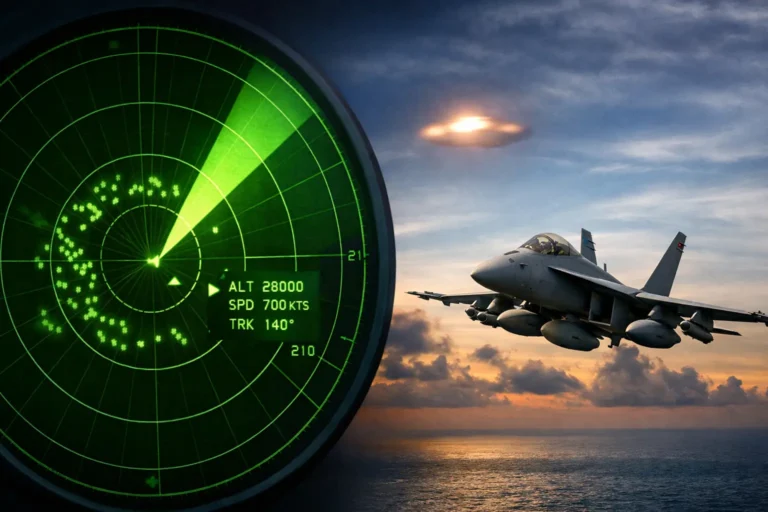
Radar is the hard evidence in many UAP (unidentified aerial phenomena) reports. Unlike eyewitness accounts that vary, radar gives a machine-recorded trace: distance, bearing, track history, and sometimes speed or altitude. When a strange object lights up a radar screen, operators notice patterns — sudden appearances, rapid accelerations, loops, or disappearing-and-reappearing returns. Those patterns are the focus of this piece: what they look like, why they occur, and how professional analysts evaluate them.
What reporters and military operators often describe
When military crews or civilian air-traffic controllers report UAP-related radar returns, certain repeating features turn up in their descriptions:
- Sudden appearance and disappearance — a return that appears on the scope without an obvious originating contact and then drops off the display for no clear reason.
- Erratic track lines — abrupt changes in bearing or range that don’t fit normal flight profiles.
- High radial velocity or speed estimates — sometimes returns imply speeds well beyond known aircraft capabilities (though these speed readings can be affected by angle and sensor modes).
- Multiple sensor corroboration — the most compelling cases involve visual sightings, infrared (FLIR) video, and primary or secondary radar returns all showing related behavior.
The 2004 carrier strike-group incidents are a clear example where operators, pilots, and sensors all reported the same unusual behavior. USS Nimitz. Reporting and public investigations into these events helped push radar anomalies into mainstream attention.
Classic cases that shaped understanding
The Nimitz / “Tic Tac” case (2004)
During training operations off the southern California coast, Navy radar operators recorded intermittent contacts that appeared and vanished and showed strange altitude and speed behavior. Pilots scrambled and later described a white, fast-moving object that matched no known aircraft profile. That incident includes radar traces, pilot testimony, and cockpit sensors — the combination that makes it noteworthy.
Gimbal and GoFast (2015) — cockpit/infrared + radar contexts
Shortly after, videos recorded by Navy sensors (commonly labeled “Gimbal” and “GoFast”) entered public view. These clips, and the subsequent reconstruction attempts, highlighted how infrared imagery and radar (or commercial flight-data overlays) can tell different parts of the same story, and also how interpretation depends on sensor calibration and geometry.
Official imagery and recent reviews
The U.S. government’s own repositories and analysis summaries (for example from agencies collecting UAP imagery) show that many cases involve radar tracks that line up with other sensor data or commercial flight records — and many cases are resolved once that full context is added. The official analysis of some clips concluded that a visible infrared return matched distant commercial traffic when overlayed with flight data. Still, several cases remain officially unresolved.
What a “radar pattern” actually is — the science, simply put
Radar systems send radio pulses and listen for echoes. The echo strength, time delay, and direction tell the system where an object is and how strong the reflection is. But the return on screen is not a perfect photograph. It’s shaped by:
- Sensor type and settings: Primary radar gives raw echoes; secondary radar depends on transponder replies. Different modes reveal different features.
- Atmospheric conditions: Layers, temperature inversions, and humidity can bend or duct radar waves, producing false or displaced returns (known as anomalous propagation).
- Clutter and ground returns: Waves bouncing off the sea surface, precipitation, or birds create speckled backgrounds that can hide or mimic objects.
- Processing and display: Track smoothing, filtering, and antenna sweep rates influence how a moving target’s path looks on screen.
A lot of what looks like weird motion is sometimes an artifact of how the return was picked up, processed, or displayed — but not always. Scientific studies of radar echoes and anomalous propagation show mechanisms that can produce surprising patterns, yet they do not explain every recorded case.
Why some radar patterns are convincing — and why some aren’t
Convincing patterns usually share two features: sensor diversity (more than one independent instrument sees the same event) and contextual cross-checks (flight plans, radar maintenance logs, weather data). When a primary radar return, a transponder reply, an infrared image, and pilot sighting all align in space and time, the case becomes harder to dismiss.
Less convincing patterns often lack this corroboration. A single radar site during a temperature inversion, for example, can produce ring-like or patchy echoes that look like objects but are purely atmospheric. Many meteorological and maritime radar anomalies (sea clutter, ring echoes, outflow boundaries) produce striking visuals on scopes — but they’re well understood by experienced operators.
How analysts test radar anomalies
Analysts follow a standard checklist:
- Check sensor health — Was the radar calibrated? Any maintenance issues?
- Cross-check with other sensors — Did ADS-B, secondary radar, or nearby sites record the same track?
- Review environmental data — Temperature profiles, precipitation, or ionospheric effects can cause false returns.
- Overlay commercial flight and maritime data — Sometimes distant commercial aircraft or ships explain returns once ranges and geometry are calculated.
- Model propagation — Run electromagnetic propagation models to test whether ducting or refraction could explain observed shifts.
When analysts publish results, they usually show how each step strengthened or weakened the case for a genuine physical object versus a sensor artifact. The official repositories and research papers make these analysis steps visible for many public cases.
Competing explanations you’ll hear — all deserve careful weight
- Sensor error or miscalibration. Equipment sometimes fails or outputs misleading readouts.
- Anomalous propagation. Atmospheric ducting can bend radar beams and create “ghost” returns.
- Known aircraft or drones. At times, distant or small aircraft appear odd on a particular scope.
- Weather and biological returns. Birds, insects, and meteorological effects can look like small targets.
- Deliberate deception. Hoaxes or adversarial spoofing of transponders are possible, though harder to achieve against military-grade primary radar.
- Unknown technology or phenomena. A small number of incidents — backed by multiple sensors and trained observers — resist conventional explanations and remain open.
Each explanation has technical tests that either support or rule it out. Good reporting and careful analysis are the guardrails here: extraordinary claims demand clear, multi-sensor evidence.
What pattern before a UAP sighting looks like in practice
Operators report a recurring sequence in some cases:
- A faint, intermittent return appears on the edge of the sweep — often described as “popping” on the screen.
- Return strengthens and becomes trackable, sometimes with a discrete track history that shows a short burst of movement.
- Range or bearing jumps — the estimated position changes abruptly as the object moves or the radar geometry changes.
- Visual or IR cue follows — pilots or FLIR systems catch an object near where the radar placed it.
- Return disappears for minutes, then reappears, or multiple returns show coordinated movement.
It is that sequence — faint-to-strong-to-visual — that makes many operators take the report seriously and call higher command. Where only the radar appears without visual or IR confirmation, the case is weaker. Where multiple independent sensors match, the case becomes unusually compelling. Examples from public incidents match this description, which is why those cases drew sustained scrutiny.
How journalism and official agencies handle these claims now
In recent years, UAP reports that include radar data have moved from fringe to mainstream news and official review. Government studies now publish sanitized imagery and explanatory notes. Independent scientists push for raw data releases so outside teams can replicate analyses. That trend toward transparency helps reduce misinterpretation and forces more rigorous testing of radar anomalies.
FAQs
Q: Can radar be trusted as evidence for UAPs?
A: Radar is powerful because it’s machine-recorded, but it’s not infallible. Trust grows when radar data is supported by other sensors (IR, visual, ADS-B) and by environmental checks that rule out propagation errors.
Q: Do weather effects explain most radar UAPs?
A: Many radar anomalies have meteorological explanations. But not all. The most puzzling cases have multiple independent sensor confirmations and trained observers reporting the same event.
Q: Has any radar-detected UAP been proven to be extraterrestrial?
A: No verified case has been proven extraterrestrial. Some remain unresolved after careful study, but unresolved is not the same as proven alien. It simply means current data and models don’t fully explain the observation.
Q: How do I read a radar image for anomalies?
A: Look for sudden isolated blips away from normal traffic lanes, abrupt changes in a track’s direction or speed, and repeated appearances in the same location. But only trained operators can reliably interpret raw scope data — outsider interpretation can mislead.
Q: Where can I find original radar or sensor data?
A: Some official agencies and investigative journalists publish sanitized imagery and analysis summaries. Independent researchers also publish reconstructions. See the reference list below for starting points.
why this matters for safety and science
Radar patterns before UAP sightings are not just intriguing curiosities: they can signal unknown risks in controlled airspaces and reveal gaps in our detection and analysis systems. For pilots and operators, unknown radar returns are potential hazards. For scientists, unresolved radar patterns are invitations — not to sensationalize, but to study, model, and test. When governments, academia, and independent analysts share data and methods, we get closer to answers.
References and source material (for verification)
(References are listed as URLs for primary reporting and official analysis. No links inserted in the article body.)
- History Magazine — When Top Gun Pilots Tangled with a Baffling Tic-Tac-Shaped UFO (Nimitz incident overview).
https://www.history.com/articles/uss-nimitz-2004-tic-tac-ufo-encounter. - Pentagon UFO videos (public page listing FLIR/GIMBAL/GOFAST).
https://en.wikipedia.org/wiki/Pentagon_UFO_videos. - CBS News — Nimitz/Tic-Tac reporting and pilot testimony.
https://www.cbsnews.com/news/tic-tac-ufo-sighting-uap-video-dave-fravor-alex-dietrich-navy-fighter-pilots-house-testimony/. - AARO (official U.S. office) — UAP imagery and case summaries (analysis notes).
https://www.aaro.mil/UAP-Cases/Official-UAP-Imagery/. - Scientific study on anomalous radar propagation and echoes.
https://www.scirp.org/journal/paperinformation?paperid=138426. - Project Blue Book archive (historical radar sighting reports and reviews).
https://upload.wikimedia.org/wikipedia/commons/3/3b/Project_Blue_Book%2C_BBA-PBSR1-300.pdf. - NOVA / TIME coverage of recent documentary and the evolution of public and official interest.
https://time.com/7208931/what-are-ufos-pbs-documentary/.

0 Comments