









By Ronald Kapper
Editorial Disclaimer
This article explores scientific discussions related to plasma physics, self-organizing systems, and theoretical astrobiology. There is no confirmed evidence of plasma-based organisms. The material presented here is grounded in published research, laboratory experiments, and astrophysical theory. Speculative sections are clearly framed as possibilities rather than discoveries. Reference sources are listed at the end for verification.
When we picture life, we imagine something solid. We think of cells, tissues, and carbon-based chemistry. Life, as we know it, is built from atoms arranged into stable molecules. It depends on water, membranes, and genetic material.
Yet most of the visible universe is not solid at all. It is plasma.
Plasma is a superheated state of matter in which atoms lose their electrons and become electrically charged. Stars are made of plasma. Lightning is plasma. The shimmering auroras near Earth’s poles are plasma interacting with magnetic fields. Even interstellar space contains vast regions of diffuse plasma.
If plasma dominates the cosmos, a natural question arises: could life ever arise in plasma rather than in chemistry?
At first glance, the idea seems impossible. The temperatures inside stars reach millions of degrees. Molecules cannot survive in such conditions. However, some physicists have explored whether plasma can form complex, organized structures that resemble the earliest building blocks of life. The idea remains controversial, but it has not been dismissed outright.
What Makes Plasma Different
To understand the debate, it helps to grasp what makes plasma unique. In solids, atoms are tightly bound. In liquids, they flow but remain connected. In gases, atoms move freely. Plasma goes one step further. The atoms become ionized, meaning electrons separate from nuclei. The result is a sea of charged particles that respond strongly to electric and magnetic fields.
Unlike ordinary gas, plasma can form filaments, loops, and cellular patterns when influenced by electromagnetic forces. Solar flares arch in giant loops because magnetic fields shape them. In laboratory experiments, plasma can twist into intricate, long-lived formations.
This ability to self-organize is the key reason scientists even entertain the idea of plasma-based life.
Self-Organization and the First Steps Toward Life
Life depends on order. A living system maintains structure and resists disorder by processing energy. It separates itself from its surroundings while still interacting with them.
In laboratory conditions, researchers have observed plasma forming structures that appear surprisingly organized. In 2007, scientists studying complex plasma reported formations that displayed membrane-like boundaries and internal structuring. These plasma configurations behaved in ways that reminded researchers of primitive biological cells.
It is important to be clear: these were not living organisms. They did not reproduce or evolve. However, they demonstrated that plasma can spontaneously create ordered systems under the right conditions.
That observation alone keeps the discussion open.
Could Life Exist Inside Stars?
The most dramatic version of this idea suggests that plasma-based organisms might exist inside stars. This possibility has been discussed cautiously by physicists such as Freeman Dyson, who once argued that life might adapt to environments far beyond what we consider habitable.
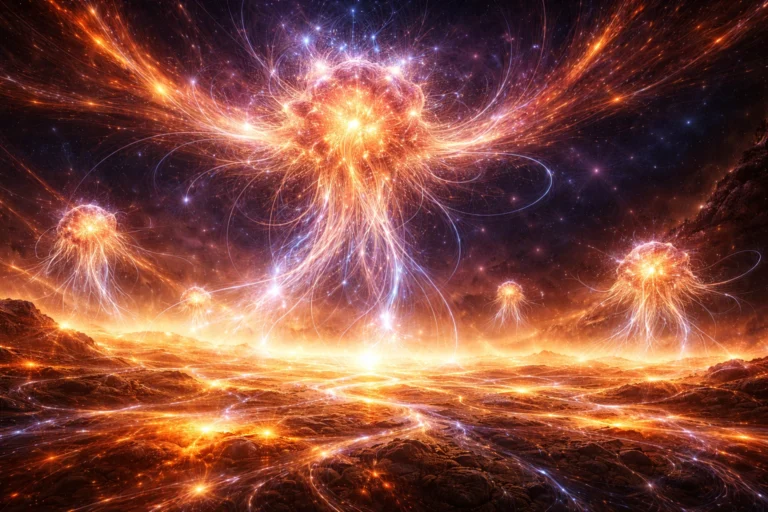
Stars contain enormous amounts of energy. They also contain structured magnetic fields and convection zones where plasma moves in large, circulating patterns. In theory, magnetic loops might create relatively stable regions within a star’s turbulent interior.
However, the challenges are immense. Temperatures inside stars would instantly destroy any chemical structure. Therefore, a plasma organism could not rely on molecules the way Earth life does. Instead, it would need to exist purely as an organized electromagnetic pattern.
Such a system would need to store information in magnetic or electric configurations rather than in DNA or proteins. At present, no evidence suggests that plasma naturally stores information in this way.
Laboratory Discoveries and Plasma Crystals
While stars represent extreme environments, laboratory plasma experiments offer a more controlled setting. Scientists have created what are known as plasma crystals, which are ordered lattices formed by charged dust particles suspended in plasma. These crystals arrange themselves into repeating geometric patterns and can persist for extended periods.
In some experiments, plasma formations have even divided into smaller structures under certain conditions. Division alone does not constitute reproduction, but it demonstrates that plasma can behave in surprisingly structured ways.
The leap from structured plasma to living plasma remains enormous. Yet the existence of self-organizing plasma formations challenges the idea that chemistry is the only path to complexity.
Energy Flow and Stability
Life requires energy, but it also requires balance. Too little energy leads to stagnation, while too much destroys structure.
Stars provide more than enough energy. The problem is maintaining stability within such an intense environment. Plasma-based organisms, if they were possible, would need to exist in zones where energy gradients are controlled rather than chaotic.
Magnetic fields might provide scaffolding for such stability. In fusion research, magnetic confinement is used to hold plasma in place. This demonstrates that plasma behavior can be guided and stabilized by electromagnetic forces.
However, long-lived structure alone is not sufficient. Life requires information storage, replication, and adaptation.
The Information Barrier
The greatest obstacle to the plasma life hypothesis is information stability. Biological systems store genetic information in molecules that are stable yet flexible enough to mutate over time. This balance allows evolution to operate.
Plasma, by contrast, is dynamic and often unstable. Charged particles move rapidly, and magnetic fields shift constantly. Maintaining a stable pattern long enough for natural selection to act would be extraordinarily difficult.
Without a mechanism for storing and copying information reliably, evolution cannot proceed. Until such a mechanism is demonstrated in plasma systems, the idea remains speculative.
Why Scientists Keep Exploring the Idea
Astrobiology has repeatedly shown that life can exist in environments once thought impossible. Organisms thrive in boiling hydrothermal vents, beneath Antarctic ice, and in highly acidic lakes. Each discovery expanded our understanding of life’s limits.
Because plasma is the most common state of visible matter in the universe, some researchers argue that it would be unwise to dismiss the possibility entirely. Even if plasma-based organisms are unlikely, exploring the concept deepens our understanding of complexity and self-organization.
Scientific progress often begins with bold questions tested carefully against evidence.
What Evidence Would Be Required
For plasma-based organisms to move from speculation to serious consideration, scientists would need to observe persistent plasma structures that display clear boundaries, internal organization, energy processing, and some form of reproduction with variation.
Such findings would need to be independently verified and repeatable. So far, no telescope observation or laboratory experiment has produced evidence meeting these criteria.
Until then, plasma life remains a hypothesis grounded in physics but unsupported by direct evidence.
Conclusion
Could plasma-based organisms exist? Based on current knowledge, there is no proof that they do. Physics shows that plasma can self-organize into complex patterns. That fact is intriguing but not sufficient to demonstrate life.
The essential ingredients of life — stable information storage, replication, and evolution — have not been observed in plasma systems.
Still, the universe is vast, and plasma dominates its visible matter. Exploring even unlikely possibilities strengthens scientific inquiry. It encourages researchers to refine definitions and remain cautious about declaring absolute limits.
For now, plasma-based organisms remain an idea at the boundary between physics and imagination. Whether that boundary will ever shift depends on future evidence.
FAQs
Q1: Has plasma life been discovered?
No. There is no confirmed evidence of plasma-based organisms.
Q2: Can plasma form organized structures?
Yes. Laboratory experiments have demonstrated plasma crystals and self-organizing plasma formations.
Q3: Could life exist inside stars?
There is no evidence supporting this idea, but some physicists have explored it theoretically.
Q4: What is the biggest obstacle to plasma life?
The lack of a known mechanism for stable information storage and reproduction.
Q5: Why explore this topic at all?
Because studying extreme possibilities expands our understanding of life and helps guide astrobiology research.
References (For Verification)
- Tsytovich, V. N. et al. From plasma crystals to possible cell-like structures. New Journal of Physics (2007). https://iopscience.iop.org/article/10.1088/1367-2630/9/8/263
- NASA — What is Plasma? https://science.nasa.gov/heliophysics/focus-areas/what-is-plasma/
- Freeman Dyson. Time Without End: Physics and Biology in an Open Universe. Reviews of Modern Physics (1979). https://journals.aps.org/rmp/abstract/10.1103/RevModPhys.51.447
- ESA — Plasma and Space Weather Overview. https://www.esa.int/Science_Exploration/Space_Science/Space_weather
- National Academies of Sciences — Astrobiology Strategy Report. https://nap.nationalacademies.org/catalog/25187/an-astrobiology-strategy-for-the-search-for-life-in-the-universe

0 Comments