

















By Ronald Kapper
Disclaimer
This article surveys mainstream science, peer-reviewed work, and speculative proposals. Many claims about plasma “organisms” are theoretical or poorly tested. Where evidence is thin or disputed I say so plainly. The aim is to explain the idea carefully and honestly, not to sell certainty. A list of source URLs appears at the end so you can inspect the original material.
Life as we know it, and life as something very different
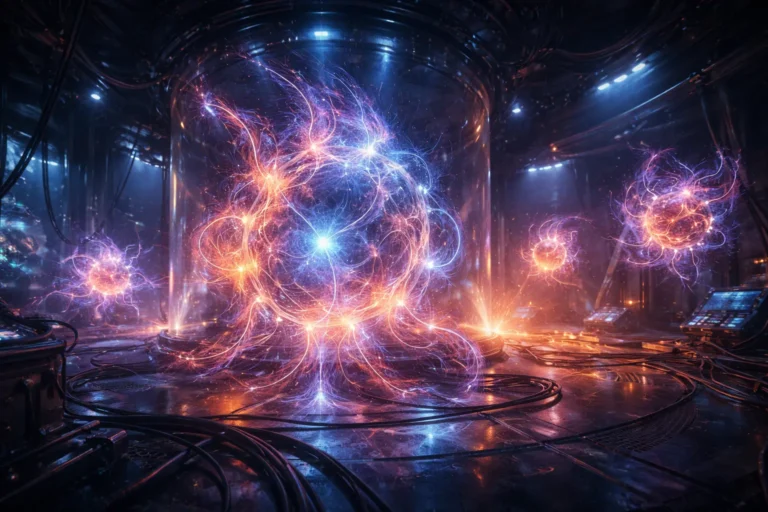
Most life we meet on Earth is made of cells, proteins and genetic code. That biological package depends on chemistry in liquids, usually water. But what if life could be built from something else entirely — from coherent patterns in ionized gas, glowing and electric, that persist and change like a living thing? That is the idea behind plasma-based life: structures of charged particles and electromagnetic fields that show self-organization, information transfer, persistence, and in the wildest proposals, reproduction.
This idea sounds wild. It should. But it also deserves a careful look. We can separate the sensible, testable pieces from the purely imaginative ones. The short answer? Plasma can show complex behavior and can help make organic molecules. It can mimic some properties we usually call “living.” But the jump from interesting physics to bona fide life remains large and unproven. Below I walk you through how plasma behaves, why some thinkers consider it a life candidate, the strongest counterarguments, and where researchers are testing the idea.
What is plasma, in plain language?
Plasma is often called the fourth state of matter. Heat or energetic radiation rips electrons off atoms, creating a soup of free electrons and positively charged ions. Plasma glows, conducts electricity, and responds to magnetic and electric fields. Most of the visible universe — stars, the Sun, the thin gas between stars — is plasma. On Earth, lightning and neon signs are familiar plasma examples.
Plasmas range from diffuse, faint ionization in space to dense, hot fusion plasmas in the lab. They show structures: filaments, sheets, and coherent blobs called plasmoids. Those structures can move, merge, split and sometimes persist far longer than a naive model would expect. That self-organization is part of what tempts a few researchers to ask whether plasmas could be more than physics — perhaps a different substrate for life. (See research reviews on plasma chemistry and plasma kinetics in prebiotic contexts.)
Why some researchers even propose plasma as a life substrate
There are a few scientific observations and logical steps that make the hypothesis plausible enough to discuss:
- Self-organization. Plasmas can form stable, repeating patterns and structures under the right conditions. Nature already produces long-lived plasma filaments and magnetic flux tubes. On their own, these behaviors do not equal life — but self-organization is a feature of living systems.
- Information and memory. In principle, electromagnetic structures can carry and store patterns. Electric and magnetic field configurations can alter how plasma moves, allowing some history-dependent behavior. This has led to speculative models where field patterns act as analogues to memory or signaling. Those models remain conceptual for now.
- Energy use. Plasmas can absorb, redistribute and emit energy. Life needs ways to harvest energy to maintain order. Plasmas are excellent at exchanging energy with their surroundings; in extreme environments — stellar coronae, accretion disks, lightning storms — plasma dynamics are the dominant energy flows. That physical property makes energy budgets a point in favor of plasma-life thinkers.
- Chemical factory role. Laboratory plasmas and lightning discharges can drive chemistry that produces complex molecules. Experiments show that plasmas can form organics and other prebiotic compounds from simple starting materials. Thus plasmas may help create building blocks for chemistry-based life, or — in speculative models — supply the raw material for a non-chemical plasma information system.
These facts create a logical path to asking the question: if plasma can organize, store patterns, and couple to chemistry and energy, could it in some contexts meet the core criteria we use for life — persistence, metabolism, information handling, and reproduction?
The strongest objections — and why most scientists remain skeptical
The leap from plasma physics to biology faces major barriers.
1) Lack of clear replication and heredity. Earth life reproduces using molecules that copy themselves (DNA, RNA). For an entity to evolve, it must pass on reliable variations. While plasma fields can hold structure, mechanisms for faithful copying and inheritance in a plasma medium are speculative. Without a robust, testable replication process, it is hard to treat a plasma structure as a living lineage. Reviewers emphasize this gap.
2) Fragile persistence. Many plasmas require continuous external energy to persist. Life on Earth maintains order by local energy flow but does so within stable, bounded cells that protect their chemistry. Plasma structures in many environments dissipate quickly unless a steady energy source exists. That makes long-term persistence and slow evolution a challenge.
3) Measurement and falsifiability. Science advances by testable predictions. Proposals for plasma organisms must produce measurable, falsifiable signatures distinct from ordinary plasma physics. So far, many claims rely on ambiguous observations — luminous blobs in the upper atmosphere, transient plasmoids near lightning — that can be explained by known plasma behavior without invoking life. Serious scientists demand stronger, repeatable evidence.
4) Energetic and material constraints. The microphysics of plasmas — collisions, recombination, radiative losses — often work against maintaining complex, information-rich states at small scales. That makes it uncertain whether plasma can support the kind of robust, localized information processing required for cognition, reproduction or durable metabolism. Advanced models are exploring the limits, but consensus is far away.
Because of these issues, mainstream astrobiology treats plasma-life ideas as intriguing but speculative. Most researchers focus on detecting chemical biosignatures and environments that could host liquid-water chemistry. Even so, the plasma idea forces us to think more broadly about what counts as a “biosignature,” and that intellectual exercise is valuable.
Cases and claims: what has been observed, and how reliable are those observations?
Over the years, various reports have circulated about luminous, mobile plasma structures seen in upper atmospheres or in space shuttle footage. A number of papers and preprints have catalogued such reports and suggested that some may show organized, life-like behavior. However, many of these claims face serious challenges:
- Observation artifacts and misinterpretation. Camera optics, charged particle interactions with instrument housings, and charged dust can create strange glows and motions that look structured but are not biological.
- Known plasma phenomena. Natural plasmas produce features that move, merge and pulsate — for instance, sprites and elves in the upper atmosphere or magnetospheric plasmoids. These are explained well by electrodynamics and do not require a living interpretation.
- Lack of repeatable, peer-reviewed evidence. The most extraordinary claims often come from single datasets or non-mainstream journals. Reproducible, independently verified observations in controlled contexts remain absent. For that reason, the claims carry low scientific weight until better data appear.
Still, it is scientifically healthy to catalog, analyze and challenge unusual observations. Sometimes surprising phenomena do lead to new physics or new biology — but they do so only when evidence crosses a high threshold.
How plasma research connects to origin-of-life studies
Even if plasma organisms remain speculative, plasma physics plays two important, grounded roles in origin-of-life research:
- Prebiotic chemistry driver. Electric discharges and low-temperature plasmas can make amino acids, nucleobase precursors and complex organics from simple gases. Several laboratory studies and reviews show plasma discharges are a valid route to building blocks. That does not produce life by itself, but it does show plasmas can help create the raw ingredients.
- Broader habitability thinking. Astrobiology must consider “life as we don’t know it.” NASA strategy documents and leading reviews encourage scientists to look beyond carbon-water dogma and to conceive of agnostic biosignatures. In that spirit, plasma-based scenarios become part of a broader catalog of “what to look for” when scanning the Universe. They help sharpen observational tests even if the plasma life idea remains remote.
How would we search for plasma life? Practical signatures to seek
If plasma organisms were a real possibility, what would we look for? The most useful observational targets would be signatures that cannot be explained by ordinary plasma physics and that show hallmarks of life:
- Complex, repeatable, information-rich patterns that persist and respond to stimuli in ways inconsistent with known plasma instabilities.
- Energy selective behavior, like moving toward localized energy sources and away from harm in a way that implies goal-directedness beyond simple physical drift.
- Reproducible “offspring” events where a pattern splits and both parts retain complex structure and functionality.
- Coupling to chemistry — effects on local gas composition that indicate active processing rather than passive interaction.
Designing instruments and missions to separate these possibilities is hard but not impossible. Lab experiments that deliberately create long-lived plasmoids in controlled fields and test for inheritance or self-repair would be a key step. So far, most lab plasmoids lack the complexity and persistence to tick those boxes.
Where does mainstream science stand — and where could this field head?
Mainstream astrobiology takes a cautious, open-minded stance. Agencies and research programs emphasize robust evidence: reproducibility, peer review and testable predictions. Plasma-life ideas are discussed in review articles that cover “life as we don’t know it” and non-standard biosignatures, but they remain a tiny thread inside a larger tapestry that focuses mostly on liquid chemistry, genetic systems, and planetary environments.
That said, the future could move in two ways. One path is continued skepticism, where plasma proposals stay speculative and mostly inhabit conference talks and fringe papers. The other path is incremental science: better plasma experiments, focused lab tests for inheritance or information storage, and careful, independent re-analysis of odd space observations. If those steps provide reproducible evidence, the field would shift rapidly from speculation to active research.
Why the idea matters even if it proves wrong
As a scientific exercise, the plasma-life hypothesis is valuable because it pushes researchers to define life more carefully and to design experiments and instruments that are agnostic about substrate. Extreme ideas test the limits of our methods. If plasma life is disproved, the research still leaves us with better models of prebiotic chemistry, improved plasma diagnostics, and a tighter set of criteria for what counts as a biosignature. In that way, even speculative ideas produce useful science.
FAQs
Q: Is there any proven plasma life anywhere?
A: No. There are no confirmed plasma-based organisms. Reports of luminous, moving plasma structures exist, but none have survived rigorous, repeatable scientific testing as living systems.
Q: Could lightning or auroras be life?
A: Lightning and auroras are plasma phenomena explained by electrodynamics. They do not meet key life criteria like reproduction and heredity. Scientists study them as physics phenomena, not biology.
Q: Do plasmas help make biological molecules?
A: Yes. Laboratory and modeling studies show that plasma discharges can synthesize amino acids and other organic precursors. That makes plasmas relevant to origin-of-life research.
Q: Could plasma life exist around stars or in accretion disks?
A: Some theorists imagine exotic habitats — dense plasma in stellar atmospheres or accretion disks — where self-organized structures could persist long enough to evolve. These ideas are highly speculative and face major physical hurdles, but they are taken seriously enough to be discussed in theoretical papers.
Q: How should we respond to sensational claims online about plasma aliens?
A: Treat such claims with skepticism. Extraordinary claims require strong, reproducible evidence. Look for peer-reviewed papers, independent replication, and clear falsifiable tests before accepting dramatic interpretations.
Bottom line: a radical idea worth disciplined study
Plasma-based organisms are a fascinating concept. The physics of plasmas includes self-organization and complex dynamics, and plasmas can drive chemistry that builds prebiotic molecules. Those facts justify scientific curiosity. But current evidence falls short of proving that plasmas can support life in the biological sense we use on Earth. The most responsible path forward is methodical: devise clear experiments, hunt for reproducible signatures, and keep an open but critical mind.
If you love the idea, the right question is not “Is it true?” but “What would make it true, and how do we test for it?” That shift — from storytelling to test design — is exactly what turns speculation into science.
References and further reading (proof / source URLs)
- Micca Longo, G., et al., “Plasma Modeling and Prebiotic Chemistry: A Review,” Molecules, 2021. https://www.mdpi.com/1420-3049/26/12/3663.
- Schulze-Makuch, D., et al., “The Adaptability of Life on Earth and the Diversity of Planetary Environments,” Life (Basel), 2017. https://www.ncbi.nlm.nih.gov/pmc/articles/PMC5650640/.
- Preiner, M., et al., “The Future of Origin of Life Research: Bridging Decades-Old Questions,” Frontiers / PMC review, 2020. https://www.ncbi.nlm.nih.gov/pmc/articles/PMC7151616/.
- Gan, D. W., “Discharge plasma for prebiotic chemistry: Pathways to life’s building blocks,” eppcgs.org / 2024 review, 2024. https://www.eppcgs.org/article/doi/10.26464/epp2024066.
- “Plasma Effects on Microorganisms in Space: Implications for Astrobiology and Space Missions,” RSIS International Journal, 2025. https://rsisinternational.org/journals/ijrsi/articles/plasma-effects-on-microorganisms-in-space-implications-for-astrobiology-and-space-missions/.
- NASA Astrobiology Strategy and reviews on alternative biosignatures — NASA Astrobiology program. https://astrobiology.nasa.gov/about/ and https://astrobiology.nasa.gov/uploads/filer_public/87/56/nasa_astrobiology_strategy_2015_final_041216.pdf.
- Reviews and commentary on speculative plasma life and plasmoids (for context and examples of claims; treat as speculative): ResearchGate preprints and conference proceedings discussing plasmoids and plasma phenomena in the thermosphere. Example: “Extraterrestrial Life in Space. Plasmas in the Thermosphere,” ResearchGate entry. https://www.researchgate.net/publication/377077692_Extraterrestrial_Life_in_Space_Plasmas_in_the_Thermosphere_UAP_Pre-Life_Fourth_State_of_Matter.

0 Comments