


















Penetrating the Mantle: China’s “Meng Xiang” Ship Begins the 11km Drill to Find Earth’s Deep Life
Far beneath the ocean floor lies a world no human has ever touched. It is a realm of crushing pressure, extreme heat, and ancient rock formed billions of years ago. Scientists believe this hidden region may hold answers to some of Earth’s deepest mysteries. Now, China has begun a mission that aims to reach it.
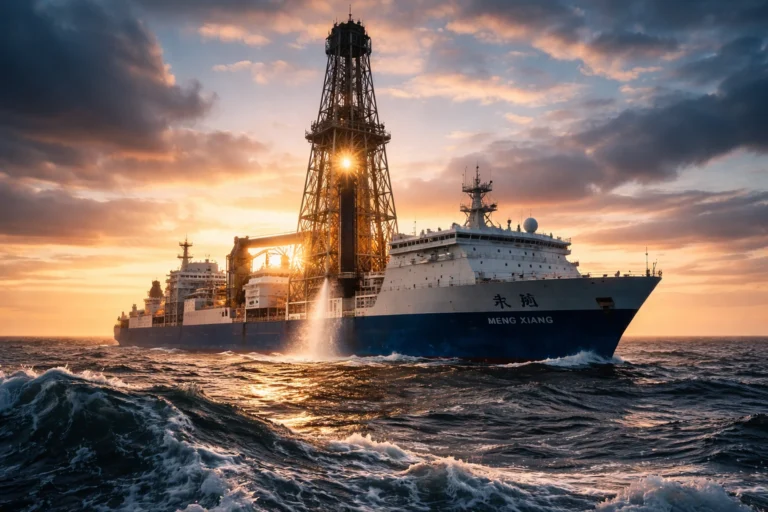
The advanced deep-sea drilling vessel Meng Xiang, whose name means “Dream,” has launched an ambitious effort to drill nearly 11 kilometers below sea level. The ultimate objective is to approach, and possibly penetrate, the boundary between Earth’s crust and its mantle. If successful, the project would mark one of the most significant geological achievements in human history.
This is not simply a drilling operation. It is a scientific expedition into the least explored part of our planet.
Why Reaching the Mantle Is So Difficult
Earth’s mantle begins beneath the crust and extends thousands of kilometers toward the core. On land, the crust can be more than 30 kilometers thick. Under the oceans, however, it is much thinner, often just 6 to 7 kilometers. That thinner crust makes ocean drilling the best chance of reaching the mantle.
Previous attempts have fallen short. In the 1960s, American scientists launched Project Mohole, which aimed to drill into the mantle from the ocean floor. The project was eventually abandoned due to technical and funding challenges. The Soviet Union drilled the Kola Superdeep Borehole on land, reaching more than 12 kilometers, but even that record-breaking hole did not penetrate the mantle.
The Meng Xiang mission represents the latest and most technologically advanced attempt to accomplish what earlier generations could not.
What Scientists Hope to Discover
The mantle is more than just rock. It plays a central role in shaping our planet. It drives tectonic plate movement, fuels volcanic activity, and influences Earth’s magnetic field.
Yet beyond geology lies another question that has captured scientific attention: could life exist deeper than we ever imagined?
Over the past two decades, researchers have confirmed the existence of microbial life several kilometers beneath Earth’s surface. These organisms survive without sunlight. They rely instead on chemical reactions between rock and water for energy. This underground ecosystem is known as the deep biosphere.
If microbes can survive at such depths, scientists wonder whether even more extreme forms of life might exist closer to the mantle.
The Concept of “Dark Life”
The term “dark life” refers to organisms that live entirely without sunlight, drawing energy from Earth’s internal chemistry rather than photosynthesis. These microbes may feed on hydrogen released from fractured rocks, sulfur compounds, methane, or iron reactions.
Temperatures deep below the surface can exceed 120 degrees Celsius. Pressures are immense. Until recently, scientists believed life could not survive under such conditions. However, discoveries of heat-loving microbes, known as hyperthermophiles, have already challenged those assumptions.
The Meng Xiang mission aims to collect rock cores and fluid samples from unprecedented depths. If microbial traces are found, they could reveal life forms adapted to extreme heat and pressure beyond known biological limits.
The Engineering Challenge
Drilling nearly 11 kilometers below sea level is an extraordinary technical feat. The Meng Xiang vessel is equipped with advanced positioning systems that keep it stable even in rough ocean conditions. Its drilling systems are designed to withstand high temperatures and extreme pressure.
As drilling progresses deeper, conditions become increasingly hostile. Rock can behave unpredictably under pressure. Equipment faces intense friction and heat. Maintaining the integrity of the borehole becomes more difficult with every additional meter.
Each stage of the operation requires careful monitoring. Even minor mechanical failures can cause delays. The mission demands precision, patience, and resilience.
Scientific Discipline and Verification
It is important to approach this mission with measured expectations. No confirmed discovery of mantle life has been announced. The goal of the expedition is to gather samples and data for analysis. Any claims regarding new organisms will require thorough laboratory testing and independent review.
Contamination control is critical. Scientists must ensure that any life detected truly originates from deep below and is not introduced during drilling or sample handling. Strict procedures are in place to maintain scientific integrity.
Excitement must always be matched by caution.
Why This Matters Beyond Earth
The implications of deep-life research extend far beyond geology. If organisms can survive in extreme underground environments, similar life might exist on other worlds.
Mars shows signs of ancient water beneath its surface. Jupiter’s moon Europa and Saturn’s moon Enceladus are believed to contain subsurface oceans heated by internal energy. Understanding how life adapts to harsh underground conditions on Earth could guide future space missions searching for life elsewhere.
The Meng Xiang mission, while focused on Earth, contributes to the broader study of life in extreme environments.
Environmental and Safety Considerations
Deep-sea drilling projects operate under strict environmental guidelines. Preventing contamination of marine ecosystems is a priority. Monitoring systems track potential gas releases or geological disturbances.
Chinese authorities have stated that safety protocols are integrated into the project design. Continued transparency and adherence to global scientific standards remain essential as drilling progresses.
Responsible exploration must accompany scientific ambition.
The Long Journey Ahead
Drilling to extreme depths takes time. Progress may be slow and subject to technical setbacks. Weather conditions at sea can also interrupt operations.
Even if the mantle is not fully reached, the scientific data collected will still be valuable. Each core sample adds to our understanding of Earth’s formation and evolution.
The journey itself holds knowledge.
A Historic Attempt
Humanity has explored the highest peaks and ventured into space. Yet the vast interior of our own planet remains largely unknown. The Meng Xiang mission represents a renewed effort to explore that hidden frontier.
Whether it discovers new microbial life or simply deep geological secrets, the project stands as one of the boldest scientific undertakings of our time.
The search for answers continues, one kilometer at a time.
FAQs
Q: Has the Meng Xiang reached the mantle?
No. The mission aims to drill toward the mantle boundary, but it has not yet confirmed reaching it.
Q: Is there confirmed life in the mantle?
No confirmed mantle life has been reported. The mission seeks to study deep subsurface conditions and potential microbial evidence.
Q: Why drill under the ocean instead of on land?
Oceanic crust is significantly thinner than continental crust, making it a more practical location for attempting mantle access.
Q: Could deep drilling cause earthquakes?
Scientific drilling of this scale is carefully managed and is not designed to trigger tectonic events.
Q: Why is deep-life research important?
Studying extreme life forms expands our understanding of biology and helps inform the search for life beyond Earth.
Disclaimer
This article is based on publicly available reports and official announcements regarding the Meng Xiang deep-sea drilling project. As of publication, no discovery of mantle life has been confirmed. Scientific findings will require peer review and verification before conclusions are established.
Reference URLs (Proof of Incident and Reporting)
- Xinhua News Agency coverage of Meng Xiang deep-sea drilling vessel
https://english.news.cn - South China Morning Post reporting on China’s mantle drilling mission
https://www.scmp.com - International Ocean Discovery Program overview
https://www.iodp.org - U.S. Geological Survey explanation of Earth’s mantle
https://www.usgs.gov - Nature journal discussion of deep biosphere research
https://www.nature.com

0 Comments