



















By Ronald Kapper
Disclaimer: This article discusses speculative ideas grounded in real physics. Neutron stars and their debris are extreme environments; many claims below are active scientific questions rather than established facts. I present current thinking, the strongest objections, and what observations would matter most. Read with curiosity and care.
A strange, urgent question
When most people imagine life beyond Earth, they picture temperate planets, oceans, or maybe floating organisms in gas giants. Few imagine anything to do with the smashed, radioactive wreckage left by dead stars. Yet the violent deaths of massive stars — supernovae, neutron-star collisions, and the rags of debris they fling into space — play a central role in making the heavy elements that life depends on. That connection raises a bold question: could fragments, dust, or second-generation objects made from neutron-star material ever host something we would call life?
The short answer is: almost certainly not in the dense core matter itself. But the longer answer is complicated, surprising, and worth a careful look. Below I walk through the physics of neutron-star matter, what debris looks like after explosive events, how that material evolves, and whether any realistic pathway could lead from neutron-rich wreckage to habitats that support chemistry rich and slow enough for life to arise.
What neutron-star matter actually is — and why it’s hostile
Neutron stars are the compressed cores left when massive stars explode. Their densities are enormous: a teaspoonful of neutron-star matter would weigh billions of tons on Earth. The star’s outer crust is a lattice of exotic nuclei bathed in a sea of degenerate electrons; deeper inside, neutrons drip out of nuclei and form neutron-rich phases and possibly superfluid states. Under those conditions, ordinary atoms and molecules cannot survive. The chemistry and timescales we rely on for life simply do not apply in the hot, ultra-dense interior.
This is not hand-waving. The physics of neutron-star crusts and cores is an active field; it shows structures and phases that are exotic and extreme, not hospitable laboratories for carbon chemistry. The outermost layers cool and radiate, but the bulk of the matter remains utterly alien to life as we know it.
Debris, kilonovae, and the cosmic origin of heavy elements
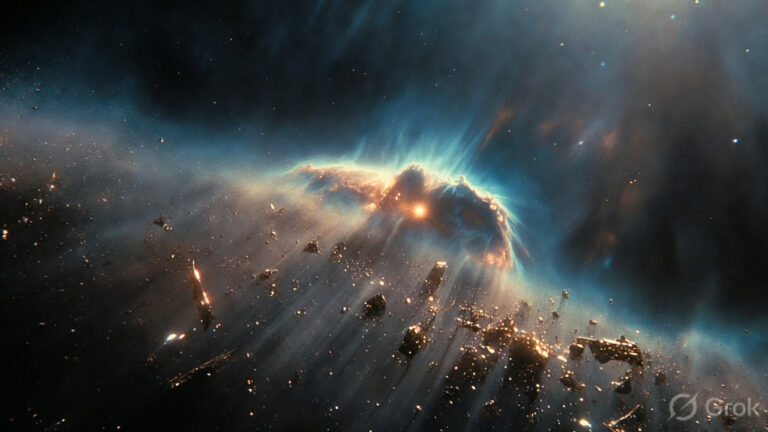
When neutron stars collide or when a supernova tears off a star’s outer layers, enormous amounts of exotic, neutron-rich material are flung into space. These events light up as kilonovae — brief but brilliant eruptions powered by the radioactive decay of heavy elements made in the so-called r-process (rapid neutron capture). The ejecta contain a very wide range of heavy nuclei: gold, platinum, uranium and many other elements that are key to later planet chemistry.
Because these collisions synthesize and eject raw material, they seed the surrounding interstellar medium with heavy elements that over time become part of new star systems, dust grains, and eventually planets. In short, neutron-star debris is the cosmic foundry for many of the elements life later uses. Observations of mergers and their kilonova light curves — including the famous multi-messenger event GW170817 — show this process in action.
From lethal radiation to cooled dust: the long evolution of debris
Right after ejection, the debris is hot and intensely radioactive. Short-lived isotopes decay and produce high-energy radiation that would sterilize any nearby complex chemistry. But the universe is patient. Over decades to millennia, the most intensely radioactive isotopes decay away, and the ejecta expand and cool. Radiative cooling, mixing with surrounding gas, and grain formation lead to dust and molecules forming in the wake of the blast.
Given enough time — and enough dilution of the dangerous radiation — the material’s physical state can shift drastically. Hot plasma becomes cool dust. Icy mantles and metal-rich grains can form on longer timescales, especially as debris mixes with molecular clouds. This transformation is essential: only when temperatures and radiation levels fall to benign ranges can complex, long-lived chemistry develop in principle.
But “in principle” is a long way from “in practice.” The initial toxicity and the mixing processes make the path from raw neutron-rich ejecta to life-friendly material complex and probabilistic.
Could neutron-star debris make planets or second-generation worlds?
We have direct evidence that compact remnants can host planets. The very first confirmed exoplanets were discovered orbiting a pulsar (PSR B1257+12). Those planets likely formed from disks of material that collected after the star’s death — so-called second-generation planets arising from fallback or from a destroyed companion. That shows that debris can, under the right conditions, reassemble into long-lived bodies.
But planets around neutron stars are rare, and their environments are extreme. Pulsars emit strong radiation and energetic particles that challenge habitability. Still, the basic mechanism — debris settling into a disk, cooling, and accreting into bodies — is real. Where conditions allow a disk to survive long enough and to cool, rocky or metal-rich worlds can form from the wreckage left by catastrophic stellar events.
Heavy elements, unusual chemistry — any advantage for life?
One striking feature of debris from neutron-star events is the unusual abundance of very heavy elements. Elements beyond iron play critical roles in catalysis, mineralogy, and planetary differentiation. Rare elements such as uranium drive long-lived internal heating in planets via radioactive decay; that heating can power hydrothermal systems that on Earth are hotspots for complex chemistry and early biology.
So the extra dose of heavy elements in a region seeded by neutron-star debris might, paradoxically, create niches where chemistry runs in interesting directions: metal-rich dust could support unusual surface chemistry, and long-lived radioisotopes could provide a local energy source long after the initial explosion.
But heavy-element abundance alone is not enough. For life to emerge, material must be cool enough, chemically diverse in the right ways, and organized into stable liquid environments or other chemical reactors. If the debris ends up mostly as dispersed, highly radioactive grains, it remains hostile. If instead it mixes and forms planetesimals that differentiate and cool, the added inventory of heavy elements could help create long-lived geothermal systems. That’s the hopeful route — but it is speculative and depends on many contingent details.
The biggest barriers — radiation, timescale, and chemistry
There are three major obstacles that make life from neutron-star debris unlikely in many settings:
- Initial sterilizing radiation. Fresh ejecta contain short-lived isotopes that decay violently. Any complex molecules near the blast are likely destroyed. The only way around that is dilution, burial, or waiting long enough for radioactivity to decay.
- Hostile early environment. The post-explosion surroundings are turbulent, hot, and chemically extreme. Molecules will form, but the initial conditions are not favorable to the slow, stable chemistry that supports life.
- Timescales and mixing. For life to emerge you need prolonged stable conditions — oceans, atmospheres, or protected subsurfaces that last millions of years. Debris must either settle into a massive body that cools and holds volatiles, or it must be carried into a molecular cloud that later collapses into a star system. Both are possible, but neither is guaranteed.
These hurdles do not prove impossibility. They simply show how narrow the path is from neutron-star wreckage to cozy, life-friendly worlds.
Where the best chances lie
If any realistic scenario could produce life connected to neutron-star debris, it would likely follow one of a few routes:
- Second-generation planets around a compact remnant. If a stable disk forms and accretes into planets that cool and retain volatiles, internal radioactivity and geothermal energy could power long-lived habitats. Such planets would likely be metal-rich and unusual, but not strictly impossible for life if heating and chemistry align.
- Seeding of star-forming clouds. Debris that mixes into a cold molecular cloud could enrich the next generation of planetary systems with heavy elements. Those later systems would not be living inside debris per se, but they would owe their heavy-element inventory to neutron-star events — a crucial indirect role in habitability.
- Localized sheltered niches on larger bodies. If debris ends up inside a sufficiently massive object that forms a crust and hydrosphere, deep subsurface habitats (protected from surface radiation) might persist, powered by radioactive decay.
In short, the most plausible connection between neutron-star debris and life is indirect: the debris supplies elements and energy sources that later support life on worlds formed from mixed material.
What observations would change the debate?
This is a theory-driven problem, but observations can sharpen it. The most useful evidence would include:
- Direct studies of supernova and kilonova remnants that show how quickly dust forms, its composition, and how radioactive heating affects grain survival.
- Surveys of second-generation disks around young neutron stars or pulsars that show how common stable fallback disks are and whether they have the mass and chemistry to form planets.
- Detailed study of pulsar planets — their composition and structure — which might reveal whether they are born of fallback debris, companion disruption, or other processes.
- Isotope mapping in meteorites and planetary systems that pinpoints whether certain heavy-element patterns match neutron-star origins and how those patterns correlate with early heating and volatile retention.
Progress on these fronts would move the question from speculative to empirical.
Could life use wholly different chemistries in such settings?
Some thought experiments ask whether life might arise in unusual chemistries made possible by high metal content or exotic surfaces. Could catalytic networks on metal-rich grains or in high-pressure silicate layers produce replicating chemistry?
Theoretical chemistry suggests that many catalytic pathways require liquid solvents or surfaces with mobility. Deep subsurface oceans heated by radioactive decay or hydrothermal systems in a second-generation planet could in principle support such chemistry. But chemistry under very different bulk compositions — a mantle heavy with rare elements or a crust soaked in radiogenic heat — remains poorly explored.
So while the chemistry might be stranger than Earth’s, the requirements — sustained liquid medium, energy flow, and stable compartmentalization — do not vanish. The hurdles remain steep, but they are not logically impossible.
The philosophical angle: life as a consequence of rare events
If neutron-star debris plays a role in producing the raw materials for life, that highlights a philosophical point: life may depend on a chain of rare, contingent events. The very atoms in our bodies were forged in stellar furnaces and explosive collisions. The same processes that seem so violent may also be necessary to supply the diversity of elements that allow complex chemistry.
That does not make life inevitable, but it does show how cosmic violence and quiet biological emergence can be parts of the same story.
FAQs
Q: Can life exist inside a neutron star itself?
A: No. The densities, pressures, and temperatures inside a neutron star destroy atoms and molecules. Those conditions are utterly incompatible with chemistry as we know it.
Q: Could debris from neutron stars form planets that support life?
A: Possibly, but rarely. Debris must cool, mix with volatiles, and form a planet that retains an atmosphere and liquids. Pulsar planets show that planet formation from stellar wreckage can happen, but such planets are uncommon and often hostile.
Q: Is neutron-star material especially useful for life?
A: It supplies heavy elements that are useful for planetary geology and long-term heating. Those elements can help create habitable niches on planets that later form from mixed material.
Q: Would radiation from remnants always sterilize forming systems?
A: Not always. Radioactivity declines over time. If material is buried, diluted, or incorporated into a massive body that cools, radiation levels can drop to safe ranges on geological timescales.
Q: If neutron-star debris seeded our planet, could we detect that signature?
A: Perhaps. Isotope patterns in meteorites and planetary composition can carry fingerprints of enrichment by particular nucleosynthesis events. Detecting those fingerprints requires careful isotopic archaeology.
Final take — cautious curiosity
The headline “Life in neutron-star debris” tempts dramatic images. Reality is subtler. The dense interior of a neutron star is sterile by any sensible definition. But the debris those objects fling across the galaxy plays a creative role: it builds heavy elements and, after cooling and mixing, can contribute to the raw materials for planets and long-lived heat sources that may, far downstream, help life arise.
If life ever emerges on a world born from star-smash leftovers, it will be a testament to the way violent creation and gentle chemistry dance across time. For now, the hypothesis remains one of the more speculative but scientifically grounded ideas in the field of astrobiology. It highlights how life’s deep story is a cosmic one — forged in fire, shaped by chance, and revealed by patient observation.
References and sources
(These links are provided for verification and further reading. They are not embedded in the article body.)
- Chamel, N., & Haensel, P. — Physics of neutron star crusts (review). Philosophical Transactions of the Royal Society A / PMC review. https://www.ncbi.nlm.nih.gov/pmc/articles/PMC5255077/.
- Neutron star merger and kilonova overview (GW170817 results and r-process production). Wikipedia / review entry. https://en.wikipedia.org/wiki/Neutron_star_merger.
- AP News — Space telescope spies neutron star in the debris of famous supernova (SN 1987A) (example of remnant studies and element detection). https://apnews.com/article/26dce19f08868e4a1a5d59cbd03349d3.
- Wired / news summary — Exotic Superfluid Found in Ultra-Dense Stellar Corpse (evidence for exotic phases in neutron stars). https://www.wired.com/2011/02/superfluid-neutron-star.
- Wolszczan, A. — Confirmation of Earth-mass planets orbiting the millisecond pulsar PSR B1257+12 (first confirmed exoplanets; pulsar planet formation from debris). https://ui.adsabs.harvard.edu/abs/1994Sci…264..538W/abstract.
- Klion, H. et al. — Impact of r-process heating on the dynamics of neutron star merger ejecta (MNRAS, ejecta dynamics). https://academic.oup.com/mnras/article/510/2/2968/6459743.
- Witten, T. A. Jr. — Compounds in neutron-star crusts (historical discussion on crust compositions). https://ui.adsabs.harvard.edu/abs/1974ApJ…188..615W/abstract.

0 Comments