















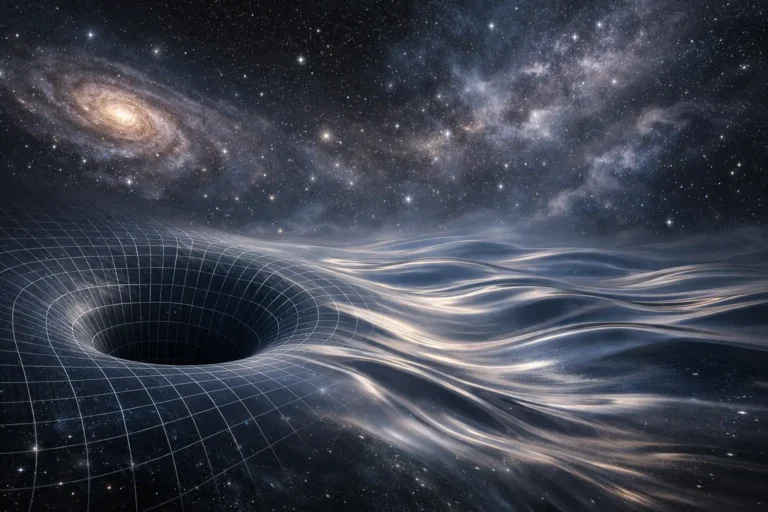
By Ronald Kapper
Disclaimer: This article explores serious scientific ideas and ongoing debates in theoretical physics. It explains established research along with speculative proposals that are still being tested. Nothing here suggests that space has literally turned into water or air. The discussion focuses on whether space might behave like a fluid at deep physical levels.
A Question That Refuses to Stay Quiet
For centuries, space was treated as empty — a silent stage where planets moved and stars burned. Then Albert Einstein changed the story. Space wasn’t empty. It could stretch, curve, ripple. It could bend light and slow time.
But modern physics has gone even further. Some researchers now ask a daring question: What if space behaves like a fluid?
Not in the sense that you could swim through it. Not like wind or ocean waves. But in the mathematical sense — obeying equations that look strikingly similar to fluid dynamics.
This idea is not fringe science fiction. It appears in serious research papers. It connects gravity, black holes, quantum physics, and even cosmology. And if it turns out to be correct in some deep sense, it could reshape how we understand the universe.
Let’s walk carefully through what scientists mean — and what they don’t.
From Empty Void to Dynamic Fabric
In classical physics, space was absolute. Isaac Newton treated it as a fixed background. Things moved inside it, but space itself did nothing.
Then Einstein introduced general relativity. According to this theory, space and time form a unified structure called spacetime. Mass and energy bend spacetime. That curvature tells objects how to move.
Suddenly, space was not passive. It could stretch. It could ripple as gravitational waves. It could collapse into black holes.
That was the first hint that space behaves less like emptiness and more like something physical.
Why Some Equations Look Like Fluid Equations
Here’s where things get interesting.
In the 1970s and later, physicists noticed something remarkable. The mathematics describing black hole horizons and gravitational systems sometimes mirrors the mathematics used to describe fluids.
In certain conditions, Einstein’s field equations — the equations governing spacetime curvature — can resemble the Navier-Stokes equations that describe fluid flow.
This doesn’t mean space is water. It means the behavior of spacetime curvature, under specific limits, can be expressed in a form that looks like fluid motion.
For example:
- Black hole horizons can behave like membranes with viscosity.
- Certain gravitational systems have temperature and entropy, like thermodynamic fluids.
- In holographic models, gravity in higher dimensions corresponds to fluid behavior in lower dimensions.
These parallels are not metaphors. They appear in rigorous calculations.
The Membrane Paradigm: Black Holes That Flow
One powerful example comes from black hole physics.
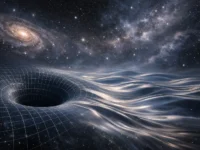
Physicists developed what is called the “membrane paradigm.” In this framework, the event horizon of a black hole can be treated mathematically like a viscous fluid membrane.
It has:
- Electrical conductivity
- Shear viscosity
- Entropy density
The equations describing disturbances on a black hole horizon resemble fluid dynamics equations.
This does not mean the black hole surface is made of liquid. It means that, from the perspective of an outside observer, the physics behaves as if it were fluid-like.
That realization opened a door. If black hole boundaries behave like fluids, could spacetime itself be emergent from something deeper?
The Holographic Clue
In the late 1990s, a major breakthrough called the AdS/CFT correspondence suggested a deep link between gravity and quantum field theory.
In certain theoretical models, gravity in a higher-dimensional space is mathematically equivalent to a non-gravitational quantum system in lower dimensions.
Here’s the surprising part: the gravitational dynamics in those models correspond directly to fluid dynamics in the lower-dimensional system.
In simple terms, gravity equations map onto fluid equations.
This discovery led researchers to ask whether spacetime geometry might emerge from more fundamental quantum processes that resemble fluid behavior.
Could Space Be a Superfluid?
Some physicists have explored the idea that spacetime might resemble a quantum superfluid.
A superfluid is a state of matter that flows without friction under certain conditions. It exhibits strange quantum behavior on macroscopic scales.
In certain approaches to quantum gravity, spacetime is not continuous but arises from microscopic degrees of freedom — possibly behaving like a condensate or superfluid at large scales.
In these models:
- The smooth geometry we observe is like the large-scale behavior of molecules in water.
- At extremely small scales, space may have discrete structure.
- Gravity could be a collective effect, like sound waves in a fluid.
These ideas remain under investigation. They are not proven. But they are mathematically consistent within specific frameworks.
Why This Doesn’t Bring Back the Old “Aether”
You might wonder: Didn’t scientists already reject the idea of a fluid-like medium called the “aether” over a century ago?
Yes. The classical aether theory was ruled out by experiments like the Michelson–Morley experiment.
But modern proposals are very different.
They do not propose a preferred direction in space.
They do not violate Einstein’s relativity.
They arise within quantum gravity frameworks.
The key distinction is this: earlier aether models tried to explain light propagation. Modern “fluid-like” models attempt to explain the deep origin of spacetime geometry itself.
Entropy, Temperature, and Gravity
Another clue comes from thermodynamics.
Black holes have temperature. They emit radiation (Hawking radiation). They have entropy proportional to their surface area.
Even more surprising, researchers have shown that Einstein’s field equations can be derived from thermodynamic principles under certain assumptions.
This suggests gravity may not be fundamental but emergent — similar to how pressure or temperature emerge from microscopic particle motion.
If gravity is emergent, then spacetime curvature could also be emergent — perhaps analogous to fluid behavior arising from molecular motion.
What Would It Mean If Space Is a Fluid?
Let’s be precise.
If space behaves like a fluid at fundamental scales, it would mean:
- Spacetime geometry is not basic.
- There are underlying microscopic degrees of freedom.
- Smooth curvature emerges statistically.
- Gravity could be a collective phenomenon.
This would not change daily life. Planets would still orbit. GPS would still work.
But our deepest understanding of reality would shift.
Space would no longer be the stage. It would be a macroscopic pattern emerging from something deeper.
Major Challenges and Unanswered Questions
Despite the excitement, major obstacles remain.
No Direct Experimental Proof
We do not yet have clear experimental evidence that spacetime is literally fluid-like at fundamental scales.
Quantum Gravity Is Still Incomplete
No fully accepted theory of quantum gravity exists. Competing frameworks — string theory, loop quantum gravity, emergent gravity — explore different routes.
Scale Separation Problem
How do microscopic degrees of freedom give rise to smooth spacetime at large scales without contradictions?
Testability
The ultimate test is empirical. Any viable theory must make predictions distinguishable from standard general relativity.
Scientists continue searching for observable signatures in gravitational waves, black hole evaporation, and cosmology.
Why This Idea Is So Attractive
The appeal of the fluid analogy is powerful.
Fluid behavior emerges from simple microscopic rules.
It naturally explains collective phenomena.
It unifies thermodynamics with geometry.
And it provides intuitive language for otherwise abstract mathematics.
Many researchers suspect that spacetime’s smoothness may be an illusion at large scales — much like the smooth surface of water hides countless molecules beneath.
Is This Just a Mathematical Trick?
Some critics argue that the fluid analogy may simply be a useful mathematical mapping, not a statement about physical reality.
After all, many systems share similar equations without being physically identical.
That caution is important.
Physicists must distinguish between analogy and ontology — between equations that resemble fluid behavior and the claim that spacetime literally is fluid.
The current state of research does not prove that space is a fluid. It shows that gravity and spacetime sometimes behave like one.
That distinction matters.
The Road Ahead
The future of this idea depends on:
- Progress in quantum gravity
- Observational clues from black holes
- Precision cosmology
- Theoretical consistency
If future work reveals that spacetime emerges from quantum informational degrees of freedom behaving collectively, the fluid analogy may gain deeper support.
If not, it may remain a powerful but limited mathematical bridge.
Either way, it has already reshaped conversations in theoretical physics.
Frequently Asked Questions
Q: Can we move through space like swimming in a fluid?
No. The fluid analogy refers to mathematical behavior, not literal physical properties like viscosity you can feel.
Q: Does this contradict Einstein?
No. These ideas build on general relativity and often reproduce its predictions at large scales.
Q: Would this allow faster-than-light travel?
No credible model based on fluid-like spacetime removes the speed limit set by relativity.
Q: Is this widely accepted?
It is widely studied, but not confirmed. It remains an active research area.
Q: Could this solve quantum gravity?
Possibly. Emergent spacetime is one promising path among several competing approaches.
Final Reflection
The question “Is space actually a fluid?” forces us to confront something extraordinary.
What feels solid and fixed may not be fundamental at all.
Space might not be a container.
It might be a consequence.
It might be the large-scale ripple of deeper quantum structure.
Or the fluid analogy might simply be a stepping stone toward an even more surprising truth.
Science advances by daring to ask uncomfortable questions — and by testing them without bias.
For now, space remains curved, dynamic, and mysterious.
Whether it flows beneath the surface is one of the most fascinating puzzles modern physics has to offer.
References and Source URLs
(Provided for verification and transparency.)
- Damour, T. — Black Hole Eddy Currents (Membrane Paradigm)
https://journals.aps.org/prd/abstract/10.1103/PhysRevD.18.3598 - Thorne, Price, Macdonald — The Membrane Paradigm
https://press.princeton.edu/books/hardcover/9780691084141/black-holes - Kovtun, Son, Starinets — Viscosity in Strongly Interacting Quantum Field Theories
https://journals.aps.org/prl/abstract/10.1103/PhysRevLett.94.111601 - Maldacena, J. — The Large N Limit of Superconformal Field Theories and Supergravity
https://arxiv.org/abs/hep-th/9711200 - Jacobson, T. — Thermodynamics of Spacetime
https://journals.aps.org/prl/abstract/10.1103/PhysRevLett.75.1260 - Hawking, S. — Particle Creation by Black Holes
https://journals.aps.org/prd/abstract/10.1103/PhysRevD.14.2460

0 Comments