
















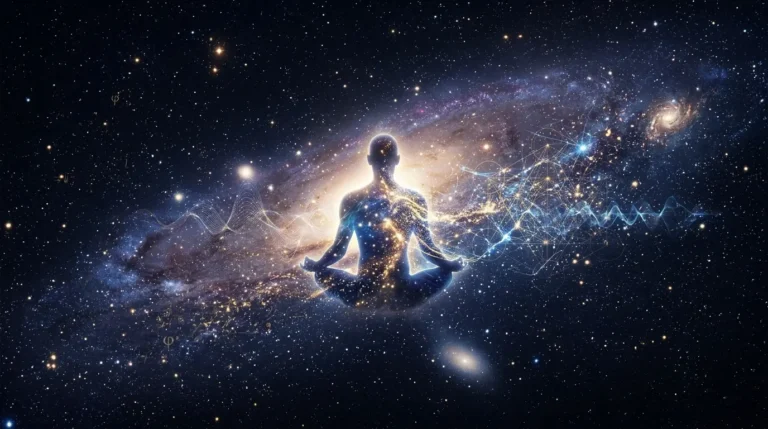
What if the universe doesn’t produce consciousness — what if consciousness produces the universe?
This isn’t a line from a sci-fi novel. It’s a hypothesis being seriously debated by neuroscientists, physicists, and philosophers of mind at some of the world’s most prestigious institutions. And the more we learn about the brain, quantum mechanics, and the nature of reality, the less absurd it sounds.
Welcome to one of the deepest rabbit holes in all of science: the theory that consciousness is not an emergent byproduct of matter, but a fundamental feature of reality — as basic as space, time, and gravity.
This article breaks down what that claim actually means, who’s making it, what the evidence looks like, and why it could change everything.
The Hard Problem: Why Neuroscience Can’t Explain You
Before we get to the theory, we need to understand the problem it’s trying to solve. In 1995, philosopher David Chalmers coined the term “the hard problem of consciousness” — and it’s been haunting science ever since.
The easy problems of consciousness are things like: How does the brain process sensory information? How does it control behavior? How does it integrate data from different sources? These are genuinely complex neuroscientific questions, but they’re tractable — we can imagine, in principle, building machines that do these things.
The hard problem is different. It asks: why is there subjective experience at all?
When you look at a red apple, your brain processes wavelengths of light, fires neurons, and generates a behavioral response. We can map all of that. But why does it feel like something to see red? Why isn’t all that processing happening in the dark, with no inner experience — no “what it’s like”?
That inner experience — philosophers call it “qualia” — is what science cannot currently explain. You can describe every neuron firing in perfect detail and still not explain why any of it is accompanied by conscious awareness.
This is the problem. And here’s the thing: standard neuroscience assumes consciousness emerges from sufficiently complex brain activity. But nobody has explained how or why that emergence happens. It’s just assumed. The hard problem says: that assumption is not good enough.
The Standard View: Consciousness Emerges from Complexity
The mainstream scientific position is called physicalism (or materialism). It holds that everything — including mind and consciousness — is ultimately physical. Consciousness, in this view, is what the brain does. It emerges from the organization and complexity of neurons firing, in the same way that wetness emerges from water molecules.
This is a reasonable working assumption. It’s guided enormous progress in neuroscience, psychology, and medicine. And for many scientists, it’s simply common sense.
But physicalism has a serious explanatory gap. It can explain correlation — this brain state correlates with this conscious experience — but correlation isn’t causation or explanation. We don’t know why physical processes give rise to subjective experience. We don’t know what makes a system conscious versus not. And we don’t know how to test for consciousness in anything other than ourselves.
That explanatory gap is exactly where alternative theories step in.
Panpsychism: Consciousness All the Way Down
The most prominent alternative is panpsychism — the view that consciousness, or proto-conscious properties, is a fundamental and ubiquitous feature of reality.
Before you dismiss this as mysticism, consider that it’s being taken seriously by heavyweight thinkers including philosopher Philip Goff, neuroscientist Christof Koch, and even figures like the late philosopher Derek Parfit. It’s also the subject of serious peer-reviewed research.
Panpsychism doesn’t claim that rocks have rich inner lives or that electrons experience joy. It claims something subtler: that the intrinsic nature of matter has something experiential about it, at even the most basic level — and that complex consciousness, like human awareness, emerges when those basic experiential properties combine and organize.
Think of it like mass or charge. We don’t ask “where does charge come from” — it’s a fundamental property of particles. Panpsychism proposes that experience might be the same kind of thing: not something that appears out of nowhere when neurons get complicated enough, but a primitive feature of reality that scales and organizes into the rich consciousness we know.
This solves the hard problem neatly. If experience is fundamental, you don’t need to explain how non-experiential matter generates experience. It was always there.
Donald Hoffman and the Case Against Objective Reality
Cognitive scientist Donald Hoffman at UC Irvine has taken this line of thinking in a radical and scientifically rigorous direction. His “Interface Theory of Perception” argues — based on evolutionary game theory and mathematical modeling — that our perceptions don’t show us objective reality. They show us a useful interface, like a desktop on a computer, that hides the underlying complexity.
The icons on your screen aren’t the actual code running your programs. They’re a simplified representation that helps you navigate. Hoffman argues our senses are the same: the world of rocks, trees, and apples is a useful fiction — a species-specific interface evolved for survival, not truth.
What’s the underlying reality beneath the interface? Hoffman’s answer is striking: consciousness and conscious agents all the way down. In his framework, space, time, and matter are not fundamental. Conscious experience is. Space-time is what conscious agents use to communicate; it’s not the bedrock of existence.
This isn’t mysticism — Hoffman has published this in peer-reviewed journals and derives it mathematically. Whether he’s right is another question, but he’s doing science, not philosophy of the armchair variety.
Quantum Mechanics and the Observer Problem
Here’s where physics enters and things get genuinely strange.
In quantum mechanics, particles don’t have definite states until they’re measured or observed. Before measurement, a particle exists in a superposition of multiple possible states simultaneously. The act of observation “collapses” the wave function, forcing the particle into a definite state.
This is not interpretation — it’s one of the best-tested phenomena in physics. The double-slit experiment demonstrates it with breathtaking clarity. What remains deeply controversial is what it means.
The question nobody can fully answer: what counts as an “observation”? Does a camera count? A rock? Or does it require a conscious observer? Most physicists prefer interpretations that don’t require consciousness — like the Many Worlds interpretation, where every possibility plays out in a branching universe — but the measurement problem hasn’t been conclusively resolved.
Some physicists, like John Wheeler, have proposed that consciousness plays a constitutive role in the universe — that we don’t just passively observe reality but participate in bringing it into existence. This is the idea of the “participatory universe.”
More recently, Penrose and Anesthesiologist Stuart Hameroff have proposed “Orchestrated Objective Reduction” (Orch OR), a controversial but mathematically developed theory suggesting consciousness arises from quantum processes in microtubules within neurons — and that this quantum process has cosmological significance. Most physicists are skeptical, but nobody has definitively refuted it.
Integrated Information Theory: Measuring Consciousness
If consciousness is fundamental or universal, can we measure it? Neuroscientist Giulio Tononi thinks so. His Integrated Information Theory (IIT) proposes that consciousness is identical to integrated information — a property he quantifies with a mathematical measure called phi (Φ).
The higher a system’s phi, the more conscious it is. The human brain, with its dense web of integrated information processing, has very high phi. Simple systems — a single neuron, a thermostat — have low or near-zero phi. This gives us, for the first time, a potential scientific measure of consciousness.
IIT has provocative implications. It suggests that consciousness is substrate-independent — it doesn’t matter if you’re made of neurons or silicon, what matters is the pattern of information integration. It also implies that some simple systems might have faint, minimal forms of experience, which aligns it with panpsychism.
IIT is controversial — some critics argue it has counterintuitive consequences, including that certain simple feed-forward networks could theoretically be conscious even when intuitively they shouldn’t be. But it remains one of the most mathematically rigorous theories of consciousness ever developed, and it’s actively researched by major labs worldwide.
Why This Changes Everything
If consciousness turns out to be fundamental rather than emergent, the implications cascade through every field of inquiry.
In physics, we’d need to rethink the foundations of quantum mechanics and possibly incorporate consciousness into our fundamental equations. The universe would no longer be a mindless machine that accidentally produced observers — it would be something closer to an experiential process in which observation is built into the fabric of reality.
In neuroscience, the brain would stop being the producer of consciousness and become instead a receiver or filter — a system that tunes into consciousness rather than generating it. This resonates with theories proposed by figures like Aldous Huxley and, more recently, cognitive scientist Bernardo Kastrup.
In medicine, it would reshape how we think about anesthesia, disorders of consciousness, and potentially what it means to be alive. It would deepen the ethical urgency of questions about AI sentience, animal consciousness, and the moral status of non-human systems.
In philosophy and religion, it would bridge the explanatory gap that has separated science and spiritual traditions for centuries — not by validating any specific belief system, but by acknowledging that inner experience might be as real and fundamental as matter.
Where the Science Stands Today
Here’s an honest summary: we don’t know. The hard problem remains unsolved. Panpsychism, IIT, Orch OR, and the Interface Theory are all live hypotheses — none proven, none definitively refuted.
What has changed is the respectability of the question. Thirty years ago, consciousness was barely considered a legitimate scientific topic. Today it’s a thriving interdisciplinary field with major research centers, dedicated journals, and growing funding. The 2023 Templeton Foundation funded a large-scale adversarial collaboration between IIT supporters and Global Workspace Theory supporters — the largest scientific test of competing consciousness theories ever attempted.
What’s emerging from the data is that no purely neural, purely physical account of consciousness feels complete. The hard problem persists. And the theories that take consciousness seriously as a fundamental feature of reality are gaining ground — not because they’re mystical, but because the alternative keeps failing to explain the most obvious feature of our existence: the fact that there is something it is like to be you.
Conclusion: The Most Important Question
The question of whether consciousness is fundamental or emergent isn’t just academic. It determines how we understand our place in the universe. Are we matter that learned to think, or is thinking something the universe has always been doing — and we’re one of its most vivid expressions?
Science doesn’t have the answer yet. But for the first time in history, it’s asking the question with the seriousness it deserves.
And if the theorists exploring consciousness as fundamental turn out to be right, then the greatest discovery in the history of science won’t be about the stars, atoms, or genes. It will be about the one thing you’ve had direct access to your entire life: your own awareness.
The observer was never separate from the observed. It just took physics a few centuries to catch up.

0 Comments