



















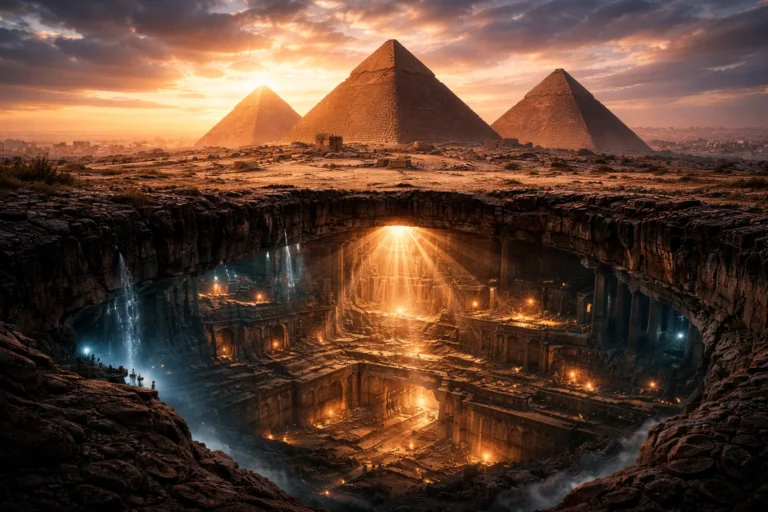
4,000 Feet Down: The Massive “Invisible City” Recently Detected Beneath the Pyramids
Few places on Earth ignite the imagination like the Pyramids of Giza. For more than 4,500 years, they have stood in silence, watching civilizations rise and fall. Now, in 2025 and 2026, a new controversy has brought them back into global headlines.
A team of researchers analyzing sub-surface scan data has suggested the presence of enormous underground formations beneath the Giza Plateau — formations some describe as being far larger than the pyramids themselves. Supporters have called it an “invisible city.” Critics have called it an overinterpretation of limited data.
The truth, as always, is more complicated.
This is what we know — and what we do not.
Where the Story Began
The debate centers on advanced scanning techniques used around the Giza Plateau. Over the past decade, scientists have deployed technologies such as ground-penetrating radar, seismic imaging, and cosmic-ray muon detection to better understand what lies beneath ancient structures.
Earlier efforts, including the internationally recognized ScanPyramids project, confirmed previously unknown voids inside the Great Pyramid of Giza. That discovery was peer-reviewed and widely reported.
The new controversy, however, involves claims that much deeper scans suggest large structural anomalies thousands of feet below the surface.
Some independent researchers analyzing publicly discussed scan patterns argue the signals resemble organized formations rather than natural geological layers.
But Egypt’s leading archaeologists and government officials have not confirmed the existence of any underground “city.”
What the 2025–2026 Claims Actually Say
The most widely circulated claim suggests sub-surface readings indicate massive geometric formations extending as deep as 4,000 feet below ground. Some online interpretations describe pillars, chambers, and layered construction far larger than the pyramids above.
It is important to pause here.
No official excavation has confirmed these formations. No peer-reviewed archaeological paper has validated the existence of a buried city. The data being discussed comes primarily from interpretation of remote sensing scans, not from direct access.
In other words, this is a debate over signals — not stones.
Understanding Sub-Surface Scanning
To understand the controversy, it helps to understand how scanning works.
Ground-penetrating radar sends radio waves into the earth and records reflections. Seismic imaging measures how vibrations travel through rock. Muon tomography detects cosmic particles that pass through solid material and can reveal hidden voids.
Each method has strengths and limitations.
Deep scans become less precise as depth increases. At extreme depths, distinguishing between natural rock formations and possible man-made structures becomes difficult.
Signals can be influenced by mineral composition, groundwater, fractures, and geological layering.
This is why interpretation matters so much.
Why Experts Are Skeptical
Leading Egyptologists and geophysicists have urged caution.
First, 4,000 feet is exceptionally deep. Most confirmed archaeological remains worldwide are found within tens of feet below the surface. Going nearly a kilometer underground raises serious geological questions.
Second, there is no historical record suggesting construction at such depths in ancient Egypt.
Third, deep underground rock layers beneath Giza are known to include natural limestone and sedimentary formations that can produce geometric-looking radar patterns.
Several academic voices have stated that extraordinary claims require extraordinary evidence — and that evidence must come from direct verification, not speculation.
Why the Idea Captures Attention
Despite skepticism, the story has exploded across social media and search engines.
Why?
Because the idea is thrilling.
The pyramids themselves were once thought impossible. The notion of a lost underground network hidden beneath them taps into humanity’s fascination with secret knowledge and ancient engineering.
It also touches on deeper questions. Did ancient civilizations know more than we assume? Are we missing chapters of human history?
These questions fuel curiosity — but they do not replace evidence.
Geology Beneath Giza
The Giza Plateau rests on layers of limestone dating back millions of years. Beneath that are sedimentary deposits shaped by ancient seas.
Geological surveys conducted over decades show natural cavities and fractures in the region. Karst formations — created when limestone dissolves — can produce voids and unusual underground shapes.
Such formations could easily be misread as artificial if viewed only through indirect imaging.
This geological context is central to the debate.
The Role of ScanPyramids
It is important to separate confirmed discoveries from speculation.
The ScanPyramids mission, launched in 2015, used muon detection to identify a large void inside the Great Pyramid. That discovery was peer-reviewed and published in scientific journals.
However, ScanPyramids has not announced any findings of a vast underground city thousands of feet below the plateau.
Mixing confirmed internal pyramid voids with unverified deep-earth interpretations has contributed to confusion.
Egypt’s Official Position
Egyptian authorities have not endorsed claims of a massive underground city beneath Giza.
Officials have emphasized that archaeological announcements must follow formal excavation, documentation, and review procedures.
In recent years, Egypt has invested heavily in preserving and promoting its heritage. Any discovery of this scale would be internationally announced and scientifically documented.
Until that happens, the “invisible city” remains a hypothesis.
Could There Be Hidden Chambers?
Yes — but likely at shallower depths.
Archaeologists widely agree that undiscovered chambers, tunnels, or burial shafts may still exist near the pyramids. Ancient Egyptian construction often included hidden corridors and sealed rooms.
Discoveries at Saqqara and Luxor over the past decade show that major finds are still possible.
But these are typically located within dozens of feet, not thousands.
The Problem With Viral Interpretations
In the digital age, raw scan images can circulate quickly. Without technical expertise, patterns may appear artificial.
Rectangular shapes can emerge from layered rock. Repeated signals can look like pillars. Human perception naturally seeks order in complexity.
This does not mean researchers are acting in bad faith. It means interpretation requires caution.
Archaeology moves slowly for a reason.
If It Were True
If a vast engineered structure truly existed 4,000 feet below Giza, the implications would be staggering.
It would rewrite ancient engineering history. It would challenge assumptions about construction capabilities. It would demand new timelines.
But such a claim would also require physical access, excavation technology capable of deep penetration, and transparent international collaboration.
Until then, it remains speculative.
What Happens Next
Researchers advocating further investigation are calling for expanded geophysical surveys and clearer data release. Critics are urging restraint and scientific review before public conclusions.
The path forward likely includes:
- Additional high-resolution seismic studies
- Independent verification
- Careful peer review
- Possible shallow test excavations
Real answers require methodical work.
Why Responsible Reporting Matters
It is easy to present this as proof of a lost underground metropolis. That would generate clicks. But responsible journalism must distinguish between confirmed discovery and interpretation.
There is a real story here — the story of how new technology is pushing archaeology deeper than ever before.
But there is also a responsibility to avoid turning hypothesis into headline.
The pyramids do not need exaggeration to remain extraordinary.
FAQs
Q: Has an underground city been confirmed beneath the pyramids?
No. There is no confirmed archaeological evidence of a city 4,000 feet beneath Giza.
Q: What sparked the 2025–2026 controversy?
Interpretations of sub-surface scan data suggesting large anomalies deep below the plateau.
Q: Are underground chambers possible?
Yes, at shallower depths. Ancient Egyptian sites often contain hidden shafts and rooms.
Q: Why is 4,000 feet considered unlikely?
Because most archaeological remains are near the surface, and deep geology beneath Giza consists mainly of natural rock layers.
Q: What would prove the claim?
Direct excavation, physical confirmation, peer-reviewed research, and official announcements.
Final Thoughts
The idea of an invisible city beneath the pyramids is powerful. It reminds us that history still holds secrets.
But science demands patience.
For now, what lies 4,000 feet beneath Giza is rock, mystery, and debate — not confirmed ruins.
If future research reveals more, the world will know. Until then, the pyramids continue to guard their secrets as they always have — quietly.
Disclaimer
This article is based on publicly discussed scan interpretations and official archaeological statements available as of 2025–2026. No confirmed discovery of a massive underground city beneath the Pyramids of Giza has been verified through peer-reviewed excavation. Readers are encouraged to rely on formal scientific publications for confirmed findings.
Reference URLs (Proof of Incident and Reporting)
- ScanPyramids official project site
https://www.scanpyramids.org - Nature article on muon detection in the Great Pyramid
https://www.nature.com/articles - Egyptian Ministry of Tourism and Antiquities announcements
https://egymonuments.gov.eg - Reuters coverage of pyramid scanning developments
https://www.reuters.com - BBC News reporting on pyramid discoveries
https://www.bbc.com/news

0 Comments