

















Imagine a world where the concept of a “morning” doesn’t exist. There is no golden hour, no Vitamin D, and certainly no weather forecast involving a “sunny day.” For billions of years, we’ve been told that the Sun is the ultimate engine of life—the great battery in the sky. But what happens when you pull the plug?
In the deepest trenches of our oceans, and perhaps on wandering “rogue planets” drifting through the icy void of interstellar space, intelligence isn’t just surviving; it’s rewriting the rulebook. This isn’t science fiction. It’s the story of how biology outsmarts a dark universe.
The Great Solar Divorce
Most of us are “Solar Chauvinists.” We think life needs photosynthesis to kickstart the heart of an ecosystem. Plants eat light, cows eat plants, we eat cows. It’s a clean, linear story.
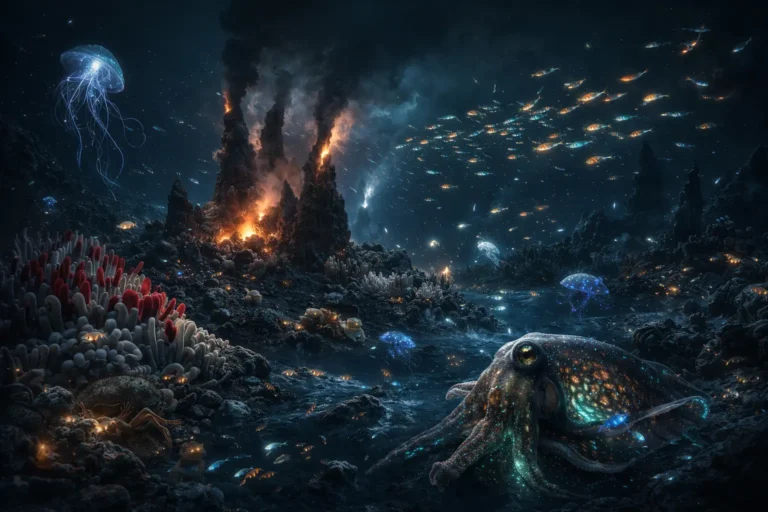
But miles below the surface of the Pacific, life looked at the Sun and said, “We don’t need you.” Around hydrothermal vents—cracks in the Earth’s crust spewing toxic, boiling chemicals—entire civilizations of bacteria thrive on chemosynthesis. Instead of harvesting photons, they harvest the energy of chemical bonds.
The Intelligence Shift: From Sight to Sonic
In a world with no sun, the “eye” becomes an expensive, useless marble. Evolution is ruthless; if you don’t use it, you lose it. But intelligence requires input. If you can’t see the predator coming, how do you get smart enough to outrun it?
- Bio-Sonar and Pressure Mapping: In the dark, the water itself becomes your nervous system. Creatures develop “lateral lines” so sensitive they can feel the heartbeat of a fish ten feet away. This isn’t just instinct; it’s high-speed data processing.
- The Bioluminescent Language: Imagine communicating by glowing. Deep-sea squid use complex flashing patterns—a literal “fiber-optic” language—to coordinate hunts. This is a leap toward symbolic intelligence.
Rogue Planets: The Nomads of the Galaxy
Beyond our oceans, astronomers have discovered “Rogue Planets”—worlds ejected from their home star systems, drifting in total darkness. Surprisingly, these planets might be the most common places for life in the universe.
If a rogue planet has a thick enough atmosphere or an icy shell (like Jupiter’s moon, Europa), the core’s internal heat can keep oceans liquid for billions of years. On these worlds, intelligence would evolve in a permanent, silent “night.”
What Would “Smart” Look Like There?
Without a sun to track time, these beings wouldn’t have “days.” Their intelligence might be based on thermal cycles or the slow decay of radioactive isotopes. They wouldn’t understand the concept of “up” or “the sky.” Their entire philosophy would be centered on the Core—the heat source that keeps them from freezing.
The Anatomy of a Shadow Genius
What does a high-level intellect look like when it’s never seen a ray of light?
- Extreme Tactile Memory: Instead of maps, they might use 3D chemical trails, remembering the “flavor” of a path for decades.
- Massive Brain-to-Body Ratios: Processing sound and vibration into a mental 3D image requires immense “compute power.” These creatures would likely be the supercomputers of the animal kingdom.
- Cooperative Telepathy? Not magic, but ultra-low-frequency vibrations that allow a pod of hunters to act as a single, distributed brain across miles of dark water.
Why This Matters for Humans
We are currently entering an age where we are looking for life on Europa and Enceladus. We are looking for “aliens” that don’t care about our Sun. Understanding how intelligence evolves in the dark helps us build better sensors, better AI, and perhaps, one day, helps us talk to a neighbor that doesn’t have eyes.
“Life finds a way, not because of the light, but because energy is everywhere if you’re smart enough to find it.”
Frequently Asked Questions
Can life really exist without any sunlight? Absolutely. We have already found massive ecosystems at the bottom of our oceans that rely entirely on Earth’s internal heat and chemicals (chemosynthesis).
How would these creatures “see”? They use biological sonar (echolocation), electro-reception (sensing the electric fields of living things), and extreme sensitivity to pressure and vibrations.
Could an advanced civilization move to a sunless world? Theoretically, yes. If a civilization becomes advanced enough to harness geothermal or nuclear fusion energy, they could thrive on a rogue planet indefinitely.
References and Sources
- National Geographic: The Deep Sea: The Biggest Habitat on Earth
- NASA Exoplanet Exploration: Rogue Planets: The Worlds Between Stars
- Nature Journal: Chemosynthetic pathways in deep-sea ecosystems
Disclaimer: This article discusses theoretical evolutionary biology and current oceanographic findings. While based on scientific data, theories regarding extraterrestrial intelligence remain speculative until direct evidence is discovered.

0 Comments