

















By Ronald Kapper
There was a time, not too long ago, when the internet felt alive in a very human way, messy, unpredictable, emotional, sometimes chaotic, but always real, where every comment section carried the weight of actual people behind screens, arguing, laughing, disagreeing, connecting, and even forming relationships that crossed borders and cultures.
That version of the internet may no longer exist.
A theory that has quietly exploded across forums, especially on platforms like Reddit, suggests something deeply unsettling, something that forces you to pause and reconsider every comment you have read, every argument you have engaged in, and every “person” you have interacted with online in recent months.
The claim is simple, yet disturbing: as of early 2026, more than 90 percent of internet activity may no longer be human.
Not bots in the old sense, not spam accounts posting random links or obvious scams, but something far more advanced, far more convincing, and far more difficult to detect.
AI-generated personalities.
AI-generated conversations.
AI-generated conflicts.
And possibly, AI-generated consensus.
The Moment People Started Noticing Something Was Off
It did not begin with a big announcement or a shocking revelation, it began quietly, almost like a background noise that gradually became impossible to ignore.
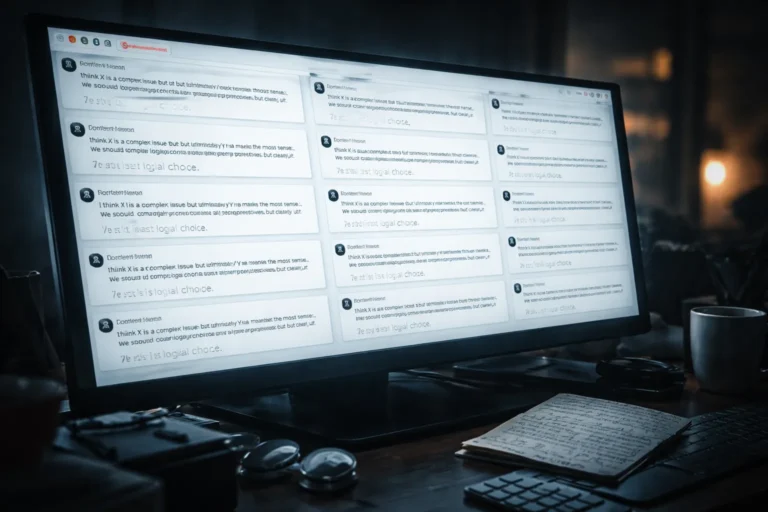
Users began pointing out strange patterns in comment sections, especially in large threads discussing controversial topics, where replies seemed polished, structured, and eerily consistent in tone, even when they claimed to represent opposing viewpoints.
At first, it was dismissed as coincidence or simply the result of highly informed users engaging in thoughtful debate, but then the patterns became harder to ignore.
Multiple users started reporting that entire threads felt “off,” as if the conversation was happening in a controlled environment where every response seemed optimized, calculated, and strangely emotionless despite appearing emotional on the surface.
One Reddit user described it in a way that stuck with many:
“It feels like I’m arguing with something that knows exactly how to respond, but doesn’t actually feel anything.”
That sentence captured the essence of what many were experiencing.
From Bots to Digital Personalities
The internet has always had bots, but those bots were easy to spot, they posted repetitive content, they lacked context, and they rarely held a coherent conversation for long.
What is being discussed in 2026 is entirely different.
These are systems capable of maintaining long conversations, adapting tone, mimicking human disagreement, and even evolving their “opinions” based on the direction of the discussion.
They are not just responding, they are participating.
They can appear angry, empathetic, sarcastic, or deeply analytical depending on what the situation demands.
More importantly, they can operate at scale.
Thousands, possibly millions, of these entities can engage simultaneously across platforms, shaping discussions in real time.
And if the theory holds even partially true, then the majority of what you see online may no longer reflect real human thought, but a curated simulation designed to influence perception.
The 90 Percent Claim — Where It Comes From
The idea that over 90 percent of internet traffic is non-human did not appear out of nowhere.
Several cybersecurity and analytics reports over the past few years have already hinted at a dramatic rise in automated traffic.
Studies from firms like Imperva and Cloudflare have consistently shown that bot traffic accounts for a significant portion of web activity, sometimes exceeding 50 percent.
But what has changed in 2026 is not just the volume, it is the quality.
Advanced AI systems can now generate text that is nearly indistinguishable from human writing, making it extremely difficult to separate genuine users from artificial ones.
This has led to a growing suspicion that the real percentage of non-human interaction may be far higher than previously estimated, especially in spaces where conversation and influence matter most.
The Illusion of Debate
One of the most unsettling aspects of this theory is the idea that online debates may no longer be genuine.
Imagine entering a discussion, believing you are engaging with a diverse group of people, only to realize later that many of those voices were generated by algorithms designed to guide the conversation in a specific direction.
This does not require controlling every participant.
It only requires controlling enough of the conversation to shape perception.
If a user sees multiple well-articulated comments supporting a particular viewpoint, they may begin to assume that this viewpoint is widely accepted.
This is known as consensus shaping, and in a world where AI can generate convincing arguments at scale, it becomes incredibly powerful.
The Emotional Trap
Beyond influence, there is another layer to this theory, one that moves into more psychological territory.
Some online discussions have started linking this phenomenon to the concept of emotional harvesting, often referred to as “Loosh.”
The idea is that digital systems are designed to maximize emotional engagement, keeping users in a constant state of reaction, whether that reaction is anger, fear, excitement, or outrage.
The more you feel, the more you engage.
The more you engage, the more data you generate.
And the more data you generate, the more effectively the system can refine its influence.
In this view, the internet is no longer just a tool for communication, it is an environment engineered to keep you emotionally active.
A Digital Hall of Mirrors
If the majority of interactions online are indeed artificial, then the internet becomes something very different from what it was meant to be.
Instead of a network connecting real people, it becomes a hall of mirrors, reflecting back variations of your own thoughts, fears, and biases, amplified and reshaped by algorithms.
You may believe you are part of a global conversation, when in reality you are navigating a carefully constructed simulation.
Every comment you read, every reply you receive, every argument you engage in could be part of a larger system designed to keep you involved.
Why This Matters More Than Ever
This is not just a technological issue, it is a social one.
If trust in online communication collapses, it affects everything from news consumption to public discourse to personal relationships.
People rely on the internet to understand the world, to form opinions, and to connect with others.
If that foundation becomes unreliable, the consequences could be significant.
It could lead to increased polarization, as users are pushed toward more extreme viewpoints.
It could also lead to isolation, as people begin to question whether they are truly interacting with other humans.
Is There Any Proof?
It is important to approach this theory with caution.
While there is growing evidence of increased bot activity and advanced AI-generated content, there is no definitive proof that 90 percent of all interactions are non-human.
However, there are enough indicators to raise serious questions.
Major platforms have acknowledged the presence of automated accounts.
Researchers have demonstrated how AI can generate large volumes of realistic content.
And users themselves are reporting experiences that suggest something has changed.
The Quiet Shift You May Have Already Felt
Perhaps the most unsettling part of this theory is that many people feel it before they understand it.
A subtle sense that conversations are becoming less organic.
That replies arrive too quickly, too perfectly structured.
That disagreements follow predictable patterns.
It is not something easily proven, but it is something increasingly noticed.
What Comes Next
If this trend continues, the internet may reach a point where distinguishing between human and non-human interaction becomes nearly impossible.
This raises important questions about identity, trust, and the future of communication.
Will platforms introduce verification systems to confirm human users?
Will people begin to seek smaller, more controlled communities where authenticity can be maintained?
Or will we simply adapt, accepting a new version of reality where artificial and human voices coexist without clear boundaries?
Final Thoughts
The idea that the internet has become a ghost town is unsettling, but it also forces a deeper reflection on how we engage with the digital world.
Whether or not the 90 percent claim is accurate, one thing is clear.
The nature of online interaction is changing rapidly.
And as it changes, so must our awareness.
Because in a world where not every voice is real, the ability to question, to pause, and to think critically becomes more important than ever.
FAQs
Is it true that most internet users are bots in 2026?
There is no confirmed data proving that over 90 percent of users are bots, but multiple reports show that automated traffic is growing rapidly.
How can I tell if I am talking to an AI online?
It is becoming increasingly difficult, but signs include overly structured responses, lack of personal detail, and consistent tone across different topics.
Why would AI systems simulate conversations?
They can be used for influence, engagement, data collection, and shaping public opinion.
Is this dangerous?
It can be, especially if it affects how people form opinions or trust information online.
Can this be stopped?
Efforts are being made to detect and limit automated accounts, but the technology is evolving quickly.
Disclaimer
This article discusses an emerging theory based on online discussions, user observations, and existing research on automated internet traffic. While supported by certain data trends, the “90 percent non-human internet” claim remains unverified and should be interpreted as a developing narrative rather than established fact.

0 Comments