














By Ronald Kapper
Disclaimer: This article explores active ideas in physics about the deep structure of space and time. It presents mainstream science and bold, emerging proposals in plain language. These ideas are still being tested. Read with curiosity and a healthy dose of scientific caution.
A short, exciting invitation
Imagine peeling back reality like an onion and finding, underneath the familiar stage of space and time, a strange pattern of shapes, connections, and information. These hidden shapes would not be visible like planets or atoms. Instead they would be the rules that stitch together what we call “here” and “now.” Physicists call this broad search for deeper structure the study of the geometry of spacetime. In the last two decades that search has taken surprising turns: geometry may arise from quantum information, from networks of entanglement, and from principles that look as much like coding as like calculus. This article walks you through the big picture, the strongest clues, the puzzles that remain, and why this matters beyond the ivory tower.
What we mean by “geometry of spacetime”
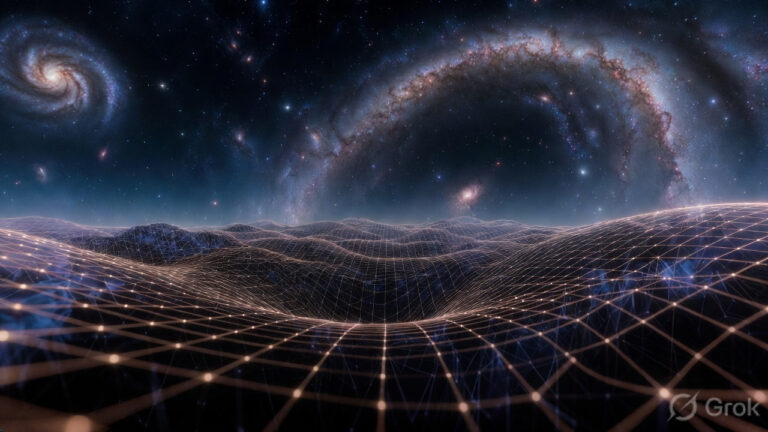
When physicists say “geometry of spacetime,” they mean the way distances and times are measured and how matter moves. In Einstein’s theory, that geometry curves where mass and energy are present; that curvature is gravity. The geometry tells objects how to move, and objects tell geometry how to change. That simple slogan captures a deep shift from Newton’s fixed stage of absolute space and time to a living, dynamic fabric. Bold new work asks: might that fabric itself be made of something more primitive — discrete pieces, networks of information, or quantum correlations — rather than being continuous and fundamental? The answer is not settled, but the evidence is exciting.
The classic picture: spacetime as a smooth fabric
For most practical purposes — rockets, GPS satellites, black hole predictions — general relativity works beautifully. It treats spacetime as a smooth four-dimensional manifold equipped with curvature that follows Einstein’s equations. That curvature explains why planets orbit, why light bends, and why time runs differently near massive objects. The math is elegant and the predictions match experiments and observations to high precision. Yet, when we push to the smallest scales or highest energies, this smooth picture runs into trouble; quantum rules resist being written on an infinitely smooth stage. That tension is part of why scientists look for a deeper geometric foundation.
The surprising hint: information and geometry
A radical clue emerged from studies of black holes and quantum physics: information seems to be linked to geometry. The surprising discovery was that the amount of information associated with a black hole scales with the area of its horizon, not the volume it encloses. That idea — the holographic principle — suggests that a region’s geometry may be encoded on a lower-dimensional boundary, like a hologram. If geometry and information are tied this closely, it opens the possibility that the bulk geometric picture we live in is actually a macroscopic expression of microscopic information patterns. In short: geometry could be a large-scale story told by many tiny informational notes.
AdS/CFT: a laboratory for emergent geometry
One concrete arena where these ideas have been sharpened is the AdS/CFT correspondence. This discovery links a gravitational theory in a “bulk” spacetime (with negative curvature) to a non-gravitational quantum theory living on that spacetime’s boundary. Remarkably, precise geometric features in the bulk — distances, surfaces, and curvature — can be re-expressed as quantum properties like correlation and entanglement on the boundary. Researchers have used this mapping to show how notions of distance and even spacetime connectivity can emerge from entanglement patterns. AdS/CFT is a powerful theoretical laboratory where emergent geometry can be computed and tested in detail.
Entanglement: the thread that might weave space
Entanglement is the quantum link that joins separated systems so their states cannot be described independently. Over the last decade, physicists realized that entanglement may do more than generate spooky correlations — it may literally shape space. In many holographic setups, the area of certain minimal surfaces in the bulk matches the entanglement entropy of boundary regions. Put simply: more entanglement can correspond to a larger or more connected chunk of geometry. This has led to metaphors like “geometry is entanglement.” While the metaphors are vivid, the technical results show deep and surprising formulas tying quantum information to geometric measures.
From networks to geometry: tensor networks and spin networks
Several research paths try to make emergent geometry concrete by building discrete structures whose large-scale behavior looks like continuous spacetime.
• Tensor networks are networks of contracted tensors used in condensed-matter physics to capture many-body quantum states. When arranged cleverly, they produce emergent spatial geometry; distances in the emergent space can be read off from correlation patterns. Tensor networks have been used to model simple holographic setups and to illustrate how geometry and connectivity arise from local building blocks.
• Spin networks and loop-inspired pictures attempt to quantize space itself into discrete chunks — nodes and links carrying quantum numbers. These approaches focus on making a background-free quantum geometry, where space is not a preexisting stage but an outcome of network degrees of freedom.
Both lines of work aim to show how familiar geometry can arise from microscopic, pre-geometric data. They are technical but promising.
Why black holes and entropy keep showing up
Black holes are a testing ground for ideas about geometry because they push gravity and quantum theory to their limits. The link between horizon area and entropy ties geometric quantities to counting of microstates. This connection forces theorists to ask: what are the microscopic degrees of freedom that give rise to area and curvature? If those microstates are informational or network-like, then geometry itself might be a coarse-grained description. Many modern studies use black hole thought experiments and actual calculations (like the Page curve) to test whether proposed microscopic pictures are consistent with what gravity demands. These are not idle curiosities — they are key checks of any proposal that aims to replace the smooth fabric of spacetime.
Open questions that matter most
The emerging-geometry program is rich but faces hard roadblocks.
- Recovering realistic cosmology. Much of the precise progress is in special spacetimes (like anti–de Sitter space). Our universe looks different: it is expanding and seems closer to de Sitter space. Translating emergent-geometry tools from one setting to the other is an ongoing challenge.
- Locality and causality. How do smooth local light cones and cause-effect relationships arise from nonlocal entanglement patterns? Reproducing the everyday causal structure — the fact that signals travel within light cones — is nontrivial.
- Testing in the lab or sky. Ultimately, we need observable signatures that could falsify or support these ideas. Some proposals suggest subtle traces in gravitational-wave signals, black hole evaporation patterns, or cosmological imprints. Pinning down unique signals remains a top priority.
- Why geometry looks classical. The microscopic ingredients are quantum and probabilistic. Explaining why large-scale geometry settles into the smooth, stable form we measure — and why measurements yield definite outcomes — is a major task.
What this could mean for everyday reality
This work might seem remote, but its implications are profound. If space and time are emergent, then the basic arena of reality is made of relations, information, and quantum connections. Locality, distance, and even the notion of “now” could be effective, approximate rules that hold because of the way underlying degrees of freedom organize. For engineers and ordinary life, nothing immediate changes — your phone and your car will still work — but we would have a fundamentally new map of what reality is made of. That new map could reshape how we think about information, computation, and the architecture of future technologies that push quantum systems to new limits.
A human story: why physicists care so passionately
Behind the equations are people who get excited the way artists do when they spot a fresh pattern. The drive to find a simpler, deeper account of space and time comes from curiosity and the taste for unity. Einstein felt the same hunger when he replaced Newton’s fixed stage with a geometric one. Today’s researchers hope to do something equally radical: show that the stage itself is a story told by bits and bonds. That is an idea with poetry in it: reality, once stripped bare, might be an orchestra of relations that, when played together, sings up the world we live in.
FAQs — clear answers to common questions
Q: Is spacetime really just information?
A: “Just” is too strong; a better phrasing is that information appears to play a fundamental role in many modern theoretical approaches. Several frameworks show geometry linked to information measures. This does not yet prove spacetime is information, but it shows the link is real and powerful.
Q: Will this let us travel faster than light or into the past?
A: No. The proposals reframe how spacetime arises; they do not overturn physical limits like the speed of light. Any viable theory must reproduce the causal limits we observe. So science fiction remains science fiction for now.
Q: Is this all mathematics, or will experiments test it?
A: Much of the progress is mathematical and conceptual. However, researchers seek observational handles — for example, precise properties of black hole radiation, signatures in the cosmic microwave background, or patterns in gravitational waves. Finding unambiguous experimental tests is a central goal.
Q: Will this unify quantum mechanics and gravity?
A: That is the long-term hope. Emergent geometry is one promising route to reconcile quantum rules with gravitational geometry. It is not the only route; loop-based approaches and others pursue different ideas. Whether one of them will succeed in providing a full, testable unification remains an open question.
Q: How soon will we know the answer?
A: Scientific revolutions do not have neat timetables. Expect steady progress: deeper mathematical links, sharper thought experiments, and more targeted observational proposals. Decisive proof may take years or decades.
How scientists are testing these ideas now
Researchers are combining tools from quantum information, black hole physics, and cosmology. They use toy models where calculations are tractable, explore how entanglement patterns rebuild geometry, and search for unique signatures in high-energy astrophysical processes. Progress also comes from mathematical advances that let physicists define curvature and geometry in settings where smoothness is absent. The convergence of ideas from different fields — condensed matter, quantum computing, and gravity — is accelerating progress.
Closing: a humble, thrilling frontier
The hidden geometry of spacetime sits at the meeting point of deep math and bold imagination. It is a place where entropy and information, black holes and networks, quantum bits and curvature all seem to speak the same language. The road ahead is hard and full of puzzles, but that is exactly what makes it electrifying. Whether spacetime proves to be emergent or whether we discover a deeper continuity beneath it, the journey is rewriting how we picture the universe — and reminding us that the simplest questions can open the widest vistas.
References and source URLs
(Provided for verification and further reading — not inserted in the article body.)
- Review: Holographic spacetime, black holes and quantum error correction — T. Kibe et al., Eur. Phys. J. C (2022). https://link.springer.com/article/10.1140/epjc/s10052-022-10382-1
- Exact holographic mapping and emergent space-time — X.-L. Qi (2013). https://arxiv.org/abs/1309.6282
- The holographic principle comes from finiteness of geometry — A. Bolotin et al. (2024). https://arxiv.org/abs/2407.14551
- Spacetime emergence from quantum entanglement — L. Nye et al. (thesis/review). https://inspirehep.net/files/d64c391f3aa408496952d4b533442b5b
- On the geometric meaning of general relativity — N. Rekik (2024) / ScienceDirect overview of curvature and gravitational waves. https://www.sciencedirect.com/science/article/abs/pii/S0960077924012591

0 Comments