

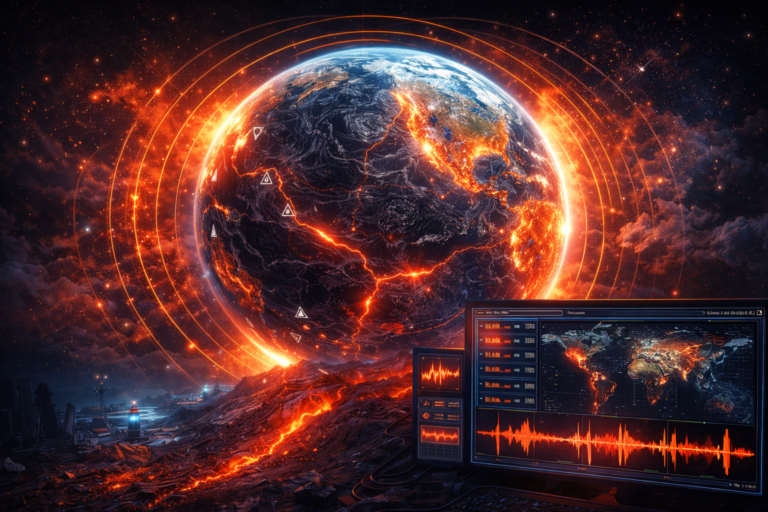

Introduction: The Ground Is Speaking More Often
Earthquakes are nothing new. The planet has always moved, cracked, slipped, and reshaped itself beneath our feet.
What is new is how often — and where — those movements are appearing.
Over recent months, geologists have observed a rise in seismic activity across multiple regions of the world. Individually, most of these earthquakes are moderate. Many go unnoticed by the public. But taken together, they form a pattern that researchers are studying with growing attention.
This is not a warning of imminent catastrophe. It is something subtler — and, in many ways, more intriguing.
What the Data Is Showing
Global seismic monitoring networks track tens of thousands of earthquakes each year. Most are small. Some are large. Patterns usually emerge slowly.
Recently, scientists have noticed:
- Increased frequency of mid-range earthquakes
- Activity clustering along multiple plate boundaries
- Seismic events occurring closer together in time
- More movement along secondary fault lines
According to a geophysicist who analyzes global seismic data:
“No single quake stands out. What stands out is the rhythm.”
That rhythm is what has drawn attention.
Where the Activity Is Concentrated
The increased activity spans several tectonically active regions, including:
- Parts of the Pacific Ring of Fire
- Sections of the Mediterranean and Middle East
- Areas along major oceanic ridges
- Secondary fault zones previously considered quieter
This distribution suggests a broader planetary process rather than a localized anomaly.
Earth’s tectonic plates are massive, interconnected systems. Stress released in one region can subtly influence another — sometimes thousands of kilometers away.
The Parallel Reality Beneath the Surface
At street level, life feels stable. Buildings stand. Roads remain intact. The ground seems solid.
Below, another reality exists.
Tectonic plates grind, bend, and store energy. Pressure builds over decades, sometimes centuries, before releasing in seconds. That release is what people experience as earthquakes.
Most of this activity remains invisible — a constant background motion shaping the planet without human awareness.
Both realities coexist.
The surface stays calm while the deeper system adjusts itself.
Why This Pattern Has Scientists Paying Attention
Geologists are cautious by nature. They do not react to headlines — they react to data.
The current concern is not magnitude, but coordination.
When seismic activity increases across unrelated fault systems at roughly the same time, it raises questions about broader stress redistribution within Earth’s crust.
A senior tectonics researcher explained it this way:
“The planet doesn’t move randomly. When patterns appear, they deserve examination.”
Examination does not mean alarm. It means deeper analysis.
What This Does — and Does Not — Mean
It is important to separate observation from prediction.
What It Means:
- Earth’s crust is actively redistributing stress
- Monitoring systems are capturing more detailed data than ever
- Scientists are comparing current patterns with historical cycles
What It Does Not Mean:
- A single massive earthquake is guaranteed
- A global disaster is imminent
- Faults are “synchronizing” in a dramatic sense
Earthquakes remain notoriously difficult to predict in precise terms.
Technology Is Changing How We See Earthquakes
One reason these patterns are being discussed now is improved detection.
Modern seismic networks can detect:
- Smaller quakes previously unnoticed
- Deeper movements beneath ocean floors
- Subtle tremors linked to slow-slip events
As a result, Earth appears more active — not because it suddenly changed, but because humans are listening more closely.
This creates a challenge: distinguishing between genuine increases and newly visible background activity.
Historical Context Matters
Earth has experienced periods of heightened seismic activity before.
Historical records show clusters of earthquakes occurring within certain decades, followed by quieter intervals. These cycles are not fully understood, but they suggest that variability is part of Earth’s natural behavior.
What makes the current moment notable is the global scale of observation — not necessarily the severity of events.
How Scientists Are Responding
Rather than issuing warnings, geologists are:
- Updating stress models for major fault systems
- Comparing modern data with historical seismic records
- Coordinating across international monitoring agencies
- Studying interactions between tectonic plates and mantle dynamics
This work happens quietly, away from public view.
As one monitoring official noted:
“Most of our work is about understanding, not predicting headlines.”
Why These Stories Capture Public Attention
Earthquakes touch a deep human nerve. They remind people that the ground itself is not permanent.
When reports mention “patterns” or “increases,” imagination often fills the gaps left by uncertainty.
But uncertainty is not the same as danger.
In science, it is simply the starting point for better understanding.
FAQs
Is global seismic activity actually increasing?
Some data suggests higher frequency in certain ranges, but interpretation is ongoing.
Does this mean a major earthquake is coming?
There is no reliable way to predict specific earthquakes based on current patterns.
Are these earthquakes stronger than before?
Most are moderate and comparable to historical norms.
Why are scientists discussing this now?
Improved monitoring allows broader pattern recognition.
Should people prepare differently?
Standard earthquake preparedness is always advisable in active regions.
Final Perspective
Earth is not static. It never has been.
The rise in global seismic activity does not signal chaos — it signals motion. A planet adjusting itself, redistributing stress, and continuing processes that have shaped continents for billions of years.
What feels unsettling is not the movement itself.
It is our growing ability to see it.
The planet has always been alive beneath our feet.
We are just paying closer attention now.
References
- U.S. Geological Survey (USGS) Global Seismic Reports
- International Seismological Centre (ISC) Data Archives
- European-Mediterranean Seismological Centre (EMSC)
- Peer-reviewed studies on global tectonic stress redistribution
- Geological Society publications on seismic clustering

0 Comments