



















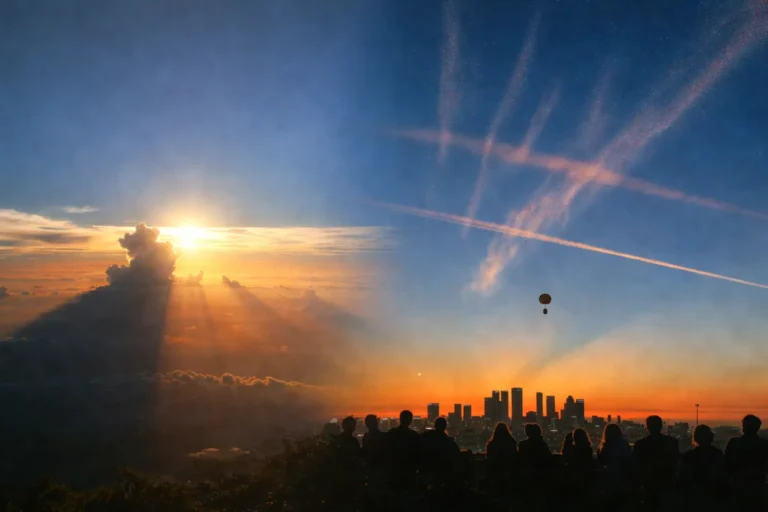
There is a strange pattern unfolding across the internet in 2026, and it is spreading faster than most people realize, because it does not begin with official announcements or scientific papers, it begins with forwarded WhatsApp messages, short viral reels, and dramatic claims that sound just believable enough to spark fear, curiosity, and outrage at the same time.
One message claims that Bill Gates is spraying chemicals into the sky to create artificial rain, another says the sun is being blocked on purpose, and yet another warns that secret experiments are already controlling the climate over entire countries.
At first glance, these claims sound like recycled conspiracy theories from years ago, especially those tied to the old “chemtrails” narrative, but here is where things get more complicated, because unlike earlier internet myths, today’s rumors are built on something real, something that actually exists in scientific research labs and policy discussions around the world.
That real thing is called geoengineering, and more specifically, a controversial concept known as stratospheric aerosol injection, and this is exactly where truth and misinformation begin to mix in a way that is confusing millions of people globally.
The Big Disclaimer Before We Begin
Let’s make one thing very clear from the start, because this is where most confusion begins and where most viral posts go wrong.
There is no evidence that any individual, including Bill Gates, is currently controlling the weather, creating artificial rain on a global scale, or blocking the sun in real-world deployment.
At the same time, it is also true that scientists are actively researching ways to cool the Earth by reflecting sunlight, and some of these ideas sound so extreme that they naturally trigger fear and suspicion.
Both of these statements are true at the same time, and understanding that balance is the key to separating fact from fiction.
What Is Geoengineering and Why Is It Suddenly Everywhere
Geoengineering is not a single technology, it is a broad category of ideas designed to deliberately change the Earth’s climate system, usually as a response to global warming.
Among these ideas, the most talked-about and most controversial is something called solar geoengineering, which focuses on reflecting sunlight away from the planet to reduce heat.
One of the leading theoretical methods in this category is stratospheric aerosol injection, often shortened to SAI.
According to scientific research, SAI involves releasing tiny reflective particles into the upper atmosphere so that a small portion of sunlight is bounced back into space, creating a cooling effect similar to what happens after large volcanic eruptions.
This is not science fiction, it is a concept studied seriously by climate scientists, and it has been discussed in major global climate reports as a potential emergency tool if warming becomes uncontrollable.
But here is the important part that viral posts ignore, this technology is not currently deployed at a global scale, and most of the work being done today is still in the research and modeling stage.
The SCoPEx Experiment: The Center of the Storm
If you trace most of the viral claims circulating in 2026, they almost always lead back to one specific scientific project, the Stratospheric Controlled Perturbation Experiment, better known as SCoPEx.
This experiment, supported by researchers linked to Harvard, was designed to study how tiny particles behave in the upper atmosphere and how they interact with sunlight.
The idea behind SCoPEx was not to control the climate, but to collect data that could help scientists understand the risks and potential of geoengineering in the future.
The scale of the experiment is where reality sharply diverges from viral claims, because the amount of material involved in these tests is extremely small, far less than what a typical airplane emits during a normal flight.
In fact, fact-checking investigations have repeatedly clarified that such experiments are not capable of altering the weather or blocking the sun, and are instead limited to controlled scientific observations.
Despite this, the presence of a real experiment has made it easy for misinformation to grow, because it gives conspiracy theories a foundation that sounds credible.
Where Bill Gates Fits Into the Story
The name Bill Gates appears in almost every viral post related to weather control, and this is not entirely random.
He has financially supported research into climate solutions, including geoengineering concepts, which has been publicly reported and widely discussed.
However, there is a massive leap between funding research and personally controlling the climate, and that leap is where misinformation thrives.
Research programs like the Harvard Solar Geoengineering initiative exist to explore scientific possibilities and understand risks, not to deploy global weather manipulation systems.
Even Gates himself has suggested that such technologies should only be considered in extreme climate scenarios, not as a current solution being secretly used.
Why the “Artificial Rain” Rumor Is Spreading So Fast
The explosion of these rumors in 2026 is not accidental, it is the result of several powerful forces coming together at once.
First, climate change is becoming more visible, with extreme weather events making people more sensitive to anything related to the sky, heat, or rain.
Second, geoengineering has moved from obscure academic discussions into mainstream headlines, making it easier for misinformation to attach itself to real science.
Third, social media algorithms reward shocking content, and nothing spreads faster than the idea that someone is secretly controlling the weather.
Research has shown that conspiracy theories around geoengineering, especially those linked to “chemtrails,” tend to spread across platforms and influence public perception globally.
When people see a real concept like aerosol injection combined with a powerful name like Bill Gates, the story becomes emotionally convincing, even if the details are wrong.
The Real Risks Scientists Are Actually Worried About
While viral posts exaggerate the idea of weather control, scientists themselves are not dismissing geoengineering as harmless.
In fact, many researchers warn that if technologies like SAI were ever deployed at scale, they could have serious and unpredictable consequences.
Some models suggest potential disruptions to rainfall patterns, including impacts on monsoons that billions of people depend on.
Others warn about risks like droughts, uneven regional effects, and even geopolitical tensions if one country’s climate intervention affects another.
There are also ethical concerns, including who gets to decide if such technologies are used, and what happens if something goes wrong.
This is why many experts emphasize that geoengineering is not a replacement for reducing emissions, but at best a last-resort option.
The Dangerous Middle Ground Between Truth and Fear
What makes the current situation so unique is that we are no longer dealing with pure conspiracy theories or pure science, but something in between.
Geoengineering is real, but it is not being deployed in the way viral messages claim.
Research is happening, but it is not secret global weather control.
Funding exists, but it does not equal power over the planet.
This middle ground is where confusion grows, because people are reacting to a mix of facts and exaggerations, and in that mix, fear often wins.
Why Governments Are Still Hesitating
Despite decades of research, no country has officially deployed large-scale solar geoengineering, and there are strong reasons for that.
The science is still uncertain, the risks are global, and the consequences could be irreversible if handled poorly.
There is also no clear international framework for who controls such technology, which makes it politically sensitive.
Even planned experiments have faced resistance from communities and environmental groups, highlighting how controversial the field remains.
The Bottom Line: What You Should Actually Believe
If you strip away the noise, the truth is both less dramatic and more important than the viral stories suggest.
There is no secret global weather control program creating artificial rain in 2026, and there is no evidence that any individual is manipulating the climate at scale.
At the same time, scientists are seriously studying ways to cool the Earth, and some of those ideas involve altering how sunlight interacts with the atmosphere.
These ideas are controversial, risky, and still far from real-world deployment, but they are not imaginary.
Understanding this balance is the only way to stay informed without falling into fear-driven narratives.
FAQs
Is Bill Gates controlling the weather in 2026?
No, there is no scientific or factual evidence that Bill Gates or anyone else is controlling the weather.
What is SCoPEx in simple terms?
SCoPEx is a research experiment designed to study how tiny particles behave in the upper atmosphere, not to control the climate.
Can scientists really block the sun?
Not in the way viral posts claim, current research is limited and cannot block the sun or control global weather.
What is stratospheric aerosol injection?
It is a proposed method to cool the Earth by reflecting sunlight using particles in the upper atmosphere.
Is geoengineering dangerous?
It could be, which is why it is still being studied carefully and not widely used.
Final Word for Readers
This topic sits at the edge of science, politics, and public fear, and that makes it one of the most misunderstood issues of our time.
The truth is not as simple as “it’s all fake” or “it’s already happening everywhere,” the truth is that humanity is exploring powerful technologies while still trying to understand their consequences.
And in that uncertainty, rumors will always travel faster than facts.
References / Sources
- https://www.forbes.com/sites/arielcohen/2021/01/11/bill-gates-backed-climate-solution-gains-traction-but-concerns-linger/
- https://en.wikipedia.org/wiki/Stratospheric_aerosol_injection
- https://salatainstitute.harvard.edu/research-initiatives/the-harvard-solar-geoengineering-research-program/
- https://www.geoengineeringmonitor.org/scopex
- https://www.poynter.org/tfcn/2021/claims-that-bill-gates-is-going-to-block-the-sun-lack-context/
- https://www.geoengineeringmonitor.org/current-geoengineering-attempts-briefing-scopex-2021
- https://www.sciencedirect.com/science/article/pii/S2589004223002432
- https://www.thearcticinstitute.org/sami-council-resistance-scopex-highlights-complex-questions-geoengineering-consent/

0 Comments