


















The moment the sky stopped being ordinary
One ordinary morning, people looked up and saw a streak of light — not a plane, not a shooting star, but something that announced itself with a roar, a flash, or days of radio silence. Some of those things fell to Earth and stayed. Others splashed into the ocean, stayed lodged in ice, or were recovered and examined by scientists. This story digs into how objects cross the thin shell around our planet — the atmosphere — and end up staying inside our world: as meteorites on the ground, as recovered debris, or as recovered evidence of spying at high altitudes.
We’ll walk through real incidents, explain how scientists confirm what happened, present the proofs and sources, and answer the practical questions: was anyone hurt? Is Earth safe? What does it mean when something “doesn’t leave” again?
What it means to “enter” — and to “not leave”
When something from space or the edge of space enters Earth’s atmosphere it faces a brutal test. The air, thin at first, thickens rapidly. Friction and compression heat the surface of the object to thousands of degrees. Many bodies break apart, burn up, or explode in midair. Some parts survive and fall to the surface as meteorites. Spacecraft or debris that lose orbital speed can re-enter and land, intentionally or by accident. High-altitude balloons and surveillance platforms sit inside layers of the atmosphere and can be recovered after they’re brought down.
Saying an object “didn’t leave” the atmosphere can mean one of two things:
- It came through and reached the surface — fragments now rest on Earth.
- It passed into the airspace and stayed there long enough to be tracked, recovered, or to cause lasting effects.
Both kinds are real. We have hard examples.
Hard example: the Chelyabinsk meteor — a rock that refused to vanish
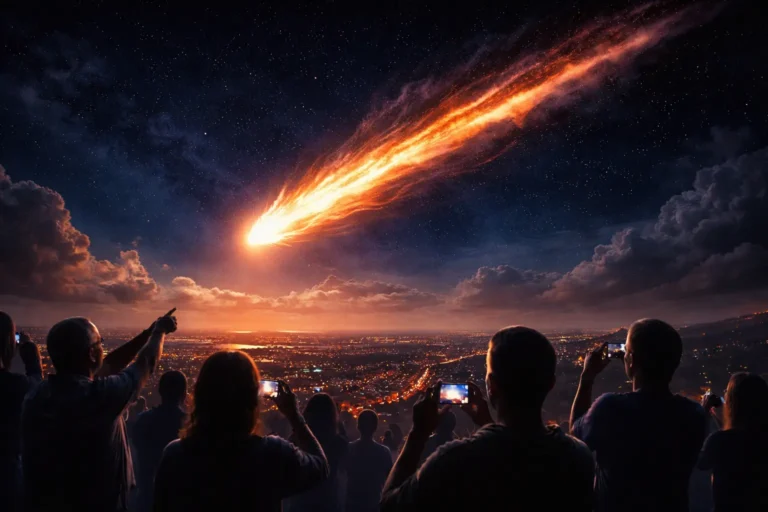
On February 15, 2013, a house-sized rock hit the atmosphere over the southern Ural region. It streaked across the sky, shattered in a massive airburst, and rained fragments down on towns below. Windows shattered. People were injured by flying glass. Divers later recovered a heavy chunk from the bottom of Lake Chebarkul. Scientists studied the fragments to learn where it came from and how much energy it released. That event is a clear case: an object entered the atmosphere and pieces remained on Earth for study.
Hard example: space hardware that falls back after decades
Not all objects are natural. Old satellites and probes sometimes stay in orbit for years and then finally lose speed and fall back. Recently, a Soviet probe that had been “stuck” in Earth orbit for decades finally returned to the surface. Pieces like this give researchers a rare chance to examine hardware designed long ago and track how materials behave after long space exposure. These returns are reminders that the near-Earth environment is crowded and that not all things launched into space simply vanish.
Hard example: the balloon that crossed a continent — then was taken down
In early 2023, an object that traveled across large swaths of national airspace made headlines. The U.S. identified a high-altitude balloon that crossed North America. The object spent days in the upper air layers before being shot down over water; the U.S. recovered debris and examined it for electronics and optics. That incident is a modern example of something that entered the skies and stayed long enough to be recovered and analyzed; it became a matter of public record and diplomatic tension.
How investigators prove an incident happened — the methods of truth
When the sky fills with a flash and people talk, scientists and authorities use several tools to turn sight and rumor into evidence:
- Seismic and infrasound records. Large airbursts create pressure waves that instruments pick up around the globe. These are a fingerprint of energy release.
- Satellite imagery and tracking data. Weather and defense satellites can spot fast moving fireballs or drifting high-altitude objects.
- Eyewitness video. Dashcams, phone footage, and CCTV often capture the event. When time-stamped and geolocated, these videos help reconstruct the path and altitude.
- Physical recovery. Meteorite fragments, debris from craft, or recovered balloon components are examined in labs. Chemical and structural tests reveal origin and material history.
When multiple lines of evidence point to the same story, researchers grow confident. That’s why recovered meteorite pieces and lab reports are so decisive.
Why these events matter to everyday people
A rock hitting uninhabited wilderness is a dramatic story but a limited immediate danger. However, the same processes that bring small meteorites can — very rarely — bring larger pieces capable of significant damage. Beyond direct harm, these events matter because:
- They test our tracking systems and early warning.
- They force governments to answer questions about foreign surveillance tools in their skies.
- They spur science: meteorites are priceless samples from other worlds.
- They push policy on space debris management and satellite design.
That’s why scientists, militaries, and newsrooms all jump into action when “something” enters the air.
How to tell natural from human-made
At first glance, bright streaks and strange shapes can look the same. Here are practical clues investigators use:
- Speed and trajectory. Natural meteoroids hit at tens of kilometers per second along curved trajectories; balloons move slowly and follow winds.
- Breakup behavior. Airbursts and fragment showers point to natural rocks; intact or partially intact structures with wiring suggest human craft.
- Material evidence. Metal alloys, circuit boards, and controlled-descent parts reveal a manufactured origin. Stone, fusion crust, and chondrules point to meteorites.
Scientists combine these clues with official tracking to assign origin.
What the data say about recent, high-profile events
- The Chelyabinsk event left clear seismic and satellite signatures and recovered fragments, proving a meteorite fall.
- The 2023 high-altitude balloon was tracked across thousands of kilometers; recovered debris showed hardware consistent with surveillance. That incident was documented by defense officials and recovered remnants were analyzed.
- Returns of long-dormant spacecraft show that old hardware eventually re-enters; these are tracked and reported in science outlets.
These examples show different ways an object can “not leave” the atmosphere: by landing, by lingering and being shot down, or by finally returning after decades.
Safety: when should you worry?
Most of the time you don’t need to. Small meteors hit daily but burn up. The rare big events make headlines. If you see a bright flash and a loud blast, follow these steps:
- Stay away from downed objects. Don’t touch unknown fragments.
- Report the sighting to local authorities or national agencies that collect fireball reports.
- If you’re in a damaged area, follow emergency instructions from local services.
Scientists ask the public to upload videos and eyewitness reports — these inputs help reconstruct events and protect communities.
Scientific gold: why recovered fragments are priceless
Meteorites are time capsules. They can contain minerals untouched since the solar system formed. Examining them reveals early chemistry, planetary building blocks, and sometimes organic molecules. That’s why labs race to collect, catalog, and study recovered pieces after any confirmed fall.
Policy ripple effects: the space we share
Every recovered piece of hardware or meteorite raises questions: Who owns recovered items? How do we manage debris from private companies and aging satellites? How do nations act when an unknown object crosses borders? These incidents push governments to refine space rules, debris mitigation, and airspace responses.
Disclaimers and responsible framing
This article reports proven facts and public investigations. It does not claim hidden motives or make wild guesses about alien craft. When authorities release lab results or when peer-reviewed science appears, those findings change our picture. I’ve cited official and reputable news and science sources so you can check the evidence yourself. If a source updates or retracts, that will alter the record.
(Plain language: extraordinary claims need extraordinary proof. If something truly unexplained were found, scientists would publish and authorities would confirm. Until that happens, treat dramatic theories as speculation.)
FAQs
Q: Can a meteor destroy a city?
A: Very large impacts — many meters or larger — can cause regional damage. These are extremely rare. Most meteoroids are small and burn up in the air.
Q: Are spy balloons common?
A: High-altitude balloons are used for weather, research, and sometimes surveillance. Increased detection and geopolitics made headline events in recent years. Not every balloon is hostile, but any unauthorized object over national airspace draws swift attention.
Q: If I find a strange chunk of metal, what should I do?
A: Don’t touch it if it’s hot or leaking. Photograph it, note the location, and contact local authorities. Experts can test it safely.
Q: Could an object stuck in the atmosphere be alien?
A: There is no verified public evidence of extraterrestrial craft being recovered. Scientists require rigorous tests and peer review. Most incidents so far have natural or human-made explanations. See the cited lab analyses for precedent.
Q: How can I report a fireball?
A: Many national agencies and meteor networks accept eyewitness reports and video uploads. Reporting helps scientists triangulate paths and find fragments.
Final take: the sky is busy, but the rules hold
The sky is not empty. Rocks fall. Machines return. Balloons drift. When something “enters and doesn’t leave,” it becomes a story for scientists, for officials, and for anyone who looked up at the right moment. The good news: we have tools to record, recover, and study these events. The better news: each recovered fragment helps us understand our place in the solar system and how to keep the air above us safe.
If you want to go deeper, read the lab reports and field accounts listed below. They show how careful work turns a bright flash into knowledge.
References and source URLs
(These sources were used to verify the incidents and science referenced above. They provide the raw evidence and official reporting.)
- NASA Jet Propulsion Laboratory — Additional details on the large Feb. 15 fireball over Russia.
https://www.jpl.nasa.gov/news/additional-details-on-the-large-feb-15-fireball-over-russia/ - Chelyabinsk meteor — Wikipedia summary and recovery.
https://en.wikipedia.org/wiki/Chelyabinsk_meteorite - National Geographic — Russian meteor’s air blast analysis and fragment recovery.
https://www.nationalgeographic.com/science/article/131106-russian-meteor-chelyabinsk-airburst-500-kilotons - Reuters — How China’s balloon sent the U.S. on a hunt for flying objects (reporting on the 2023 balloon incident).
https://www.reuters.com/world/us/how-chinas-balloon-sent-us-hunt-flying-objects-2023-02-13/ - The Guardian — U.S. said salvaged remnants reinforced it was for spying (coverage of debris recovery).
https://www.theguardian.com/world/2023/feb/18/us-says-salvaged-sunken-remnants-of-downed-chinese-balloon-reinforce-it-was-for-spying - ScienceNews — Example of long-stuck Soviet spacecraft returning to Earth.
https://www.sciencenews.org/article/soviet-spacecraft-crash-earth

0 Comments