

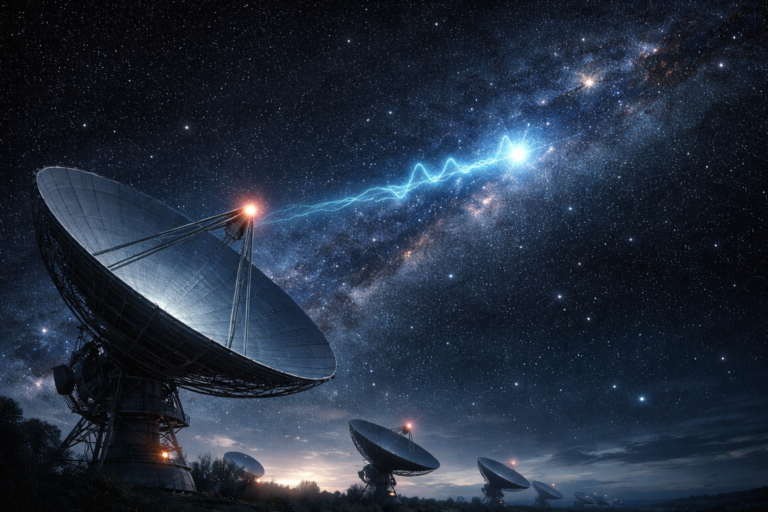

At 1:32 a.m. UTC on February 14, 2025, a radio telescope monitoring a routine sweep of the sky flagged something that shouldn’t have been there.
The signal was brief. Clean. Narrowband.
And hauntingly familiar.
Within minutes, senior researchers were pulled into the control room. Archived data was opened. Old printouts were retrieved. When the frequency, duration, and modulation pattern were aligned, the room went quiet.
They had seen this before.
The last time it appeared was September 1979.
Then — nothing.
For forty years, the universe stayed silent.
Until now.
The Signal That Refused to Stay Buried
The original detection occurred during a wide-band radio survey conducted in the late 1970s, when analog recorders and early digital filters were still standard.
At the time, the signal was logged, debated, and ultimately shelved.
Not dismissed — just unresolved.
It didn’t match known astrophysical sources. It didn’t repeat. And without repetition, science has little to hold onto.
One retired radio astronomer involved in the original review recalled during a private discussion in March 2025:
“We had one clean signal and no second chance. That’s the worst place science can be.”
For decades, it remained a footnote.
Until February changed that.
What Was Detected — And Why It Matters
The newly detected signal mirrors the original in several key ways:
- Same narrow frequency band
- Same signal duration
- Same intensity profile
- Same region of sky
That combination is extraordinarily rare.
Random noise doesn’t behave like that.
Neither do most natural cosmic sources.
The repetition isn’t continuous. It’s not periodic. It’s separated by four decades.
That gap is the story.
Confirming It Was Real
Within 90 minutes of detection, independent observatories were alerted. Follow-up monitoring began immediately.
By February 16, 2025, two separate radio arrays confirmed the signal’s characteristics matched the archived 1979 data within instrument tolerance.
Different hardware. Different era.
Same signature.
A lead data analyst said during an internal review on February 18, 2025:
“This wasn’t a fluke. It survived every filter we threw at it.”
That’s when the language changed from “interesting” to “significant.”
Why This Defies Easy Explanation
Most known repeating cosmic signals fall into recognizable categories.
Pulsars repeat constantly.
Fast radio bursts repeat irregularly, but often within years.
Stellar emissions fluctuate predictably.
A 40-year gap doesn’t fit.
For a signal to repeat after such a long interval, it would require either:
- An extremely slow astrophysical cycle
- A rare alignment of conditions
- Or a source that operates on timescales far outside human observation windows
None of those explanations sit comfortably with existing models.
The Region of Space in Question
The signal originates from a relatively quiet patch of sky — not a galaxy core, not a star-forming region, not a known energetic hotspot.
That absence of obvious activity makes the detection harder to explain, not easier.
There’s no supernova remnant. No magnetar. No obvious engine.
Just empty-looking space behaving as if it remembers something.
Scientists Are Choosing Their Words Carefully
No one involved is making dramatic claims.
There are no press releases using loaded language. No speculation about intelligence. No sensational framing.
Instead, official descriptions refer to:
- “A repeating narrowband anomaly”
- “An unresolved astrophysical source”
- “A long-interval signal recurrence”
A senior astronomer speaking at a closed symposium on March 6, 2025, put it plainly:
“The universe doesn’t owe us timely explanations.”
That restraint is intentional.
History has punished premature conclusions.
Why This Feels Like Two Timelines Touching
For forty years, the signal didn’t exist — functionally speaking.
No data. No trace. No echo.
Then, suddenly, it returns — unchanged.
Same frequency. Same structure.
As if no time passed at all.
That’s what unsettles researchers.
Not the signal itself, but the implication that something out there operates on a clock utterly disconnected from human scales.
Same sky.
Same physics.
Different sense of time.
Ruling Out Earthly Sources
Before the detection was taken seriously, teams ruled out:
- Satellite interference
- Aircraft communication bands
- Military transmissions
- Terrestrial reflections
- Instrumental artifacts
Archived logs from 1979 were cross-checked against known historical transmissions.
No match.
Modern monitoring confirmed the signal did not originate from Earth orbit or near-Earth space.
That step was decisive.
What Happens Next
Unlike in 1979, scientists now have tools that allow continuous, high-resolution monitoring.
The region is being observed daily.
The question isn’t whether it will repeat again.
It’s when — and whether the next interval will be measured in years, decades, or something stranger.
For now, patience is the only option.
Frequently Asked Questions
Is this an artificial signal?
There is no evidence to support that conclusion. Scientists are treating it as an unresolved natural phenomenon.
Why wasn’t it detected earlier?
Limited technology and observation windows in the past made long-interval events extremely difficult to track.
Could this be a fast radio burst?
The signal’s duration and structure do not match known fast radio burst profiles.
Is Earth in danger?
No. The signal is extremely distant and shows no energetic threat.
Will scientists release more data?
Yes, once peer review and verification are complete.
A Signal That Waited Longer Than We Did
Most cosmic discoveries shout.
This one waited.
Forty years passed between two identical moments — not close enough to be coincidence, not frequent enough to be predictable.
Just long enough to remind scientists of something fundamental:
The universe doesn’t move at our speed.
Sometimes it speaks once, falls silent for a lifetime, and then speaks again — unchanged — as if nothing happened in between.
Same signal.
Same sky.
A quiet repetition that connects two moments across decades — and leaves a question hanging in the dark, waiting just as patiently as it did before.

0 Comments