
















By Ronald Kapper
Disclaimer: This article summarizes public scientific reports, hydrophone logs and journalism. Where researchers are still uncertain, I explain competing ideas and point you to original sources at the end so you can judge the evidence yourself.
A sound that refuses to be tamed
Out in the black, where sunlight dies and pressure crushes steel, the ocean still talks. Sometimes its whispers are simple — the crack of ice, the chitter of shrimp, a whale’s low call. But every few years researchers pick up noises that defy a neat explanation: ultra-loud booms, long trains of rising notes, metallic twangs that sound like a machine from another world. Those recordings jump across hydrophones, light up spectrograms, and spark headlines. Yet many of those sounds still have no single, settled source. Why? The short answer: the deep ocean is huge, noisy, and hard to reach — and sound itself behaves strangely down there. Below I walk you through the mystery, the science, and what NOAA and other teams have learned so far.
How scientists listen to the deep
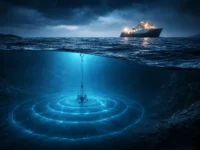
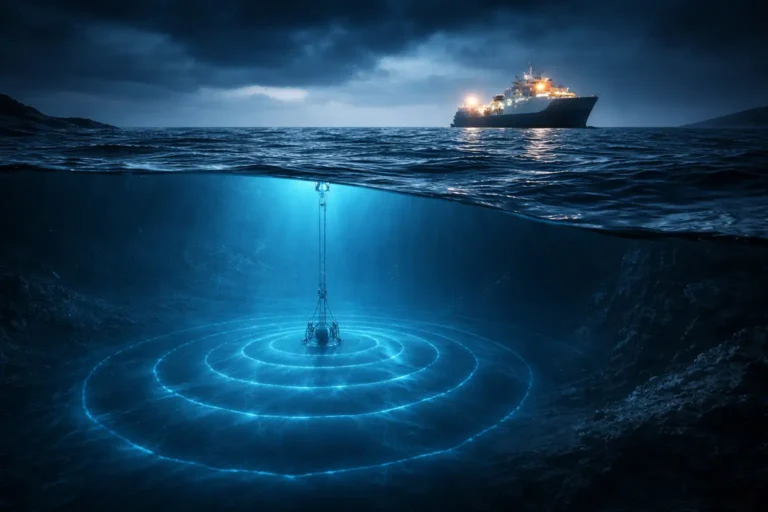
Scientists use hydrophones — underwater microphones — set on shorelines, anchored to moorings, or towed behind research ships. Networks of those sensors can triangulate where a sound came from, estimate how loud it was, and display the signature as a spectrogram: time on one axis, frequency on the other, brightness showing power. Over decades, the U.S. National Oceanic and Atmospheric Administration (NOAA) and allied labs have built listening arrays that span much of the Pacific, Atlantic and Southern oceans. Those instruments are brilliant at catching unusual events, but they are not perfect: placement is sparse, arrays can drift, and the ocean itself bends and carries sound in odd ways that can blur origin points.
Three problems that make some sounds stubbornly mysterious
1) The ocean is a messy room for sound. Temperature, salinity and depth form layers that bend sound rays. Currents and seasonal shifts change how far and in which direction a sound travels. A signal that starts in one small patch of water can bounce and refract and arrive at a hydrophone from a very different bearing. That makes triangulation tricky, especially for sensors thousands of kilometers apart.
2) Sparse coverage and timing gaps. Hydrophone networks are expensive and often deployed to serve other missions (naval monitoring, whale research, seismic surveys). Large tracts of ocean have few or no sensors. Some of the famous mysterious sounds — like the 1997 “Bloop” — were heard on sensors thousands of kilometers from the source, so the initial location estimate was very coarse until better data or models corrected it.
3) Multiple possible sources with similar signatures. Many natural events produce overlapping spectral shapes: ice quakes, volcanic tremors, landslides, seabed slides, and animal calls can look similar on short recordings. Human noise — from distant ships, seismic airguns, or undersea machinery — can also mimic or mask natural sounds. Untangling the cause needs on-site follow up, physical samples or biological sightings that are rarely available. That gap between audio evidence and physical proof keeps mysteries alive.
Famous cases: what they taught us
The Bloop (1997) — A giant, ultra-low frequency burst recorded by NOAA hydrophones captured the public imagination. At first some suggested a colossal creature. Years of follow-up work and comparisons with known cryoseismic signals pointed to massive ice fracturing and calving as the best match. The Bloop taught scientists caution: loud does not mean biological; look for matching ice, volcanic, or tectonic activity.
The Upsweep — A long train of rising notes heard across the Pacific for decades. Its level has waxed and waned over years. NOAA researchers speculated about undersea volcanic or hydrothermal activity, but the exact source remained poorly pinned down for a long time. The Upsweep became a reminder that consistent, low-frequency events can be real geophysical processes that take time and focused surveys to confirm.
Biotwang/Biotwang-like calls (Mariana region) — More recently, strange metallic-sounding notes recorded near deep trenches were traced back to specific whale species after targeted studies and new analysis methods. When biological behavior and sound libraries catch up, some mysteries resolve. That outcome shows how modern recording, big data and patience can transform “unknown noise” into documented animal behavior.
NOAA’s role: patient, methodical, sometimes humble
NOAA plays a central role in gathering and archiving ocean sound records. The agency’s acoustic programs run long-term hydrophone arrays and keep publicly available libraries of famous recordings. Crucially, NOAA scientists publish careful analyses showing when a hypothesis is supported or when the data remain ambiguous. That cautious language matters: new measurements and instruments frequently change interpretations. The steady, open approach built by NOAA helps the broader community test ideas, reproduce results, and eventually solve or reframe the mysteries.
New detective tools: machine learning and bigger sound libraries
Two trends are helping researchers move faster. First, machine learning and pattern recognition let teams scan massive archives to find similar calls and cluster events by type. Second, international sound libraries and citizen science projects now pool recordings from many organizations, giving context and comparison points that were impossible a decade ago. When a peculiar spectrogram can be compared to thousands of labeled examples, the chance of a match rises. Yet algorithms also bring a caution: they can over-fit or latch onto false patterns if training data are biased. That is why human experts still need to validate machine suggestions.
When a mystery resolves: the science of exclusion
Often the path to an answer is negative evidence: scientists rule out likely sources one by one. That can mean matching time and place of seismic events, checking ship traffic logs, examining satellite images for iceberg calving, and listening for repeatability. When all common causes are excluded and something remains uniquely consistent with one hypothesis, the community gains confidence. Several once-mysteries — including the bio-duck sound and the biotwang in the Mariana region — were cracked by combining targeted fieldwork, biological tagging, and fresh spectrogram comparisons.
Why some sounds may never be fully explained
Even with better tools and more data, some sounds may stay enigmatic for these reasons:
- No on-site evidence: If a sound happens in a remote zone and leaves no visible trace, there may be nothing to sample.
- Transitory events: A one-time landslide or rare iceberg behavior might not repeat, so follow-up surveys come too late.
- Signal masking: Constant human noise now blankets many ocean regions, burying delicate signatures.
- Ambiguous signatures: Physical processes that are uncommon or poorly studied can produce spectrograms that fit multiple models.
- Resource limits: Funding, ship time and access to remote regions are limited; not every mystery gets a full expedition.
These limits are not failures so much as part of how frontier science works: some questions take years or decades to answer.
What unresolved recordings can teach us, even when they stay unsolved
Unexplained sounds are not merely puzzles for their own sake. They force scientists to refine methods, build better sensors, and add ecological and geological context to ocean monitoring. Mystery recordings have accelerated multi-disciplinary partnerships between glaciologists, volcanologists, marine biologists and acousticians. They sharpen policy debates about ocean noise pollution, and they often highlight regions we simply know too little about. In that sense, a sound you can’t yet explain is an invitation: go measure, observe, and learn.
How researchers investigate a new mysterious sound — a stepwise playbook
- Catalog the event. Record time, sensors that picked it up, and create spectrograms.
- Triangulate and model propagation. Use multiple hydrophones and ocean sound speed models to estimate a source region.
- Cross-check other data. Look at seismic networks, satellite imagery, ship logs, and weather/sea-ice reports.
- Compare to libraries. Match against animal call databases and past geophysical events.
- Plan follow-up surveys. If possible, send a research vessel, deploy targeted instruments, or collaborate with local mariners.
- Publish and invite peer review. Share the recording and analysis so others can test alternate ideas.
That patient, iterative approach explains why some mysteries get solved slowly — and why the best answers are often consensus built over years.
People’s imagination vs. scientific caution
It’s easy to let the mind spin a sea monster tale from an eerie sound. Popular culture loves the idea of a hidden leviathan. But scientists must follow evidence: icequakes, volcanic tremors, and animal calls are often the likeliest explanations. That reality doesn’t make the story less exciting — learning that a haunting sound came from a glacier splitting under stress is, in its own way, a dramatic narrative about a planet in motion. Good science embraces mystery without inventing facts to fill the gaps.
What you can do if you care about ocean sound research
If this topic sparks you, there are concrete ways to help. Support open-data projects that publish hydrophone recordings. Back organizations that reduce noise pollution and protect marine habitats. Join citizen science sound-labeling efforts; human ears are still excellent at spotting oddities that machines miss. Even a modest contribution to awareness and funding helps expand listening networks and deploy more sensors to quiet corners of the sea.
FAQs
Q: Are any of these sounds dangerous to humans?
A: No. These mysterious noises occur far underwater and do not pose direct danger to people. However, they can signal strong geological events (like submarine landslides) that have environmental impacts.
Q: Could any be caused by secret military gear?
A: Some human activity does create undersea noise, and navies monitor acoustics. But many of the classic mysteries were ultimately tied to natural causes. Analysts check human activity logs as part of investigations.
Q: Why don’t we just drop cameras on the sound?
A: Cameras and ship surveys are costly. Many sounds originate at depths or locations that are difficult and expensive to visit quickly. Acoustic detection is a far cheaper, broader first step.
Q: Have we ever misidentified a sound as biological when it wasn’t?
A: Yes. Early excitement about the Bloop suggested a living source. Later work showed icequakes were a better match. Science self-corrects as more data arrive.
Q: How often are mysterious sounds solved?
A: Increasingly often, thanks to better data sharing and analysis tools. Still, some records remain unresolved for decades.
The deep keeps talking — and we’ll keep listening
There’s something thrilling about a sound nobody can pin down. It reminds us how big and unfamiliar the planet still is. Each unresolved ping is a question mark that drives better instruments and broader cooperation. NOAA’s archives and research programs have turned several headlines into clear science — and they keep the raw recordings so new tools can try again. The ocean’s voice is messy, full of life and movement. Some of its sentences are plain; some are poetic riddles. For now, the deep keeps talking, and we’re finally learning how to listen.
References / proof of source or incident (URLs)
- NOAA — Acoustics Monitoring Program: Icequakes and the Bloop — https://www.pmel.noaa.gov/acoustics/sounds/bloop.html
- NOAA Ocean Service — What is the Bloop? — https://oceanservice.noaa.gov/facts/bloop.html
- Scientific American — Mystery of the Deep-Ocean ‘Biotwang’ Sound Has Finally Been Solved — https://www.scientificamerican.com/article/mystery-of-deep-ocean-biotwang-sound-has-finally-been-solved/
- Royal Society Publishing — Mysterious bio-duck sound attributed to the Antarctic minke whale — https://royalsocietypublishing.org/doi/10.1098/rsbl.2014.0175
- Smithsonian / LiveScience coverage of Mariana trench sounds — https://www.smithsonianmag.com and https://www.livescience.com (search story: mysterious biotwang Mariana Trench)

0 Comments