


















Disclaimer
This article explains real laboratory work that explores alternative genetic systems and synthetic genomes. It does not claim that scientists have found extraterrestrial life or altered human DNA in the wild. The experiments described were performed under strict lab controls and peer review. The reporting below pulls from public research reports and reputable science outlets; links to source pages are listed at the end for your checking.
A electric morning in the lab
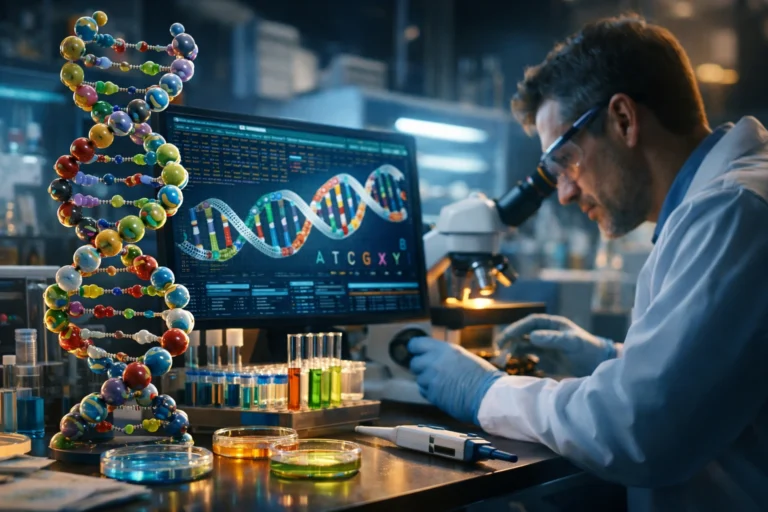
Imagine a clock striking a normal hour in a research building, but inside a small room the mood is anything but ordinary. Plates of bacteria are humming quietly in incubators. Pipettes click. A team leans over a computer that maps patterns made not of the usual four genetic letters but an alien-like alphabet. For a generation of researchers, this scene has become increasingly familiar — the day-by-day work that led to what the press sometimes calls “alien DNA.”
That shorthand sounds dramatic. Yet behind it are careful steps: making new chemical forms of genetic material, adding extra genetic letters to living cells, and building stripped-down genomes from scratch. All of these moves help answer a single big question: could life be built in a form very different from the DNA-and-RNA system we know on Earth?
What do we mean by “alien DNA”?
When journalists say “alien DNA,” they usually mean one of three things:
- Xeno-nucleic acids (XNAs): These are molecules created in the lab that act like DNA or RNA but use different chemical building blocks. They store and pass along information the way DNA does, yet their backbone or sugars are different. Scientists developed XNAs to test whether genetic systems need the exact chemistry of DNA or whether other chemistries could carry life’s instructions.
- Expanded genetic alphabets: Standard DNA uses four bases—A, T, C, G. Some labs have added extra, synthetic base pairs to create six-, eight- or even larger-letter alphabets. These experiments show how a different genetic “alphabet” could enlarge what proteins can be made and how life might store information on other worlds.
- Synthetic genomes and minimal cells: Teams have built entire genomes from scratch and placed them into cells to create organisms controlled by synthetic DNA. These are not “aliens” but synthetic life forms designed to test what genes are essential for life. That work gives engineers the tools to assemble genomes with unusual features in the future.
None of these steps proves alien life exists. Instead, they build proof-of-principle: life-like systems can, in controlled conditions, run on unfamiliar chemistry.
Why researchers try this — and why it matters
There are two honest reasons science cares about simulating “alien” genetic systems.
First, curiosity about life itself. If we can show that information-carrying molecules other than DNA can support replication and evolution, then life elsewhere could use different chemistry. That widens the search criteria for astrobiology. NASA and other agencies fund such projects to avoid Earth-only bias in the hunt for life.
Second, practical uses on Earth. Synthetic strands with unfamiliar chemistry can resist the enzymes that break down DNA and RNA. That makes them useful as stable tags, safer diagnostic tools, or as ingredients for new materials. Expanding the genetic code also lets scientists program cells to make proteins with unusual components — a powerful tool for engineering new medicines and materials.
Both motives sit within strict safety rules. Work with synthetic genomes and XNAs follows lab checks, containment practices, and ethical review. The experiments are about testing ideas, not releasing new life forms into the wild.
How scientists create a DNA-like alien molecule
Here’s a simple, stepwise picture of what these teams do:
1. Design the molecule: Chemists draw an alternative backbone or a new base pair that could fit inside a double helix. This design step uses chemical intuition and computer models.
2. Build the pieces: Organic chemists synthesize the new building blocks in the lab. This can take months — making pure, well-characterized molecules is exacting work.
3. Test for pairing: The new pieces are tested to see if they can pair and form stable strands similar to DNA’s double helix. If they pair, they may be able to store information.
4. Copy and read: The crucial test is whether enzymes — or engineered enzymes — can copy the new strands and read their information. Success here means the system has the core features of heredity.
5. Put into a living system (carefully): When safe and justified, scientists may try to get a cell to use the new system or include synthetic base pairs alongside natural DNA. This step is tightly regulated.
When NASA-funded teams and independent labs reported DNA-like XNAs that could be copied and or used to store information, it marked a milestone: chemistry that behaves like heredity, though with different building blocks.
Real breakthroughs you should know
A few landmark achievements help explain why the phrase “the day scientists simulated alien DNA” feels apt:
- XNA that can store and pass information: In work funded by NASA, researchers built DNA-like molecules that behave enough like DNA to store and transfer information in lab tests. That suggested a broader chemical landscape for genetics than we once thought possible.
- An expanded genetic alphabet in living cells: Labs created organisms that carry extra synthetic base pairs. These organisms could use new letters to make proteins beyond what the natural four-letter code allows. That opened the door to an enlarged biochemical vocabulary.
- Fully synthetic genomes and minimal cells: Teams led by the J. Craig Venter Institute and collaborators synthesized entire genomes and created cells controlled by synthetic DNA. Those experiments proved we can design whole genomes and that life can run on human-made code.
Put together, these results show both the chemistry and the cellular machinery can be pushed into new territory. That is what people mean when they say scientists have “simulated alien DNA”: they have made lab systems that function like genetic material but differ from Earth’s natural molecules.
Safety and ethical guardrails — what the public should know
Scientists work under clear limits. Projects involving synthetic genomes undergo rigorous review, reach agreements about containment, and answer ethical questions about purpose and risk. Professional societies and governments continue to refine rules because the field evolves fast.
The main safety facts are:
- Built systems are studied in controlled labs, not released into nature.
- XNAs and expanded alphabets often require engineered enzymes to function; they rarely work with ordinary cellular machinery, which limits accidental spread.
- Ethical review boards weigh the social and environmental risks before permitting experiments.
When you hear dramatic headlines, remember: the work is exploratory and runs inside strict protocols to prevent real-world harm.
Could this help us find life on other worlds?
Yes — but cautiously. If life does exist elsewhere, it might not use DNA or RNA. The laboratory demonstrations mean telescopes and probes can look for a wider range of chemical signs. For example, mission planners can consider molecules that store information in unfamiliar ways, or detect unusual polymers in samples.
This broadened view changes how we design instruments and interpret data, making the search for life less Earth-centric. But none of the lab work claims detection of life beyond Earth; it only widens the map of what might be possible.
A human note on wonder and worry
It is natural to feel both awe and unease. The idea of “alien” DNA taps deep imagination — the image of life that speaks a different biochemical language. At the same time, real risks must be handled carefully. Scientists are aware of both the promise and the responsibility.
If the work continues responsibly, it will be a story of cautious opening: new knowledge, new tools for health and technology, and clearer thinking about where to look for life beyond our planet.
FAQs
Q: Are scientists making aliens?
A: No. Researchers make chemical systems and controlled cells in labs to test ideas about heredity and biochemistry. That is very different from creating independent alien life.
Q: Can these “alien” molecules change human DNA?
A: Not in ordinary settings. XNAs and expanded bases usually need engineered enzymes or special lab setups to function. There is no evidence of these molecules changing human genomes in the real world. Labs are regulated to prevent such accidental exposure.
Q: Could alien life use this chemistry?
A: Possibly. The lab work shows alternative chemistries can store information. If a planet had the right conditions and chemistry, life there might use different building blocks. But we have no direct evidence of that yet.
Q: How soon will this change medicine or industry?
A: Some applications are already being explored, such as stable diagnostic markers, novel proteins, and materials. Others may take years of development and regulatory review. The timeline depends on both technical progress and safety approvals.
Q: Where can I read the original scientific reports?
A: I list key source pages at the end so you can follow the science yourself.
Final thoughts — an open invitation to think bigger
The day scientists simulated something that reads like “alien DNA” is not one single headline. It is a long, careful march: chemistry, enzymes, cells, safety, and verification. The result is not proof of ET life, but proof that life’s chemistry could, in principle, take many shapes.
That discovery is not a threat if it continues to be handled with care. It is an invitation: to engineers who want better medicines, to astrobiologists expanding their search plans, and to every curious reader imagining life that writes its own code in strange alphabets.
Science has made the unfamiliar a little more familiar — and in doing so it has stretched our view of what “life” might mean.
Sources & Reference URLs
(These are the original public pages and news releases referenced in the article. They provide the research reports, institutional summaries, and news coverage used to build this piece.)
- NASA Astrobiology news release — NASA-funded research creates DNA-like molecule to aid search for alien life.
https://astrobiology.nasa.gov/news/nasa-funded-research-creates-dna-like-molecule-to-aid-search-for-alien-life/ - Chemistry World — Eight-letter genetic code hints at how alien life might evolve.
https://www.chemistryworld.com/news/eight-letter-genetic-code-hints-at-how-alien-life-might-evolve/3010145.article - J. Craig Venter Institute — First minimal synthetic bacterial cell designed and constructed.
https://www.jcvi.org/research/first-minimal-synthetic-bacterial-cell - Philip Holliger and Steven Benner related overviews — research on XNAs and alternative genetic polymers (NASA and academic PDFs providing background).
https://www.nasa.gov/wp-content/uploads/2019/09/hollinger_benner_2012.pdf - Technology Networks — Synthetic “Alien” DNA Provides New Diagnostic Opportunities.
https://www.technologynetworks.com/genomics/articles/synthetic-alien-dna-provides-opportunities-for-disease-diagnostics-and-treatment-389824

0 Comments