

















By Ronald Kapper
Disclaimer
This article explains publicly published scientific ideas and research about the cosmic web and the possibility that it may carry meaningful information about the universe. It does not make extraordinary claims about unknown physics or unproven mechanisms. Sources are linked at the end for verification and deeper reading.
Why Scientists Think the Cosmic Web Could Be Carrying Information
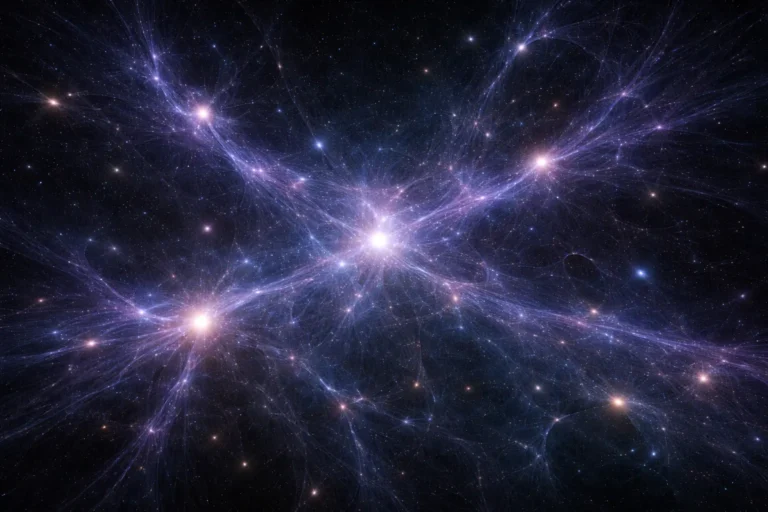
When astronomers talk about the cosmic web, they are describing the grandest structure in the known universe — a vast, filament-like network of galaxies, gas and invisible matter that stretches across billions of light-years. Imagine spiderweb strands connecting giant clumps of galaxies, weaving the entire observable universe into a single, interconnected structure.
For decades, scientists have known that galaxies don’t float randomly in space. Instead, they follow this lace-like pattern shaped by dark matter, the mysterious substance that constitutes most of the universe’s mass but cannot be seen with telescopes. Dark matter doesn’t interact with light like normal matter, but it exerts gravity, pulling galaxies and gas along these cosmic strands.
But here’s the exciting part: the cosmic web may not be just a static frame holding galaxies in place. Many researchers now think it could be carrying real information — clues about how the universe formed, how matter flows across space, and possibly even how galaxies evolve over time.
What Exactly Is the Cosmic Web?
The cosmic web is the large-scale structure of the universe. It’s made of:
- Dark matter filaments, invisible threads that make up most of the web’s mass.
- Regular matter (gas and dust), flowing along those dark threads and feeding galaxies.
- Galaxies and galaxy clusters, which cluster at the intersections or “nodes” of the web.
Cosmic web filaments can be colossal — hundreds of millions of light-years long. One recently discovered filament features a chain of galaxies spanning millions of light-years and rotating as if linked as one structure.
This immense network isn’t random. It grew from tiny density differences in the very early universe, shortly after the Big Bang, and has been stretched, pulled and shaped by gravity over billions of years.
What Kind of Information Could the Cosmic Web Carry?
When scientists talk about information in a physical system, they usually mean measurable data that can reveal the system’s history or behavior. The cosmic web could carry information in several ways:
1. The Shape of the Web Is a Fossil of the Early Universe
The way the web’s strands and nodes are arranged reflects how matter was distributed long ago. Compared with the echoes of the Big Bang recorded in the cosmic microwave background, the web’s shape helps confirm how tiny early variations grew into today’s large-scale structure.
2. Galactic Motion and Gas Flow Tell a Story
Gas doesn’t just sit in the web — it flows along filaments toward galaxies and galaxy clusters. Tracking that movement reveals the influence of gravity, the effects of cosmic expansion and hints about unseen forces like dark energy.
3. Chemical and Physical Signals May Be Hidden in Filaments
The cosmic web isn’t empty. Filaments contain sparse gas at various temperatures and states. By studying the light absorbed and emitted by this gas, scientists can detect signatures that encode information on how matter has interacted and evolved over time.
4. Dark Matter Traces Can Encode Hidden Data
Dark matter doesn’t interact with light, but its gravitational pull shapes how ordinary matter moves. Mapping dark matter filaments helps scientists understand how the universe grew and why galaxies behave as they do. Recent advances in gravitational lensing have even begun to reveal dark matter’s presence directly along the web’s strands.
Why the Idea Matters
If the cosmic web carries information, it could become a powerful tool for understanding the universe at the deepest levels:
- Cosmic history becomes readable. Instead of inferring the universe’s evolution from scattered data, we may read it directly from the web’s structure.
- Galaxy formation isn’t random. The web may literally guide how gas and matter flow into proto-galaxies, influencing how stars and planets later form.
- Dark matter and dark energy become less mysterious. How filaments fold and stretch could reveal the effects of gravity and cosmic expansion.
- Fundamental physics could be tested. Subtle patterns in the web might hint at physics beyond our current models.
How Scientists Are Studying the Web
Mapping the cosmic web is no small feat. It requires ultra-deep surveys of galaxies across billions of light-years. The recent Euclid mission data release is one step toward this goal, offering astronomers detailed maps of millions of galaxies across large regions of the sky.
Other efforts combine observations from multiple telescopes, computer simulations, and gravitational lensing — a technique where massive structures bend light from distant sources, illuminating invisible mass. By comparing real data with simulated universes, cosmologists can extract physical information encoded in the web’s geometry.
Real Evidence That the Cosmic Web Is More Than Just Structure
The idea that the cosmic web carries useful information isn’t purely theoretical. Results from recent observations support the concept:
First Direct Mapping of Filaments
Astronomers have used advanced telescopes to create three-dimensional maps of the cosmic web using galaxy positions and gas signatures. These maps reveal the filaments linking galaxy clusters and show how matter flows through them.
Dark Matter Detection Within the Web
For the first time, scientists have directly detected the presence of dark matter along cosmic web filaments using gravitational lensing. This confirms that the web structure isn’t just visible matter — it contains the invisible scaffolding that shapes cosmic evolution.
Large Rotating Structures Within Filaments
Recent discoveries of enormous rotating structures spanning millions of light-years suggest that motion and momentum may be carried along the web in ways previously unimagined.
These lines of evidence show that the web isn’t passive — it’s dynamic, shaped by gravity, dark matter and physical processes that, when decoded, can tell us a great deal about the universe.
How the Cosmic Web Could Be Carrying Information in Practice
Galactic Alignment and Spin
Galaxies within a filament can spin in similar directions — a hint that motion and momentum have been transferred through the web. Studying these patterns could reveal how structures influenced galaxy birth.
Gas Movement Along Filaments
Gas flows from the web into galaxies, feeding star formation. Observations of these flows could be read like cosmic weather patterns, showing how matter moves over time.
Chemical Markers in Intergalactic Gas
The gas in the cosmic web holds signatures of its history. Elements like hydrogen and helium leave telltale spectral lines, which, when studied, reveal conditions from early cosmic eras.
What It Would Take to Prove This More Rigorously
Scientists are careful. To cement the idea that the cosmic web carries meaningful information, researchers need:
- More accurate maps of filaments and voids.
- Detailed velocity measurements showing coherent motion over cosmic distances.
- Correlations between web structure and physical variables like galaxy age, composition and motion.
- Cross–validation between independent surveys and instruments.
These requirements reflect the fact that extraordinary cosmic claims demand rigorous data. But current progress shows this path is achievable.
FAQs
Q: What exactly is the “cosmic web”?
A: It is the large-scale pattern of matter in the universe, shaped like a web or network of threads formed by dark matter, gas and galaxies.
Q: Can anything move information along the cosmic web?
A: In principle, yes. Gravity, gas flows, momentum and even patterns of galaxy spin may carry information about cosmic history along these filaments.
Q: Why can’t we see dark matter directly?
A: Dark matter doesn’t interact with light the way ordinary matter does. We infer its presence through gravity and techniques like gravitational lensing.
Q: Is the cosmic web connected to the Big Bang?
A: Yes. Its structure emerged from tiny early variations in matter density after the Big Bang, stretched and shaped by gravity over billions of years.
Q: When will we know more for sure?
A: Upcoming data releases from missions like Euclid and ongoing deep surveys will continue to refine our maps and understanding of the cosmic web over the next decade.
Conclusion — A Web of Meaning in the Vast Universe
The cosmic web is more than a backdrop. It is the universe’s structural skeleton, shaped by gravity, dark matter, cosmic expansion and billions of years of history. Evidence increasingly suggests that this web may carry valuable information — not in a mystical sense but in a physical, measurable way that could reveal clues about cosmic origins, galaxy evolution, and the hidden dynamics of space.
We stand at an exciting stage where maps of this grand structure are becoming detailed enough to be read like cosmic archives. Each filament and knot may contain a chapter of the universe’s story. Decoding it is one of the most thrilling quests in modern science.
Sources and Reference URLs
- What the cosmic web is made of: dark matter, gas, and galaxies — https://www.astronomy.com/science/what-is-the-cosmic-web-made-of/
- Mapping the cosmic web and 3D distribution of dark matter — https://science.nasa.gov/mission/hubble/science/science-highlights/mapping-the-cosmic-web/
- Cosmic web direct imaging and dark matter filaments — https://scitechdaily.com/first-direct-image-of-the-cosmic-web-reveals-the-universes-hidden-highways/
- Giant rotating cosmic filament discovery — https://www.space.com/astronomy/scientists-discover-one-of-our-universes-largest-spinning-structures-a-50-million-light-year-long-cosmic-thread
- Dark matter detection in the web via gravitational lensing — https://www.popularmechanics.com/space/deep-space/a46807202/dark-matter-cosmic-web/
- Euclid mission first data release mapping cosmic structure — Reuters report —
- Large-scale structure origins and evolution of cosmic web — studies and simulations.

0 Comments