


















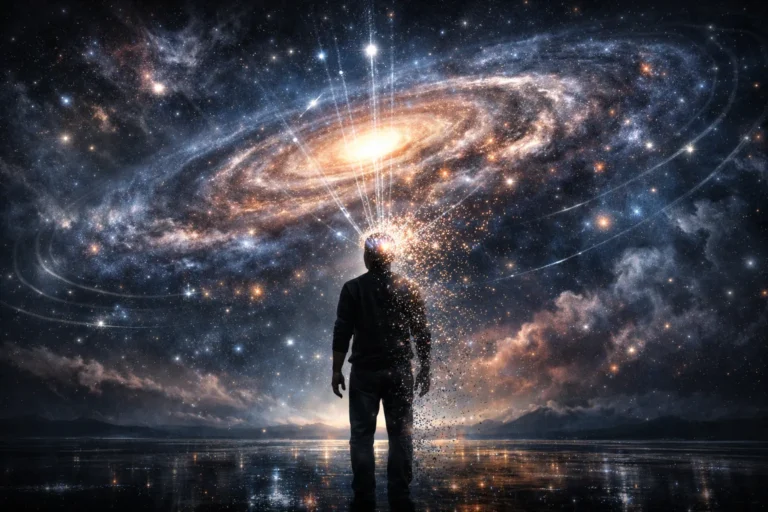
There is a quiet shift happening at the edge of science, and it feels almost uncomfortable to talk about because it challenges something we have taken for granted for centuries: the idea that consciousness is just a byproduct of the brain.
What if that assumption is wrong?
What if consciousness is not something your brain creates, but something your brain taps into?
What if it is as real and as fundamental as gravity, space, or time itself?
This idea is no longer just philosophy. It is being discussed in physics, neuroscience, and information theory. And the reason it is making scientists uneasy is simple: if it turns out to be true, it could force a rewrite of how we understand reality itself.
The Strange Gap in Modern Science
Physics has been remarkably successful at explaining the universe. It describes how particles behave, how forces interact, and how galaxies evolve. But there is one thing it still cannot explain in any complete way: why we are aware at all.
This is often called the “hard problem” of consciousness.
You can map every neuron in the brain. You can track electrical signals. You can even predict behavior. But none of that explains why those processes feel like something from the inside.
Why does seeing red feel like red? Why does pain hurt? Why is there an inner experience at all?
Some scientists argue that this gap exists because we are asking the wrong question. Instead of asking how matter produces consciousness, they suggest we should ask something far more radical:
What if consciousness is already built into the fabric of reality?
Panpsychism: The Old Idea That Refuses to Die
Panpsychism is one of the oldest philosophical ideas, and for a long time it was dismissed as strange or even mystical. But recently, it has started to return to serious scientific discussion.
At its core, panpsychism suggests that consciousness is a fundamental property of the universe, present in some form in all matter.
This does not mean that rocks think or that electrons have thoughts. It means that the building blocks of reality may carry extremely simple forms of experience, and when arranged in complex ways, like in a human brain, those simple forms combine into rich awareness.
Think of it like this:
Just as temperature emerges from the motion of particles, consciousness could emerge from simpler “units” of experience already present in matter.
It sounds radical, but it solves a major problem. If consciousness is already part of reality, then we no longer need to explain how something completely non-conscious suddenly becomes conscious.
Instead, we only need to explain how simple awareness becomes complex awareness.
Integrated Information Theory: A Scientific Attempt
One of the most serious attempts to turn this idea into a testable framework is Integrated Information Theory, often called IIT.
IIT starts with a simple but powerful claim: consciousness is not about computation or intelligence, but about how much information a system integrates into a unified whole.
According to this theory, a system is conscious to the extent that it generates integrated information within itself.
This means:
- A highly connected system (like a human brain) has high consciousness
- A simple system (like a thermostat) has very little
- But even simple systems may not be completely “zero”
Some versions of IIT go even further and suggest that consciousness is an intrinsic property of physical systems, similar to mass or charge.
That is where things start to overlap with physics.
Because if consciousness is intrinsic, then it is not something that appears only in biology. It is something woven into the structure of reality itself.
From Brains to Fields: A New Direction
Modern physics tells us that the universe is not made of solid objects, but of fields. Everything, from electrons to light, emerges from these underlying fields.
Some researchers have begun asking a bold question:
What if consciousness is not tied to particles or brains, but to fields themselves?
There are proposals suggesting that consciousness could arise from the structure of fundamental fields, particularly the electromagnetic field generated by the brain.
In this view:
- The brain does not create consciousness
- It shapes and organizes it
- Like a radio tuning into a signal
This idea is still speculative, but it offers something rare in consciousness studies: a possible bridge between physics and experience.
Why This Makes Physicists Nervous
If consciousness turns out to be fundamental, it creates a deep problem for traditional physics.
Physics has always focused on objective measurements, things that can be observed from the outside. But consciousness is subjective. It is the one thing that can only be experienced from within.
This creates a clash.
A complete theory of reality would need to include both:
- Objective structures (particles, fields, forces)
- Subjective experience (what it feels like to exist)
Many scientists are uncomfortable with this because it breaks the clean boundary that modern science has relied on for centuries.
Some critics argue that theories like IIT make strange predictions, such as simple systems having some level of consciousness, which feels counterintuitive.
Others point out that consciousness cannot be directly measured, making it difficult to test in the same way as physical theories.
And yet, the alternative is equally troubling: ignoring consciousness entirely leaves a major gap in our understanding of reality.
The “Everything Might Be Aware” Problem
One of the biggest challenges for panpsychism and related theories is something known as the combination problem.
If tiny bits of matter have tiny bits of experience, how do they combine into the unified awareness we feel?
Why does your experience feel like one continuous stream, instead of billions of tiny fragments?
This question remains unanswered, and it is one of the main reasons these ideas are still debated rather than accepted.
But interestingly, this problem mirrors a deeper issue in physics itself: how separate parts of a system give rise to unified behavior.
In that sense, the mystery of consciousness may not be separate from physics at all. It may be pointing to something physics has not yet fully understood.
A Universe That Feels, Even Slightly
Imagine a universe where consciousness is not rare, but widespread.
Not in the sense of thoughts or intelligence, but in the sense of basic experience.
In such a universe:
- A brain is a highly organized center of awareness
- A computer might have a faint trace of it
- Even simple systems might carry a tiny spark
This idea does not reduce human experience. It expands it.
It suggests that consciousness is not something that suddenly appears at a certain level of complexity, but something that exists everywhere in different degrees.
Where Science Stands Right Now
It is important to be clear: none of these ideas are proven.
Panpsychism, IIT, and field-based theories of consciousness are still under active debate. They are attempts to solve a problem that has resisted explanation for decades.
Some scientists remain strongly skeptical. Others believe these ideas may be necessary to move forward.
What is changing is not the answers, but the willingness to ask deeper questions.
And those questions are becoming harder to ignore.
Why This Matters More Than It Seems
At first glance, this might feel like abstract philosophy. But the implications are enormous.
If consciousness is fundamental:
- It could change how we think about artificial intelligence
- It could reshape neuroscience and medicine
- It could alter our understanding of life itself
It might even force us to rethink what it means to be human.
Because if consciousness is not something we produce, but something we participate in, then our place in the universe becomes very different.
A Careful Reality Check
Before going too far, a clear disclaimer is necessary.
These theories are not established scientific facts. They are exploratory frameworks built on current knowledge, mathematical models, and philosophical reasoning.
There is no experimental proof yet that consciousness is a fundamental force like gravity.
But there is also no complete explanation for consciousness within existing frameworks.
That gap is real. And it is what keeps these ideas alive.
Conclusion: The Question That Won’t Go Away
For a long time, science has tried to explain consciousness as something that emerges from matter.
Now, a growing number of thinkers are asking if the relationship might run the other way.
What if matter emerges within a universe that already contains the capacity for experience?
It is a difficult idea. It challenges assumptions. It blurs boundaries.
But history shows that the most uncomfortable questions are often the ones that lead to the biggest breakthroughs.
And this question is not going away.
FAQs
1. Is consciousness really a fundamental force like gravity?
Not yet proven. It is a theoretical idea being explored in physics and philosophy, but there is no direct experimental confirmation.
2. What is panpsychism in simple terms?
It is the idea that consciousness exists in some basic form throughout the universe, not just in living beings.
3. What does Integrated Information Theory say?
It suggests that consciousness depends on how much information a system integrates into a unified experience.
4. Why is this controversial?
Because it challenges the traditional view that only brains produce consciousness and raises difficult questions about measurement and evidence.
5. Could this idea change science?
If proven, it could significantly reshape physics, neuroscience, and our understanding of reality.
References and Sources
- https://pmc.ncbi.nlm.nih.gov/articles/PMC3912322/
- https://www.mdpi.com/1099-4300/23/6/650
- https://osf.io/download/z8f5s
- https://writings.stephenwolfram.com/2021/03/what-is-consciousness-some-new-perspectives-from-our-physics-project/
- https://selfawarepatterns.com/2025/01/19/fundamental-and-naturalistic-panpsychism/

0 Comments