













DISCLAIMER: This article reports claims, testimony, and official documents related to Unidentified Anomalous Phenomena (UAP) and alleged crash-retrieval programs. Some witnesses testified under oath; others provided analysis and context. Many claims remain unverified publicly and are disputed by official agencies. The piece focuses on documented congressional events, press reporting, and government publications; it does not assert that any extraordinary claim has been proven. Read the source links at the end and judge the evidence for yourself.
Introduction — the question that stopped the room
On a crisp November morning in 2024, a question cut through committee decorum and into the public conversation: “Has the government conducted secret UAP crash-retrieval programs?” The moment crystallized a long-running tension — between whistleblowers who say hidden programs exist, and official offices that say records show no verifiable proof of extraterrestrial technology. What followed was testimony, rebuttal, and a cascade of public documents and reporting that together created one of the clearest public timelines we have so far. This article reconstructs that timeline, examines the major claims and counterclaims, and points readers to the official records and reporting that matter.
1) Roots: Why Congress started asking
Congress’s recent interest in UAPs didn’t appear out of nowhere. For years, pilots, sensors, and whistleblowers filed reports that agencies sometimes logged but rarely fully explained. In response, Congress created an office in law — the All-Domain Anomaly Resolution Office (AARO) — to centralize reporting and analysis. That institutional shift, together with whistleblower testimony and several high-profile incidents, set the stage for lawmakers to demand clearer answers and records. The statutory creation of AARO and its published historical review are central documents showing official effort and limits.
2) The whistleblowers and the July 2023 hearing
The most public early turning point came in 2023 when a whistleblower — David Grusch, a former intelligence official — testified to Congress that he had been told of a long-running, multi-decade crash-retrieval, recovery and reverse-engineering program from which he had been denied access. Under oath, he claimed interviews with dozens of witnesses and asserted that programs might have included recovered materials and, he said, “non-human biologics.” Grusch’s testimony prompted a flurry of requests for documentation and further hearings. He also catalyzed bipartisan calls for more transparency and better whistleblower protections.
3) The November 13, 2024 hearing — a headline moment
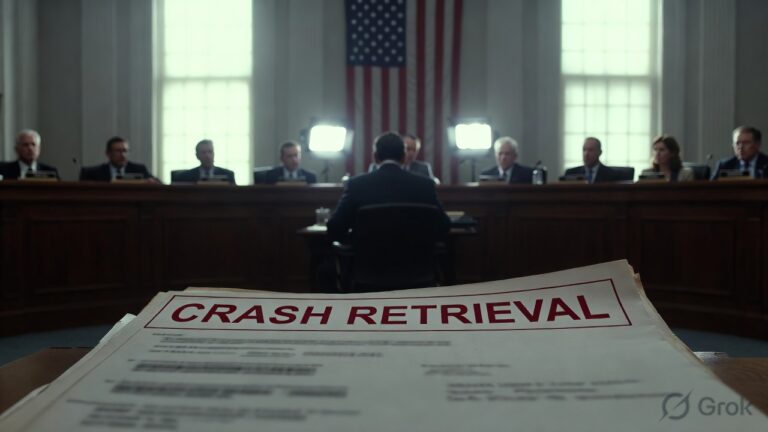
On November 13, 2024, the House Oversight Committee convened a hearing titled “Unidentified Anomalous Phenomena: Exposing the Truth.” Witnesses included retired officials and public figures who relayed what they knew, believed, or had seen in classified and unclassified records. During that hearing a dramatic exchange occurred when a committee chair asked a witness directly whether any government crash-retrieval programs existed; the witness answered affirmatively. That moment — widely reported — pushed the subject farther into mainstream media and into follow-up inquiries by other committees and offices. Journalists and analysts treated the answers as claims requiring documentary backing; many of those documents, and the lack of them in public form, remain central to the story.
4) What agencies said — AARO and the Pentagon’s public stance
While whistleblowers offered explosive claims, the Pentagon and AARO published reports and datasets that took a more cautious line. AARO’s public historical record reviews incidents, describes reporting practices, and lists imagery that remains unresolved alongside those that have mundane explanations. Importantly, official documents published by defense offices explain that many UAP reports are attributable to conventional causes, and that there is no public, conclusive proof of extraterrestrial hardware or bodies. Those official publications are not the same as a categorical denial of any secret program; rather they show what records agencies have chosen to release and how they describe their investigative limits.
5) The key players and what they claimed
- David Grusch (whistleblower): Claimed knowledge via interviews of a covert program that recovered UAP hardware and biologics. Said he was denied access to classified information necessary to substantiate details outside closed settings. Grusch’s claims remain a central driver of congressional curiosity and media coverage.
- Luis Elizondo (former DoD official): Testified and stated, under questioning, that he believed secret crash-retrieval programs had existed, and suggested that some recovered materials and even bodies were discussed internally. Such claims, powerful in public testimony, are contested by current defense leadership and lack public physical evidence.
- All-Domain Anomaly Resolution Office (AARO): Publishes case summaries, imagery, and an extensive historical record review. AARO’s outputs document both ongoing investigations and instances resolved as mundane phenomena, and are the official repository for many reported incidents.
6) The evidence problem: testimony vs. verifiable records
Congress can compel testimony and request documents. But when witnesses say critical proof exists only in classified files or SCIFs (secure rooms for sensitive materials), the public record remains thin. That means two different standards play out in public: the witness testimony that alleges programs and recovered material, and the available official documentation that so far does not include public, verifiable artifacts demonstrating alien origin or confirmed reverse engineering. The tension between sworn testimony and the lack of declassified physical evidence is the heart of this timeline’s public drama.
7) Timeline highlights — quick reference
- 2022: Congress includes language creating the record-keeping and reporting structures that led to AARO. This legally established office becomes the focal point for centralized UAP reporting.
- July 26, 2023: David Grusch testifies before the House, alleging a multi-decade crash-retrieval and reverse-engineering effort and raising claims about recovered biologics. Congress begins to press for documentation.
- Throughout 2023–2024: AARO releases case files and imagery; journalists and historians parse the material for patterns and gaps.
- November 13, 2024: “Unidentified Anomalous Phenomena: Exposing the Truth” hearing; high-profile testimony rekindles public debate. Witnesses answer direct questions from lawmakers about crash-retrieval programs, creating headlines.
8) Why Congress asked — national security, air safety, and public trust
Three pragmatic drivers explain congressional interest. First, unexplained objects near military airspace could pose national security risks if they are foreign surveillance or advanced technology. Second, there is air safety — militaries need to understand objects that might threaten aircraft. Third, there is public trust and oversight: Congress must determine whether classification practices are being overused, and whether whistleblowers are being protected when they raise systemic concerns. These practical drivers are what make the topic more than tabloid curiosity.
9) The secrecy maze: programs, shell companies, and classified accounts
Several witnesses and analysts described how programs can be hidden within larger budgets or transferred via shell entities — mechanisms that make oversight harder. Congressional staff and investigators noted that some sensitive programs historically have been structured to limit even routine oversight. Those congressional concerns are why some members pressed for stronger subpoena powers and means to access classified material within SCIFs. The result has been a push for clearer procedures: how to store, review, and, when appropriate, declassify certain categories of UAP-related information.
10) How investigators and journalists treated the claims
Journalists and investigators applied classic skepticism: big claims require big evidence. Several reputable outlets summarized testimony but emphasized the lack of publicly verifiable artifacts or rigorous peer-reviewed scientific evidence. That mode of reporting served a dual purpose — it amplified what Congress was asking while reminding readers that testimony, even under oath, must be weighed alongside physical documentation. Still, the public nature of hearings increased pressure on agencies to be more transparent about the records they maintain.
11) The road ahead: legislation, oversight, and records
Post-hearing, lawmakers began drafting further inquiries and possible legislation to improve reporting, whistleblower protections, and classification review. Some proposals focus on requiring more routine reporting to specific congressional committees, tighter rules around over-classification, and clearer channels for vetted disclosure of sensitive information to authorized oversight. Time will tell whether these measures lead to more declassified records that can be publicly examined — or whether the most consequential materials will remain classified.
Frequently Asked Questions (FAQs)
Q: Did Congress prove that the government had crash-retrieval programs?
A: No single public document released so far provides conclusive public proof that a government program recovered non-human spacecraft or biologics. Several witnesses testified claiming knowledge or interviews suggesting such programs; government offices have produced records and reports but have not released universally persuasive physical evidence of extraterrestrial origin. This is the key gap that investigators and journalists continue to press on.
Q: Who are the main whistleblowers and witnesses cited?
A: David Grusch is the most widely reported whistleblower who testified to Congress in 2023 claiming knowledge of concealed retrieval programs; others who have testified publicly include former DoD personnel and retired officials who described encounters and classified briefings. Their names and testimonies are part of public hearing transcripts and press coverage.
Q: What does AARO say in its reports?
A: AARO publishes historical reviews, case summaries, and official imagery. Its public materials list resolved and unresolved cases, describe reporting protocols, and emphasize that many incidents have conventional explanations, while some remain unexplained. AARO’s documents are an official record of what has been centrally logged and analyzed.
Q: Could proof exist only in classified files?
A: Yes — witnesses have said critical information could be classified and available only in SCIFs. That creates a structural problem: Congress and the public can’t evaluate claims without controlled access to classified records, and oversight mechanisms sometimes struggle to obtain or publish such materials.
Q: What should readers do if they want to follow the story?
A: Track official hearing transcripts, AARO reports, and mainstream investigative reporting. Read source documents and committee materials when available, and treat extraordinary claims carefully — verify what is declassified and what remains testimony or assertion.
Concluding note — why this matters beyond the sensational
Whether one starts from skepticism or from belief, the congressional episodes matter because they force institutions to reconcile secrecy with oversight. If safety in airspace is at stake, if classification is being used to hide mismanagement rather than real national security needs, or if there are genuinely anomalous objects that science must examine, then public institutions should be structured to find out. That was the practical thread running beneath every pointed question asked in those hearings: Congress isn’t asking for spectacle — it is asking for records, procedures, and accountability. The public deserves to see the evidence that justifies extraordinary classification.
Sources & Reference URLs (for public verification)
- All-Domain Anomaly Resolution Office — Historical Record Report, Volume I (AARO). Published March 8, 2024.
https://media.defense.gov/2024/Mar/08/2003409233/-1/-1/0/DOPSR-2024-0263-AARO-HISTORICAL-RECORD-REPORT-VOLUME-1-2024.PDF - House Oversight Committee — Hearing: “Unidentified Anomalous Phenomena: Exposing the Truth,” Hearing Materials and Notice, November 13, 2024.
https://oversight.house.gov/hearing/unidentified-anomalous-phenomena-exposing-the-truth/ - Time — “Witness Tells Congress ‘Nonhuman Biologics’ Were Found at Alleged UFO Crash Sites.” Reporting on the July 2023 and later hearings.
https://time.com/6298287/congress-ufo-hearing/ - The Guardian — Coverage of the November 13, 2024 congressional hearing and witness exchanges.
https://www.theguardian.com/us-news/2024/nov/13/house-ufo-hearing - U.S. Government Publishing Office — Congressional hearing records and related materials (example: CHRG-118hhrg53022).
https://www.govinfo.gov/content/pkg/CHRG-118hhrg53022/html/CHRG-118hhrg53022.htm
Final editorial note (from the author)
I wrote this piece as a timeline and source-driven investigation to help readers separate testimony from documents and rhetoric from verifiable records. Extraordinary public claims belong in the light — Congress asked tough, practical questions; the public now waits to see whether papers or physical artifacts will follow the testimony. For now, the facts we can verify are in the documents above. Read them. Judge them. And demand the records that answer the biggest questions.
— Ronald Kapper

0 Comments