

















Imagine floating in deep space with nothing around you. No planets. No stars. No galaxies. Just empty darkness.
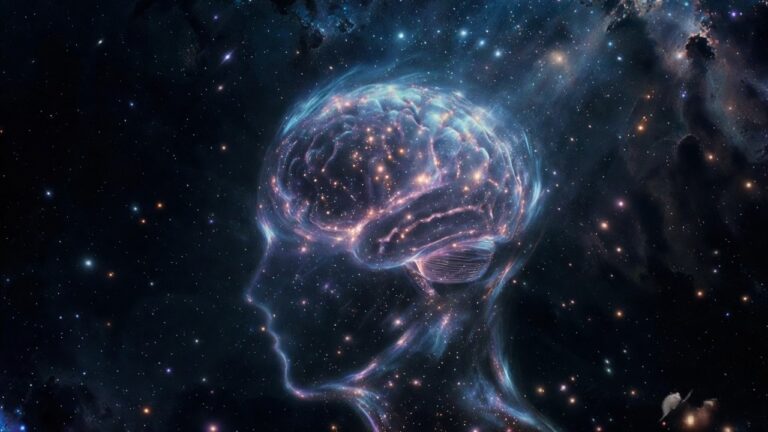
Now imagine that, by an unbelievably rare accident, particles in that emptiness suddenly arrange themselves into something astonishing: a fully functioning human brain, complete with memories, thoughts, and awareness.
It sounds like science fiction. Yet this idea exists in modern cosmology as a serious thought experiment known as the Boltzmann Brain problem.
The concept raises one of the strangest questions in science:
Could consciousness randomly appear in the universe purely by chance?
The idea is unsettling, fascinating, and deeply connected to how scientists understand time, entropy, and the origins of the cosmos.
But before diving into the mystery, it is important to understand that Boltzmann brains are not believed to exist in reality. They are used by physicists as a tool to test whether certain cosmological theories make sense.
Still, the thought experiment forces scientists to confront a bizarre possibility about the nature of reality itself.
The Physicist Behind the Idea
The roots of this strange concept go back to the 19th century.
Austrian physicist Ludwig Boltzmann spent much of his career studying the behavior of atoms and the laws of thermodynamics. His work helped explain entropy, the tendency of systems to move from order toward disorder.
Entropy is why:
- Ice melts
- Buildings decay
- The universe slowly becomes more chaotic over time
Boltzmann realized that although disorder increases overall, tiny pockets of order can occasionally appear through random fluctuations.
In theory, if the universe exists for an extremely long time, even highly complex structures could form randomly from moving particles.
Boltzmann imagined that perhaps the entire observable universe could have formed from one such fluctuation.
But later scientists realized something disturbing about that idea.
The Strange Logic Behind Boltzmann Brains
If random fluctuations can create complex structures, then the following question arises:
Which is more likely to appear by chance?
A) An entire universe filled with galaxies, stars, and life
or
B) A single human brain with false memories of such a universe
According to probability, the second option may actually be far more likely.
A brain is vastly simpler than an entire universe.
Because of this, some physicists argue that if the universe were mostly chaotic for eternity, random “Boltzmann brains” would appear more often than normal observers like us.
These hypothetical brains would exist briefly before disappearing again into randomness.
But during that short moment, they would experience thoughts and memories that feel completely real.
The Cosmic Lottery of Particles
To understand why this idea appears in physics, imagine the universe as a massive cosmic lottery.
Particles are constantly moving, colliding, and shifting.
Over extremely long periods of time, even the most unlikely arrangements of matter might occur.
Given enough time, atoms might randomly form:
- A rock
- A molecule
- A living cell
- Or even a brain
This is similar to the idea that if you shuffle a deck of cards enough times, every possible order will eventually appear.
Physicists use this concept to explore what might happen in a universe that lasts for trillions or even infinite years.
In such a scenario, random fluctuations could produce almost anything.
Including something that thinks.
Why the Idea Disturbs Physicists
The Boltzmann Brain problem creates a serious challenge for cosmology.
If Boltzmann brains are more likely than ordinary observers, then statistically most conscious beings in the universe should be Boltzmann brains.
But our experience does not match that expectation.
We observe a stable universe filled with structure:
- Galaxies
- Stars
- Planets
- Biological life
This suggests that our universe probably did not arise from a random fluctuation alone.
Instead, it likely began in a low-entropy state, such as the conditions believed to exist during the Big Bang.
The Boltzmann Brain paradox therefore acts as a warning sign.
If a cosmological theory predicts that most observers should be Boltzmann brains, physicists often consider that theory flawed.
The Arrow of Time Mystery
The paradox is closely connected to another deep puzzle: the arrow of time.
Entropy increases over time, giving the universe a direction from past to future.
But the early universe appears to have started in an extremely ordered state.
Scientists still debate why this happened.
Some theories propose that the universe began in a special low-entropy condition.
Others suggest that our universe might be part of a much larger cosmic structure or multiverse.
The Boltzmann Brain problem helps physicists test these ideas.
If a theory predicts too many Boltzmann brains, it may not correctly explain the arrow of time.
Could a Brain Really Form in Space?
Technically, physics does not forbid the possibility.
Random fluctuations can produce unusual arrangements of matter.
But the probability of particles forming a functioning human brain is so unimaginably small that it is difficult to describe.
Even in a universe lasting trillions of years, the chances would remain extremely tiny.
Yet in an eternal universe, even extremely unlikely events might eventually occur.
This is why the idea appears in theoretical physics discussions.
But again, scientists treat it primarily as a thought experiment, not as a realistic prediction.
How Scientists Try to Avoid the Paradox
Cosmologists have proposed several ways to resolve the Boltzmann Brain problem.
One possibility is that the universe does not last forever.
If the universe eventually decays or changes state, there may not be enough time for random brains to appear in large numbers.
Another approach involves refining cosmological theories so they naturally produce far more ordinary observers than Boltzmann brains.
In many modern models, the conditions needed for Boltzmann brains simply do not arise.
Researchers also explore the role of quantum physics and the structure of space-time to understand how fluctuations behave in the far future.
These investigations are still ongoing.
What the Paradox Reveals About Reality
Although strange, the Boltzmann Brain concept serves an important role in science.
It forces researchers to ask fundamental questions:
- Why does the universe have order at all?
- Why does time move in one direction?
- Why do observers like us exist in a stable cosmos?
The thought experiment highlights the importance of understanding entropy, probability, and cosmology.
It also reminds scientists that some ideas which appear logical on paper may lead to impossible conclusions.
When that happens, it often means a theory needs improvement.
Could We Be Boltzmann Brains?
The idea sometimes appears in philosophy discussions.
If Boltzmann brains were common, it might be possible that our memories and experiences are illusions created by random particle arrangements.
But most scientists consider this extremely unlikely.
Modern cosmology strongly supports the idea that the universe evolved through processes that produced galaxies, stars, planets, and biological life.
The evidence from astronomy, physics, and geology all points toward a long cosmic history.
So while the thought experiment is intellectually provocative, it does not suggest that human existence is an illusion.
The Role of Thought Experiments in Science
Physics has a long history of strange thought experiments.
Some famous examples include:
- Schrödinger’s cat
- Maxwell’s demon
- Einstein’s elevator
These scenarios were never meant to be real experiments.
Instead, they help scientists explore the consequences of theories.
The Boltzmann Brain paradox belongs to this tradition.
It acts as a stress test for cosmology models.
If a theory predicts absurd outcomes, researchers know something needs revision.
Why the Idea Still Fascinates People
Part of the appeal comes from how unsettling the idea is.
It touches on deep themes:
- Consciousness
- Reality
- Memory
- Probability
The thought that awareness could appear from random chaos challenges our everyday understanding of existence.
Yet at the same time, the paradox also highlights how extraordinary our universe truly is.
The cosmos contains billions of galaxies arranged in remarkable structure.
From that structure emerged life, intelligence, and curiosity.
In many ways, the Boltzmann Brain idea emphasizes just how rare and remarkable that chain of events may be.
Final Thoughts
The Boltzmann Brain problem is one of the strangest ideas in modern cosmology.
It suggests that if the universe were governed purely by random fluctuations over infinite time, isolated conscious brains might appear spontaneously in empty space.
Yet the paradox ultimately reinforces an important scientific conclusion.
The universe we observe — filled with order, structure, and history — likely did not arise from pure randomness alone.
Instead, something about the early conditions of the cosmos allowed complexity to grow over billions of years.
For now, Boltzmann brains remain a fascinating intellectual puzzle.
They are not evidence that consciousness randomly appears in space.
But they do remind us that the deeper we explore the universe, the stranger its questions can become.
FAQs
What is a Boltzmann brain?
A Boltzmann brain is a hypothetical self-aware brain that appears spontaneously due to random fluctuations of particles in the universe.
Did scientists actually observe a Boltzmann brain?
No. The idea exists only as a theoretical thought experiment used in cosmology.
Why do physicists discuss Boltzmann brains?
The concept helps test whether cosmological theories produce logical predictions about observers and entropy.
Could consciousness randomly appear in space?
Physics does not completely forbid it, but the probability is extraordinarily small.
Does the Boltzmann brain idea suggest reality is an illusion?
No. Most scientists believe our universe evolved naturally over billions of years, producing life through physical processes.
Sources and References
https://en.wikipedia.org/wiki/Boltzmann_brain
https://www.sciencealert.com/physicist-proposes-proof-that-you-didn-t-pop-into-existence-last-tuesday
https://arxiv.org/abs/1702.00850
https://www.santafe.edu/news-center/news/disentangling-the-boltzmann-brain-hypothesis-memory-entropy-and-time
https://www.nuclear-power.com/boltzmann-brains
https://www.physics.com.sg/theoretical-physics-dissecting-the-boltzmann-brain-paradox.htm

0 Comments