










By Ronald Kapper
A Cosmic Mystery That Refuses to Stay Quiet
Black holes were once considered the ultimate cosmic dead ends. Anything that crosses their boundary — called the event horizon — is thought to be gone forever. Crushed. Lost. Erased from our universe.
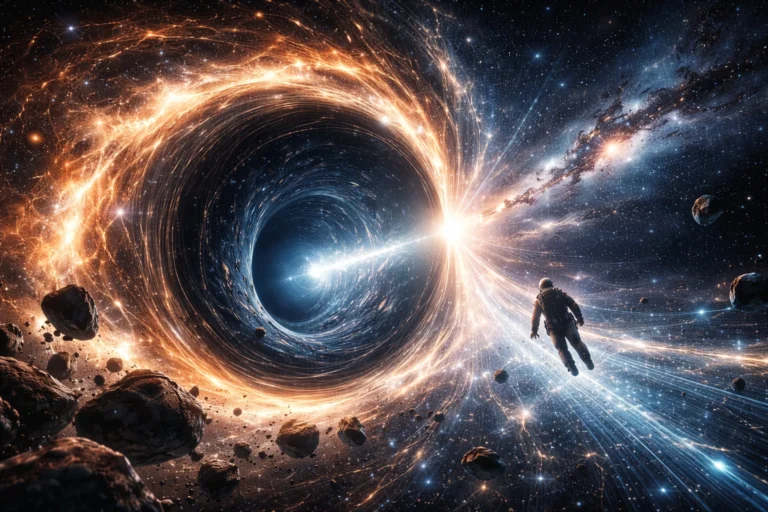
But a radical idea has been quietly gaining traction among theoretical physicists: what if black holes are not endings at all? What if they are doorways?
Not science fiction. Not fantasy. But a serious proposal rooted in Einstein’s equations.
The idea is controversial. It challenges how we understand gravity, space, and even reality itself. Yet it continues to surface in peer-reviewed research, cosmology discussions, and quantum gravity models.
What Exactly Is a Black Hole?
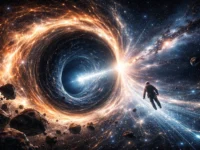
A black hole forms when a massive star collapses under its own gravity. The result is an object so dense that not even light can escape its pull. Its defining feature is the event horizon — the point of no return.
For decades, scientists believed black holes were simple in one sense: whatever falls in stays in.
But modern physics has complicated that picture.
Einstein’s Equations Hint at Something Strange
In 1935, Albert Einstein and physicist Nathan Rosen discovered a solution to the equations of general relativity that described something extraordinary: a bridge connecting two separate regions of space-time.
This theoretical structure became known as the Einstein–Rosen bridge, often called a wormhole.
In simple terms, a wormhole is a tunnel linking distant parts of the universe — or possibly entirely different universes.
And here is the intriguing part: mathematically, wormholes can appear in connection with black holes.
The Wormhole Possibility
In theory, if a black hole connects to another region of space-time, anything entering it could emerge elsewhere.
This does not mean astronauts could safely travel through one. Most wormhole models collapse instantly or would require exotic forms of matter to stay open.
But the mathematics allows the possibility.
Some researchers now explore whether black holes could contain internal structures far more complex than a simple crushing singularity.
Quantum Gravity Changes the Story
The biggest problem with black holes lies at their center — the singularity. According to classical physics, density becomes infinite. But most physicists agree nature does not allow true infinities.
That is where quantum gravity enters the picture.
Quantum gravity attempts to merge quantum mechanics with Einstein’s theory of gravity. In some models, singularities disappear and are replaced with transitional regions — possibly gateways to other space-time structures.
This has led some physicists to explore whether black holes could transition into white holes — theoretical objects that expel matter instead of absorbing it.
In that scenario, a black hole in one universe might become a white hole in another.
The ER=EPR Connection
A modern twist on the wormhole concept comes from a bold idea known as ER=EPR. This proposal suggests that wormholes (Einstein–Rosen bridges) and quantum entanglement may be deeply connected.
In simple language, entangled particles might be linked through microscopic wormholes.
If this idea is correct, space-time itself could be woven together through quantum connections.
That means black holes may not be isolated objects — they could be nodes in a vast cosmic network.
Do Observations Support This?
So far, there is no direct observational proof that black holes are doorways.
However, recent observations have changed how scientists view them:
- The Event Horizon Telescope captured the first image of a black hole’s shadow.
- Gravitational wave detectors observed black hole mergers.
- Studies suggest black holes may preserve information in subtle quantum ways rather than destroying it completely.
The information paradox — the question of what happens to information inside a black hole — remains unsolved. If information is not destroyed, where does it go?
Some theorists argue this mystery hints at deeper structures inside black holes.
The Multiverse Angle
Another bold proposal connects black holes to the multiverse idea.
Some cosmological models suggest that new universes could form inside black holes. In this scenario:
- Each black hole could create a new expanding universe.
- Our universe itself may have originated inside another black hole.
This theory is speculative, but it has appeared in serious cosmology discussions.
If true, black holes would not be graveyards — they would be cosmic birthplaces.
Why Scientists Take This Seriously
Despite sounding dramatic, the doorway idea is not dismissed outright because:
- It arises naturally from Einstein’s equations.
- Quantum gravity models require alternatives to singularities.
- The information paradox demands explanation.
- Modern physics increasingly treats space-time as flexible and dynamic.
Physicists are cautious. They do not claim black holes are proven portals. But they acknowledge the mathematics keeps reopening the question.
The Risks of Oversimplification
It is important to avoid exaggeration.
Black holes are extremely hostile environments. Even if a wormhole existed inside one, the tidal forces near the event horizon would likely destroy any physical object attempting entry.
Most wormhole solutions require forms of “exotic matter” with negative energy density — something not yet observed in nature.
So while the math allows doorways, practical travel remains purely theoretical.
What This Means for Humanity
If black holes are doorways — even in principle — it would reshape our understanding of:
- Space and distance
- The birth and death of universes
- The ultimate structure of reality
It would mean the cosmos is interconnected in ways we barely understand.
It would mean what we call an ending might be a transition.
And it would confirm that the universe is far stranger than we imagined.
Frequently Asked Questions
Q1: Are black holes confirmed to be portals?
No. There is no direct evidence that black holes function as doorways. The idea comes from theoretical models.
Q2: What is a wormhole?
A wormhole is a theoretical tunnel connecting distant points in space-time, predicted by solutions to Einstein’s equations.
Q3: Could humans travel through a black hole?
Current physics suggests this would not be survivable due to extreme gravity.
Q4: Do black holes destroy information?
This remains debated. Some theories suggest information is preserved in subtle quantum forms.
Q5: Is this science fiction?
No. While popular in fiction, wormholes and Einstein–Rosen bridges originate from real mathematical physics.
The Balance Between Wonder and Evidence
Black holes were once simple in our imagination — cosmic vacuum cleaners that swallow everything.
Today, they are among the most complex and mysterious objects in physics.
Whether they are gateways, bridges, or simply extreme gravitational wells, one thing is certain: we do not yet understand them fully.
And when science admits it does not fully understand something, that is where discovery begins.
Disclaimer
This article discusses theoretical physics models. There is no confirmed observational evidence that black holes function as doorways or portals. The ideas presented here arise from mathematical solutions and ongoing research in general relativity and quantum gravity. Interpretations remain debated within the scientific community.
Scientific References and Sources
Einstein–Rosen bridge original concept
https://journals.aps.org/pr/abstract/10.1103/PhysRev.48.73
Wormholes and general relativity overview
https://plato.stanford.edu/entries/wormholes/
Event Horizon Telescope findings
https://eventhorizontelescope.org
Black hole information paradox research
https://www.nature.com/articles/d41586-019-01403-3
ER=EPR proposal (Maldacena & Susskind)
https://arxiv.org/abs/1306.0533
Quantum gravity and singularity resolution
https://www.scientificamerican.com/article/what-is-quantum-gravity/
Cosmological natural selection and black hole universe models
https://arxiv.org/abs/gr-qc/9404011

0 Comments