








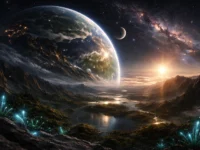





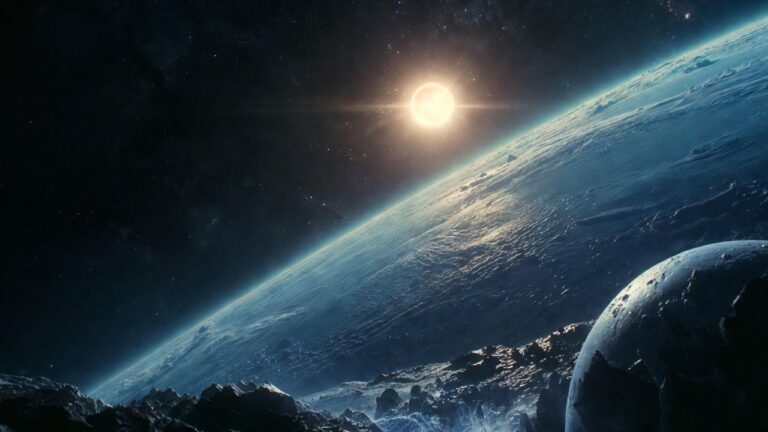
Far beyond our planet, in the cold reaches of space, scientists are studying mysterious water-rich worlds that could be older than Earth itself. These distant ocean worlds may have formed billions of years before our planet took shape, holding vast global seas beneath icy crusts or deep atmospheres. Some may still exist today, quietly orbiting distant stars. Others are hidden among the moons of our own solar system.
The idea is both simple and astonishing — if oceans formed early in cosmic history, then water, and possibly the chemistry of life, may have existed long before Earth was born.
This article explores the science behind ancient ocean worlds, the evidence researchers have gathered, and what these discoveries could mean for our understanding of the universe. It does not claim confirmed life beyond Earth. It examines scientific findings, ongoing research, and realistic possibilities grounded in astronomy.
Disclaimer
Ocean worlds older than Earth remain a scientific hypothesis based on models of planetary formation and observations of water-rich bodies in space. While strong evidence suggests water is common in the universe, there is no confirmed discovery of life beyond Earth. This article presents peer-reviewed ideas and current research, not speculation beyond scientific boundaries.
What Is an Ocean World?
An ocean world is a planet or moon where a large portion of its mass is made of water — either as deep global oceans, thick layers of ice covering liquid water, or water-rich interiors.
Unlike Earth, where oceans cover about 70 percent of the surface, some ocean worlds may contain more water than all of Earth’s oceans combined, possibly extending hundreds of kilometers deep.
Ocean worlds can exist in two major forms:
- Icy ocean worlds with subsurface oceans beneath frozen crusts
- Water-rich planets where deep oceans may exist under thick atmospheres
Scientists believe both types are common across the galaxy.
How Could Ocean Worlds Be Older Than Earth?
Earth formed about 4.5 billion years ago. But the universe is around 13.8 billion years old. That leaves billions of years before Earth existed.
After the first generations of stars exploded as supernovae, they created heavier elements like oxygen and hydrogen — the key ingredients of water.
Astronomers believe water formed very early in cosmic history, even before many planets like Earth existed. Some ancient star systems may have produced water-rich worlds billions of years before our solar system formed.
If those worlds survived, they could be far older than Earth.
Evidence From Ancient Water in Space
Astronomers using radio telescopes have detected massive water clouds in deep space, some dating back over 12 billion years. This suggests water formed early in the universe.
Spectroscopic observations of distant star systems also show water vapor in protoplanetary disks — the regions where planets are born.
These findings support the idea that water-rich planets could have formed long before Earth.
Ocean Worlds in Our Solar System
Several moons in our own solar system are considered ocean worlds:
Europa (Jupiter’s Moon)
Europa likely contains a deep ocean beneath its icy crust. Tidal heating from Jupiter’s gravity may keep the ocean liquid.
Enceladus (Saturn’s Moon)
Jets of water vapor erupt from Enceladus, indicating a global ocean below its surface.
Ganymede
The largest moon in the solar system may contain multiple layers of subsurface oceans.
While these bodies formed alongside our solar system, they demonstrate how ocean worlds can exist in different environments.
Exoplanet Ocean Worlds Beyond Our Solar System
Modern telescopes have discovered planets that may be covered almost entirely by water.
Some exoplanets orbit older stars, suggesting they could be billions of years older than Earth.
In some cases, density measurements indicate large water content. Others show atmospheric signatures consistent with water-rich environments.
Though direct imaging of oceans is not yet possible, planetary models strongly support their existence.
Why Water Forms So Easily in the Universe
Water is made from hydrogen and oxygen — two abundant elements in the cosmos.
Hydrogen formed shortly after the Big Bang. Oxygen formed later inside stars and spread through supernova explosions.
When these elements combine in cold regions of space, water molecules form naturally.
Because the ingredients are common, water may be one of the most widespread substances in the universe.
This increases the likelihood that ocean worlds formed early and often.
Could Ancient Ocean Worlds Support Life?
Water is essential for life as we know it. On Earth, life appeared relatively quickly after oceans formed.
If ocean worlds existed billions of years earlier, they may have had long periods for chemical evolution.
Subsurface oceans heated by internal energy sources could provide stable environments shielded from radiation.
Scientists consider ocean worlds among the most promising locations to search for life beyond Earth.
However, no confirmed detection of extraterrestrial life exists.
Challenges of Studying Ocean Worlds
Detecting and studying distant ocean worlds is difficult.
Most exoplanets are too far for direct surface observation. Scientists rely on indirect measurements such as:
- Planetary density
- Atmospheric composition
- Orbital characteristics
- Thermal signatures
Future space telescopes may improve detection of water-rich planets.
The Role of Cosmic Time
If ocean worlds formed early, some may have existed for billions of years before Earth formed.
This means life, if it emerged elsewhere, could be far older than life on Earth.
The timeline of cosmic habitability may be much longer than previously thought.
This possibility is reshaping astrobiology and planetary science.
What Future Missions May Reveal
Upcoming space missions aim to explore ocean worlds in our solar system more closely.
Europa Clipper and other planned probes will study subsurface oceans, chemistry, and potential habitability.
Meanwhile, next-generation telescopes will search for water-rich exoplanets and atmospheric signatures.
Each discovery brings us closer to understanding whether ancient ocean worlds truly exist.
Scientific Perspective
While evidence for widespread water is strong, confirmation of ancient ocean planets older than Earth requires further data.
Many candidate worlds exist. Their exact ages and compositions remain under study.
Science advances step by step, guided by observation and evidence.
The idea is powerful, but it remains a working hypothesis.
Final Thoughts
The universe may be far older, wetter, and more complex than once imagined.
Ocean worlds could have formed billions of years before Earth, carrying deep seas across cosmic time.
Whether these ancient waters ever hosted life remains unknown.
But one thing is clear — Earth may not have been the first world to hold oceans beneath its skies.
And somewhere in the vast darkness of space, ancient seas may still exist, waiting to be understood.
Frequently Asked Questions
Q1: Are there confirmed ocean planets older than Earth?
No confirmed example yet. Scientists are studying candidates based on planetary models and observations.
Q2: Where are ocean worlds found?
They may exist both in our solar system and around distant stars.
Q3: Why is water important for life?
Water allows chemical reactions necessary for biological processes.
Q4: Could life exist in subsurface oceans?
Possibly, especially where internal heat provides stable conditions.
Q5: How do scientists detect water on distant planets?
Through spectroscopy, density analysis, and atmospheric measurements.
Reference Sources
- https://science.nasa.gov/solar-system/ocean-worlds
- https://exoplanets.nasa.gov/what-is-an-exoplanet/overview/
- https://www.esa.int/Science_Exploration/Space_Science/Juice
- https://www.nature.com/articles/s41550-021-01336-3
- https://www.scientificamerican.com/article/ocean-worlds-in-the-search-for-life/

0 Comments