

















Disclaimer: This article is written for informational and speculative editorial purposes. The theories presented here are drawn from fringe research, whistleblower testimony, and publicly available documents. They do not represent confirmed scientific fact or the position of any government body. Reader discretion is advised.
There is a conversation happening right now — not in Reddit threads or late-night YouTube rabbit holes, but supposedly inside actual intelligence corridors — and what is being whispered there is genuinely one of the most disturbing ideas to ever attach itself to the UAP disclosure conversation. It is called the Soul-Catcher Theory, and if even a fraction of it holds up, it reframes everything. Every war. Every mass tragedy. Every unexplained aerial sighting over a battlefield. All of it snaps into a completely different and deeply unsettling picture.
Most people who follow the UAP topic have spent years focused on the hardware — the tic-tac shaped objects, the Gimbal video, the Senate hearings, the question of where these craft come from and what propulsion system could possibly explain what pilots are seeing. That framing, the “nuts and bolts” framing, has dominated the conversation for decades. But a growing number of researchers, former intelligence personnel, and interdisciplinary thinkers are now saying that focusing on the craft is like focusing on the fishing rod and completely ignoring the fisherman. The craft may not even be the point.
What Exactly Is the Soul-Catcher Theory?
The core idea, stripped of all the noise around it, goes something like this: UAPs are not spacecraft in the traditional sense. They are not piloted vehicles from another solar system carrying biological beings who are curious about Earth. Instead, they are better understood as interdimensional harvesting mechanisms — sophisticated, possibly semi-autonomous “dredges” — designed to collect a very specific kind of energy that human beings produce under very specific conditions.
That energy has a name in certain circles. It is called Loosh.
The term was originally coined by Robert Monroe, the American researcher and author who spent decades studying out-of-body experiences and published his findings in books that the Monroe Institute, still operating today in Virginia, continues to build on. Monroe described Loosh as a form of emotional energy — a frequency, essentially — that living beings generate, and that certain non-physical entities appear to actively seek out and consume. He described it almost clinically, not with horror but with a kind of detached curiosity. Monroe believed he had encountered these entities during his astral projection experiments and that they regarded human suffering the way a farmer regards a harvest. Completely without malice. Completely without concern.
What is new in 2026 is not the concept of Loosh itself. What is new is that variations of this framework are reportedly being taken seriously in places they never were before. Multiple sources — some named, most not — have described conversations within defense and intelligence adjacent communities where the “non-material” nature of UAP phenomena is no longer being dismissed outright. Former Deputy Assistant Secretary of Defense for Intelligence Christopher Mellon, who has been one of the most credible mainstream voices pushing for UAP disclosure, has repeatedly said in public forums that the phenomenon may not fit neatly into any materialist explanation. That is a careful, diplomatic way of opening a very large and very strange door.
The Frequency of Suffering — Why Loosh Is Not Just New Age Noise
Here is where it gets harder to dismiss. Human beings under extreme duress — fear, grief, physical agony, the particular cocktail of biochemical and neurological activity that accompanies death — produce measurable electromagnetic output. This is not metaphysics. The human heart generates the body’s strongest electromagnetic field, one that can be detected several feet away from the body using standard instruments. The brain, under high-stress conditions, produces electromagnetic signatures that are genuinely different in character from baseline states. Extreme suffering changes the electromagnetic fingerprint of a human being in ways that are real, measurable, and currently not fully understood by mainstream science.
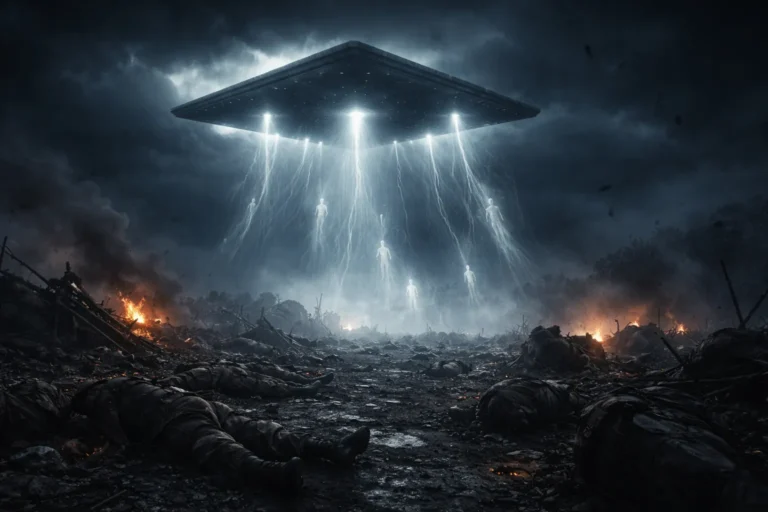
Now take that established scientific reality and stack it next to something else that is also real: the consistent, documented, across-culture-and-century pattern of UAP sightings clustering around sites of mass human death. Battlefields. Disaster zones. Conflict regions. This is not a new observation. Charles Fort, the American writer who spent his life cataloguing anomalous events, was noting in the early twentieth century that strange aerial phenomena seemed to follow wars. The same pattern appeared over the trenches of World War One. Over the Pacific theater in World War Two — the famous “Foo Fighters” that both Allied and Axis pilots reported seeing and that neither side could explain. Over Vietnam. Over contemporary conflict zones in the Middle East.
You could argue coincidence. You could argue that military activity simply creates conditions — radar, communications, unusual light and heat signatures — that produce misidentified readings. But the Soul-Catcher framing offers a different reading entirely. It says the pattern is the point. It says these are not coincidences. It says something is showing up precisely where and when the human suffering signal is at its strongest, and that it has been doing so, consistently, for as long as we have been recording the sky.
Why Disclosure Is Being Blocked — The Livestock Hypothesis
This is the part of the theory that people find hardest to sit with, and it is also the part that, if true, would explain something that has frustrated UAP researchers for decades: why, despite overwhelming evidence that something real is happening in our skies, genuine disclosure remains perpetually just out of reach.
The standard explanations for suppression are familiar. National security concerns. Technology reverse-engineering programs that governments do not want to expose. The institutional embarrassment of admitting the phenomenon was real all along. These are plausible, and they probably contain some truth. But the Soul-Catcher Theory offers a bleaker explanation — one that, once heard, is difficult to unfocus.
What if disclosure is not happening because the governments who know the most about this phenomenon have concluded that the truth is not just destabilizing but functionally useless? What if the conclusion reached — quietly, in rooms most people will never have access to — is that humanity is not at the top of any hierarchy we imagined ourselves to be at the top of? That we are, in a very practical and very terrible sense, a managed resource? That the entities behind the phenomenon have no interest in contact because contact serves no purpose on their end — any more than a farmer needs to formally introduce himself to the cattle?
That is the livestock hypothesis. And before you wave it away entirely, consider that some of the most credible voices in the UAP conversation have been edging toward language that rhymes with it. Lue Elizondo, the former head of the Pentagon’s AATIP program, has said in multiple interviews that the phenomenon “may have a consciousness component” and that its relationship to humanity might not be what we would hope. He has used the phrase “we may not be at the top of the food chain” more than once, and he has done so in contexts where he appeared to be speaking carefully rather than carelessly.
Historical “Feeding Events” — A New Way to Read Old Disasters
If you accept the framework, even provisionally, it forces a re-reading of history that is genuinely disturbing to sit with. The Soul-Catcher Theory, in its most developed form, proposes that major historical conflicts — the World Wars, large-scale famines, genocides, pandemics — may not have been caused by the entities behind UAPs, but may have been, in some functional sense, harvested by them. That whatever produces the Loosh signal was being collected at industrial scale during these events in ways that smaller, individual deaths simply cannot replicate.
There are researchers who go further and argue the causation runs the other direction — that certain conflicts were, in some indirect or non-material way, cultivated or encouraged. That claim is harder to defend and moves more quickly into territory that most serious investigators are not willing to occupy. But the correlation point — that the phenomenon clusters around mass death — is something that holds up across the historical record in ways that deserve far more serious academic attention than it has received.
Jacques Vallée, the French-American astronomer and computer scientist who has been studying UAP phenomena since the 1960s and who served as the real-world inspiration for the character Lacombe in Close Encounters of the Third Kind, has spent decades arguing that the phenomenon is fundamentally about control and manipulation of human consciousness rather than interstellar travel. His books, particularly “Messengers of Deception” and “The Invisible College,” lay out a framework that, while it does not use the word Loosh, arrives at some functionally similar conclusions through rigorous research rather than intuitive speculation.
What the Intelligence Community Is (Allegedly) Actually Saying in 2026
Sourcing this part of the story honestly requires transparency about what is confirmed versus what is circulating. What is confirmed is that the tone of official and semi-official UAP discourse has shifted dramatically since 2017, and has continued shifting in directions that would have seemed like science fiction as recently as 2020. The All-domain Anomaly Resolution Office (AARO) has acknowledged receiving reports that describe phenomena that do not fit conventional physical explanations. Multiple Congressional hearings have included testimony about UAP behavior that implies capabilities — instant acceleration, trans-medium travel, apparent awareness of observer attention — that suggest something far beyond conventional aerospace technology.
What is circulating — through researcher networks, through former defense personnel speaking off-record, through the kinds of conversations that get reported second and third-hand but keep getting reported consistently — is that within certain compartmented programs, the “consciousness-based” or “non-material” interpretation of the phenomenon is no longer being treated as fringe. That working groups have existed, and may still exist, specifically tasked with taking the interdimensional and consciousness-related aspects of UAP reports seriously as operational intelligence rather than noise.
The Soul-Catcher Theory, in this context, is not coming from one person’s fever dream. It is the end point of a vector that a lot of serious, credentialed people are being pulled along, whether they are comfortable with where it leads or not.
FAQs
Q: Is the Loosh concept scientifically validated? The term Loosh originates with Robert Monroe’s experiential research and is not recognized by mainstream science as a confirmed phenomenon. However, the underlying claim — that human emotional and physiological states produce measurable electromagnetic output — is scientifically established. The specific harvesting hypothesis remains in the category of speculative theory.
Q: Are there documented cases of UAPs over battlefields? Yes. The “Foo Fighters” of World War Two are among the most documented examples — reported independently by Allied and Axis pilots, investigated by both sides, and never officially explained. Multiple other historical conflict zones have accumulated UAP sighting records. Whether these represent the same phenomenon as modern UAP reports is debated.
Q: Has any government officially acknowledged the consciousness angle? Not in explicit terms. However, statements from former AATIP director Lue Elizondo and others have consistently pointed toward the phenomenon having properties that exceed physical explanation, and Congressional testimony has referenced “non-human intelligence” in contexts that leave room for non-material interpretations.
Q: Is this theory connected to any religion or cult? No, though it touches on concepts that appear across religious and spiritual traditions worldwide — the idea that non-physical entities feed on human energy appears in various forms in Gnostic texts, certain Vedic frameworks, and indigenous cosmologies from multiple continents. The theory as discussed here draws from research and intelligence adjacent sources rather than any religious tradition.
Q: Should I be alarmed by this theory? The honest answer is: treat it as one framework among many for understanding a phenomenon that genuinely does not have a clean, settled explanation. It is worth taking seriously as a conceptual lens. It is not worth losing sleep over in the absence of further evidence. Stay curious, stay skeptical, and watch what keeps getting confirmed.
The Bottom Line
The Soul-Catcher Theory is uncomfortable not because it sounds crazy, but because it does not sound as crazy as it should. The pieces it assembles — Monroe’s Loosh research, the documented clustering of UAPs around mass death events, the electromagnetic reality of human suffering, the persistent non-disclosure despite growing official acknowledgment — those pieces come from real places. The picture they form when arranged together is not a picture most people want to look at.
But if the history of the UAP phenomenon has taught researchers anything, it is that the most uncomfortable questions are usually the ones closest to something worth understanding. The Soul-Catcher Theory may turn out to be wrong. It may be partially right in ways that take years to untangle. Or it may be the framework that, one day, makes sense of a pattern that has been hiding in plain sight across the entire span of recorded human history.
Whatever it is — it deserves more than dismissal.
Reference Sources
- Monroe, Robert A. Far Journeys (1985) — Doubleday. Monroe’s original detailed description of “Loosh” as an energy currency consumed by non-physical entities. https://www.monroeinstitute.org/pages/about-bob-monroe
- Vallée, Jacques. Messengers of Deception: UFO Contacts and Cults (1979) — And/Or Press. Framework for UAPs as consciousness manipulation systems rather than interstellar craft. https://jacquesvallee.net
- U.S. Senate Armed Services Committee — UAP Hearings, 2023. Testimony from David Grusch and others referencing non-human intelligence. https://www.armed-services.senate.gov
- All-domain Anomaly Resolution Office (AARO) — Official Pentagon UAP reporting body. https://www.aaro.mil
- Elizondo, Luis — Multiple public interviews referencing consciousness components and food-chain language. NewsNation interview archive: https://www.newsnationnow.com/space/ufo
- Fort, Charles. The Book of the Damned (1919) — Boni and Liveright. Early cataloguing of anomalous aerial phenomena clustering around disasters. https://www.gutenberg.org/ebooks/22472
- U.S. House Oversight Committee UAP Hearing, July 2023 — Full testimony transcript. https://oversight.house.gov/hearing/unidentified-anomalous-phenomena-implications-on-national-security-public-safety-and-government-transparency/
- The Monroe Institute — Active research institution continuing Robert Monroe’s consciousness research. https://www.monroeinstitute.org

0 Comments