
















Something happened at CERN in January 2026 that the mainstream science world has been very careful about how it discusses, and honestly, when you sit with the details long enough, you start to understand why. It is not the kind of thing you can drop casually into a press release. It is not the kind of thing that fits neatly into a headline without making people deeply uncomfortable. And yet here we are, because the data does not care about our comfort levels.
What Actually Happened at the Large Hadron Collider
To understand why this matters, you need a little bit of context about how the Large Hadron Collider works. CERN’s LHC is the largest and most powerful particle accelerator ever built, stretching 27 kilometres in a circular tunnel beneath the border of France and Switzerland. It smashes subatomic particles together at speeds approaching the speed of light, generating conditions that mimic the moments just after the Big Bang, and it generates an absolutely staggering amount of data — petabytes of it every single second of operation.
Because no human team could possibly monitor all of that data in real time, CERN, like virtually every major scientific institution in the world now, uses AI-driven monitoring systems to watch for irregularities, flag anomalies, and alert researchers when something falls outside of expected parameters. These systems are designed to be cold, objective, and incapable of imagination. They do not see what they want to see. They see what is there.
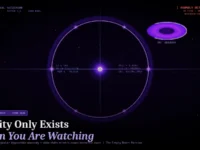
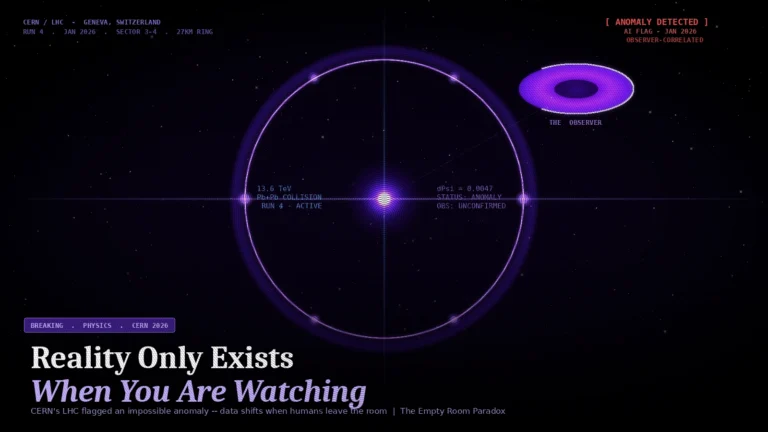
In January 2026, one of these AI monitoring systems flagged something that the engineers initially assumed was a calibration error. The data patterns coming from specific detector arrays were showing measurable, statistically significant differences based on one variable that had absolutely no business mattering at all — whether or not human operators were physically present in the control room. When people were in the room watching the data streams, the numbers behaved one way. When the room was empty and only the AI was watching, the numbers shifted. Not dramatically. Not in a way that would blow up the experiment or trigger alarms on its own. But consistently, repeatedly, and in a pattern that grew harder and harder to wave away as coincidence the longer the team looked at it.
This Is Not the Observer Effect You Learned in School
Most people who have had any exposure to quantum physics have heard of the observer effect. It is one of those concepts that gets thrown around a lot, sometimes accurately and sometimes not, and it refers to the way that measuring a quantum system inevitably disturbs it. The classic example is the double-slit experiment, where particles fired through two slits create an interference pattern suggesting they passed through both slits simultaneously — until you set up a detector to watch which slit each particle goes through, at which point the interference pattern collapses and the particles start behaving like regular, boring, non-quantum objects. The act of observing changes the outcome. This has been known since the early twentieth century and while it is philosophically interesting, physicists have spent decades finding ways to explain it without having to conclude that human consciousness is somehow steering reality.
What happened at the LHC in January is different, and the difference matters enormously. The standard observer effect operates at the quantum scale, affects individual particles, and is understood to result from the physical interaction between the measuring device and the thing being measured. What the AI flagged was not a quantum-scale anomaly. It was a pattern-level shift across massive detector arrays, and the variable that correlated with the shift was not the presence of a measuring instrument — the instruments were always there, running continuously. The variable was the presence of conscious human observers in the room. The AI watching the data counted as no one. The engineers sitting at their stations watching the same data counted as someone.
The Empty Room Paradox — What It Actually Implies
The researchers who first started digging into this anomaly started calling it, somewhat grimly, the Empty Room Paradox. The logic goes like this: if the data shifts when humans leave the room, and the data shifts back when humans enter, and this happens consistently enough to be statistically significant, then you are forced into one of a very small number of conclusions, and none of them are particularly comfortable.
The first possibility is that there is a mundane physical explanation nobody has found yet — some vibration caused by human movement, some electromagnetic interference from human equipment, something boring and fixable. The team spent months trying to prove this and could not. The anomaly persisted through controlled conditions designed specifically to eliminate every physical variable they could think of.
The second possibility, and the one that has started circulating in more speculative corners of the scientific community, is that reality itself is in some sense conditional. That what we experience as the stable, solid, measurable universe is only stable and solid and measurable because we are continuously experiencing it. That when no human awareness is present to interact with a system, that system does not maintain its full resolution, so to speak. It un-renders. It drops to a lower state. And when awareness returns, it snaps back to the version we expect to see, because that is the version that gets generated for our benefit.
Why Simulation Theory Suddenly Feels Less Ridiculous
The phrase “simulation theory” tends to make serious scientists wince a little, because it has spent years being a favourite topic of tech billionaires making provocative statements at conferences. But the theoretical underpinning of the idea — that a sufficiently advanced information-processing system could generate a reality indistinguishable from a base-layer physical universe — has always been philosophically coherent even when it lacked empirical support. The Empty Room Paradox, if it holds up, starts to look uncomfortably like exactly the kind of empirical support simulation theorists have been waiting for.
Here is the logic that makes this so disturbing: if you were designing a simulated universe and you had to balance the computational load of running it, the most efficient approach would be to only generate full-detail reality in the regions where observers exist to experience it. Everything outside the field of observation gets reduced, simplified, held in a kind of standby state until attention arrives. This is, in fact, exactly how modern video game engines work — a technique called frustum culling and level-of-detail rendering ensures that only the parts of the game world the player can currently see are rendered at full resolution. The rest exists as low-detail placeholder data until the camera turns that way.
The LHC anomaly suggests that the universe may be operating on the same principle. The empty room is not being rendered at full resolution because there is no one there to need it at full resolution. And when the engineers walk back in, reality catches up.
The Part That Should Keep You Up at Night
Here is where this stops being an abstract philosophical puzzle and starts being something that crawls under your skin a little. If reality reduces or shifts or un-renders when unobserved, then the question is not just what is happening in an empty laboratory in Switzerland. The question is what is happening everywhere that you are not looking right now.
You are reading this. Your attention is here, on these words. What is behind you? You know, of course, in the sense that you have a memory of the room or street or space you are in, and you have a reasonable expectation that it has not changed since you last looked. But that expectation is based entirely on the assumption that physical reality is continuous and observer-independent — the assumption that the LHC anomaly is now putting serious pressure on.
The question the Empty Room Paradox raises is not whether your chair disappears when you are not looking at it. It is deeper and stranger than that. It is whether the chair, and the room, and everything in your peripheral reality, is being maintained at the same level of physical specificity and consistency when your attention is elsewhere. It is whether the laws of physics themselves — the constants, the forces, the properties of matter — hold steady in the same way in unwitnessed spaces as they do the moment a conscious mind turns toward them.
What Physicists Are Actually Saying
To be clear about what has and has not been claimed: no official CERN statement has declared that reality is a simulation or that consciousness controls physics. The institution is appropriately careful, and the anomaly is still being investigated. What has happened is that the data has been verified as real by multiple independent teams, the standard physical explanations have not resolved it, and a growing number of researchers who would normally dismiss this kind of talk are finding themselves unable to dismiss the numbers.
Physicists who study the foundations of quantum mechanics have pointed out that this anomaly is consistent with interpretations of quantum theory that have always assigned a special role to observation — most notably the Copenhagen interpretation, which has always held that quantum systems do not have definite properties until they are measured, and the more radical relational quantum mechanics framework developed by Carlo Rovelli, which holds that physical reality is not absolute but always relative to an observer. Neither of these frameworks predicted the LHC anomaly specifically, but both of them have theoretical space for what it might mean.
Why This Story Matters Beyond the Science
The reason this particular discovery is resonating so strongly outside of physics departments is that it touches something older and deeper than any scientific framework. Cultures and philosophies across human history have grappled with the idea that consciousness and reality are not as separate as modern Western science assumed. The Buddhist concept of dependent origination, the idealist philosophical traditions running from Berkeley through Schopenhauer, the participatory universe concept proposed by physicist John Wheeler — all of these point in the same direction. Reality is not a backdrop against which consciousness operates. Reality and consciousness are entangled, co-arising, mutually dependent.
If the LHC anomaly is what the most unsettling reading of it suggests, then physics has not discovered something new so much as it has finally caught up to something very old. And the universe, patient as it apparently is, has been waiting for us to notice.
FAQs
What exactly did CERN discover in January 2026? AI monitoring systems at the Large Hadron Collider detected consistent, statistically significant shifts in data patterns that correlated with whether human operators were physically present in the control room, suggesting that the act of human observation may affect physical measurements at a fundamental level.
Is this the same as the quantum observer effect? Not exactly. The standard quantum observer effect is well-understood and results from the physical interaction of a measuring device with a particle. The LHC anomaly appears to involve the presence of conscious human observers specifically, independent of what instruments are running, which makes it far more unusual and harder to explain through conventional physics.
Does this prove we are living in a simulation? No single experiment proves simulation theory, and CERN has not made that claim. However, the anomaly is consistent with what you would predict if reality operated on observer-dependent rendering principles similar to how simulation systems manage computational load.
What is the Empty Room Paradox? It is the informal name researchers gave to the observed phenomenon — the paradox that an empty room, by definition unobserved, appears to behave differently than a room with conscious humans present, despite all physical instruments remaining constant.
Should I be worried about this? That depends on your philosophical temperament. If reality has always operated this way and we simply did not know it until now, then nothing has actually changed about your daily experience. The floor is still solid under your feet. The coffee is still hot. But the question of what all of that means at a deeper level is now considerably more open than it was before January 2026.
Is the anomaly being studied further? Yes. Multiple independent research teams have been given access to the data and are working to either reproduce the anomaly under controlled conditions or find the conventional explanation that has so far eluded the original team.
Disclaimer: This article discusses a reported anomaly at CERN’s Large Hadron Collider that has been flagged by AI monitoring systems and is currently under active scientific investigation. The interpretations discussed — including references to simulation theory and observer-dependent reality — represent theoretical frameworks being considered by researchers and should not be taken as established scientific consensus. CERN has not issued an official statement confirming or endorsing any interpretation of the anomaly beyond acknowledging that the data is real and under review. Readers are encouraged to follow developments through official CERN communications and peer-reviewed publications as the investigation continues. The philosophical and speculative dimensions of this article are intended to contextualise, not to sensationalise, a genuinely unusual and as-yet unresolved scientific observation.
Reference Sources:
- CERN Official Website — Large Hadron Collider Overview: https://home.cern/science/accelerators/large-hadron-collider
- CERN Data Centre and AI Monitoring Systems: https://home.cern/science/computing
- Quantum Observer Effect — Stanford Encyclopedia of Philosophy: https://plato.stanford.edu/entries/qt-quantcomp/
- Carlo Rovelli — Relational Quantum Mechanics: https://arxiv.org/abs/quant-ph/9609002
- John Wheeler — Participatory Universe: https://www.informationphilosopher.com/solutions/scientists/wheeler/
- Double Slit Experiment and Observation — Physics.org: https://www.physicsoftheuniverse.com/topics_quantum_double.html
- Nick Bostrom — Are You Living in a Simulation? (Philosophical Quarterly, 2003): https://www.simulation-argument.com/simulation.html
- CERN LHC Detector Systems: https://home.cern/science/experiments/atlas

0 Comments