
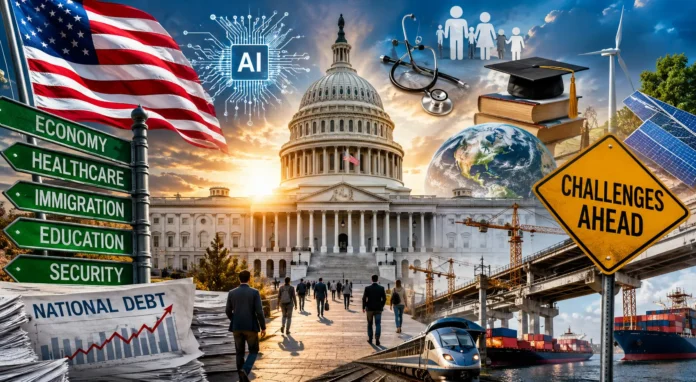
The United States has always faced difficult choices, but the next decade may prove to be one of the most consequential periods in modern American history. From rising debt and healthcare costs to artificial intelligence and geopolitical competition, policymakers in Washington are confronting issues that will shape the country’s future for generations.
Some challenges are decades old and growing harder to solve. Others are emerging rapidly, fueled by technological change and shifting global realities. What makes the coming years particularly significant is that many of these problems are interconnected. Decisions made today will influence economic prosperity, national security, social stability, and America’s position in the world.
Here are the biggest policy challenges America is likely to face over the next ten years.
1. The National Debt and Fiscal Sustainability
America’s growing national debt has become one of the most pressing long-term concerns facing lawmakers.
Federal spending continues to outpace revenues, driven largely by entitlement programs, defense expenditures, healthcare costs, and interest payments on existing debt. While borrowing has helped support economic growth and respond to crises, the long-term trajectory raises serious questions about sustainability.
As interest payments consume a larger share of the federal budget, policymakers may eventually face difficult choices involving:
- Social Security reforms
- Medicare spending adjustments
- Tax increases
- Reduced government spending
- Budget priorities between defense and domestic programs
The challenge lies in balancing fiscal responsibility without slowing economic growth or harming vulnerable Americans.
2. The Future of Social Security
Millions of Americans depend on Social Security for retirement income. Yet experts have warned for years that the program’s trust fund faces financial pressure as the population ages.
Americans are living longer, and birth rates have declined, resulting in fewer workers supporting more retirees.
Possible policy options include:
- Raising payroll taxes
- Increasing the retirement age
- Modifying benefits for higher earners
- Expanding taxable income limits
- Introducing alternative funding mechanisms
Any changes are politically sensitive because Social Security affects nearly every American family.
Finding a bipartisan solution remains one of Washington’s toughest challenges.
3. Healthcare Costs and Access
Healthcare spending in the United States continues to exceed that of most developed countries, yet millions still struggle with affordability.
Prescription drug prices, insurance premiums, hospital costs, and physician shortages continue to strain families and employers.
Over the next decade, policymakers will face several difficult questions:
- Should Medicare be expanded?
- How can rural healthcare shortages be addressed?
- Can prescription costs be reduced further?
- Should private insurance systems undergo reform?
- How should long-term care be funded?
Healthcare remains one of the few issues that directly affects Americans regardless of age, income, or political affiliation.
4. Artificial Intelligence and Job Disruption
Artificial intelligence has moved from science fiction into everyday life.
AI systems are transforming industries including finance, healthcare, transportation, customer service, education, and manufacturing. While technological innovation creates opportunities, it also threatens to disrupt millions of jobs.
Questions lawmakers must answer include:
- How should AI be regulated?
- Who is responsible when AI systems make mistakes?
- How can workers adapt to automation?
- Should AI companies face new oversight?
- How can America maintain technological leadership while protecting privacy?
Balancing innovation with safeguards may become one of the defining policy debates of the decade.
5. Immigration Reform
Immigration has long divided American politics, yet broad agreement on comprehensive reform remains elusive.
The United States faces multiple challenges simultaneously:
- Border security concerns
- Labor shortages in key industries
- Legal immigration backlogs
- Humanitarian asylum issues
- Millions of undocumented residents already living in the country
Business leaders argue immigration supports economic growth, while others emphasize border enforcement and national security.
Creating policies that address both concerns has repeatedly proven difficult.
Without reform, immigration debates are likely to remain a major source of political conflict throughout the next decade.
6. Housing Affordability Crisis
For many Americans, buying a home feels increasingly out of reach.
Rising home prices, high mortgage rates, limited housing supply, and restrictive zoning laws have created affordability problems across much of the country.
Young families and first-time buyers are particularly affected.
Possible policy solutions include:
- Encouraging new housing construction
- Reforming zoning laws
- Expanding affordable housing programs
- Tax incentives for builders
- Addressing homelessness and housing insecurity
Housing affordability is rapidly becoming both an economic issue and a political one.
7. Climate Change and Energy Policy
Climate change remains one of the most debated and complex challenges facing the United States.
Extreme weather events, droughts, flooding, rising temperatures, and wildfire seasons are increasing pressure on policymakers.
At the same time, energy security and economic competitiveness remain national priorities.
America faces difficult questions:
- How quickly should fossil fuels be phased down?
- Can renewable energy infrastructure expand fast enough?
- How should electric vehicle adoption be supported?
- How can energy prices remain affordable?
- What role should nuclear energy play?
The challenge involves balancing environmental goals with economic realities.
8. China’s Rise and Global Competition
China’s growing economic and military influence represents one of America’s most important geopolitical challenges.
Competition extends beyond military power.
It now includes:
- Semiconductor manufacturing
- Artificial intelligence
- Supply chains
- Rare earth minerals
- Cybersecurity
- Space exploration
- Trade relationships
Washington faces the delicate task of competing with China without triggering dangerous conflicts.
Maintaining alliances with Europe and Indo-Pacific partners will also remain essential.
The coming decade could define the balance of global power.
9. Cybersecurity Threats
America’s digital infrastructure faces increasing risks from criminal organizations, foreign adversaries, and emerging technologies.
Cyberattacks have targeted:
- Hospitals
- Financial institutions
- Energy pipelines
- Government agencies
- Schools
- Critical infrastructure
As society becomes more interconnected, vulnerabilities increase.
Policymakers must determine:
- How much responsibility private companies bear for cybersecurity.
- Whether stronger federal standards are needed.
- How to deter foreign cyberattacks.
- How to protect personal data.
Cybersecurity may become as important to national defense as traditional military capabilities.
10. Political Polarization and Democratic Trust
Perhaps no challenge affects policymaking more than America’s growing political divisions.
Public trust in institutions has declined in recent years.
Congress, the media, election systems, and even the judiciary have faced increasing scrutiny from voters across the political spectrum.
Polarization often makes compromise difficult.
Major issues—including healthcare, immigration, taxes, education, and climate policy—frequently become partisan battlegrounds.
The health of democratic institutions may depend on rebuilding confidence and encouraging constructive political dialogue.
11. Education and Workforce Development
The modern economy is changing rapidly, yet America’s education system struggles to keep pace.
Students face:
- Rising college costs
- Student debt burdens
- Skills gaps
- Teacher shortages
- Unequal educational outcomes
Meanwhile, employers increasingly demand workers with expertise in technology, engineering, healthcare, and advanced manufacturing.
Questions facing policymakers include:
- Should college become more affordable?
- How should vocational education expand?
- What role should AI play in classrooms?
- How can educational achievement gaps be reduced?
Preparing workers for future industries will be essential to maintaining economic competitiveness.
12. Infrastructure Modernization
America’s roads, bridges, ports, power grids, and water systems require major investment.
Although infrastructure legislation has already directed billions toward improvements, aging systems continue to present challenges.
Modern infrastructure needs now include:
- Broadband access
- Electric grids
- High-speed transportation
- Climate resilience
- Airport modernization
- Water systems
Infrastructure spending often enjoys bipartisan support, but disagreements over funding remain.
13. America’s Aging Population
Demographic changes will reshape public policy over the next decade.
Baby boomers are retiring in large numbers, creating pressure on healthcare systems, Social Security, and long-term care services.
At the same time, workforce participation may decline, potentially slowing economic growth.
Policymakers will need to address:
- Elder care shortages
- Retirement security
- Healthcare demands
- Labor force participation
- Immigration’s role in supporting economic growth
Demographic trends rarely dominate headlines, but their impact can be enormous.
14. The Future of Energy Independence
Recent geopolitical events have highlighted the importance of energy security.
America has become one of the world’s largest energy producers, yet debates continue over balancing:
- Oil production
- Natural gas exports
- Renewable energy investment
- Nuclear power
- Battery technology
- Grid reliability
Energy policy intersects with economic growth, national security, and environmental concerns.
Decisions made in the next decade could influence global energy markets for years.
15. Managing Rapid Technological Change
Beyond AI, technologies such as quantum computing, biotechnology, robotics, autonomous vehicles, and genetic engineering are advancing rapidly.
Government regulation often moves much slower than innovation.
Future policymakers may need to address:
- Ethical concerns
- Privacy protections
- Intellectual property rights
- National security implications
- Economic disruption
The challenge will be creating frameworks that encourage innovation without stifling progress.
Why These Challenges Matter
America’s next decade will not be defined by one single issue. Instead, it will be shaped by how policymakers handle a combination of economic pressures, demographic changes, technological revolutions, and geopolitical competition.
None of these problems have easy answers.
Solutions will likely require bipartisan cooperation, long-term planning, and difficult compromises—qualities often in short supply in today’s political climate.
Yet history shows that the United States has repeatedly adapted to periods of transformation. From industrialization and world wars to the digital revolution, America has navigated profound changes before.
The choices made over the next ten years could determine whether the country emerges stronger, more competitive, and more resilient—or enters a period marked by deeper divisions and mounting challenges.
One thing is certain: the policy debates of the 2030s are already beginning today.