

















For centuries, scientists believed that life on Earth evolved under unique biological conditions shaped by chemistry, planetary climate, and the slow march of evolution. Yet a surprising development in modern physics and biology is now suggesting that something deeper may be guiding life itself. A growing body of research indicates that living systems—from microscopic bacteria to complex animals—appear to follow the same mathematical relationship between temperature and biological activity. This relationship, sometimes referred to as a universal temperature curve, describes how life speeds up, slows down, and ultimately fails at specific thermal thresholds. The discovery is now sparking discussion far beyond biology because it hints at a fundamental rule embedded within the fabric of reality itself.
Some physicists are beginning to ask a bold question: if life everywhere follows the same mathematical curve, could the universe itself be operating under deeper computational laws similar to those that govern simulations? While this idea remains controversial and far from proven, the emergence of a universal temperature pattern has reopened debates about the nature of reality, the possibility of multiple universes, and whether the laws of physics might resemble an underlying program running the cosmos.
The Discovery of a Universal Temperature Curve in Biology
Researchers studying metabolic activity across a wide range of organisms have found that biological systems display strikingly consistent behavior when exposed to changes in temperature. When temperature rises within a viable range, metabolic reactions accelerate and biological processes speed up. However, once temperatures exceed certain limits, these processes break down rapidly, causing cellular damage and system failure. What surprised scientists was not this pattern itself, which has been known in different forms for decades, but the discovery that the same mathematical curve appears across nearly all forms of life.
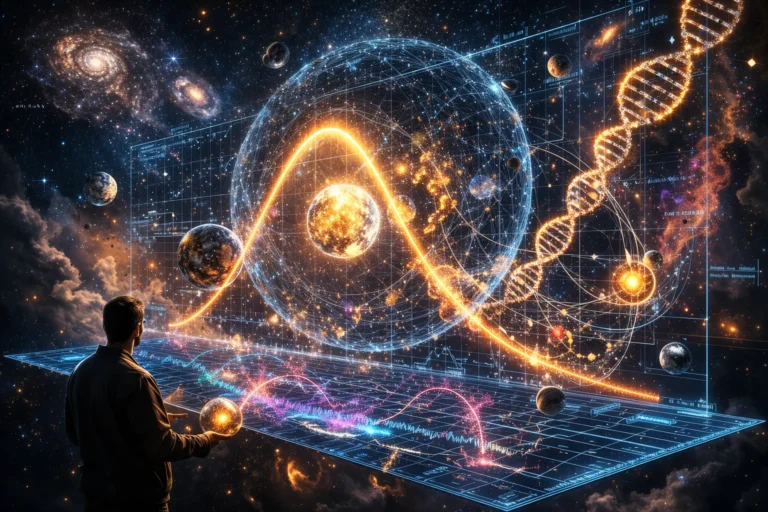
Experiments comparing bacteria, insects, fish, plants, and mammals show that the rate of biological activity often follows the same thermal scaling relationship. The curve describes how energy flows through living systems and how biochemical reactions respond to environmental heat. When plotted mathematically, the curve shows a predictable rise, peak, and decline that appears nearly universal across species.
The implication is remarkable. Despite the immense diversity of life on Earth, organisms may be constrained by the same underlying thermodynamic rules. These rules appear to determine how fast life can function, how energy is used, and how biological systems respond to environmental stress.
This discovery is now pushing scientists to examine whether similar constraints might apply not only to biology but also to complex systems throughout the universe.
Thermodynamics and the Hidden Rules of Life
At the center of the universal temperature curve lies the field of thermodynamics, which studies how energy flows through physical systems. Life depends on a constant exchange of energy between organisms and their environment. Every living cell converts energy into chemical reactions that sustain growth, reproduction, and repair.
Temperature directly affects these processes because chemical reactions occur faster when molecules move more rapidly. However, biological systems operate within a narrow window of thermal stability. Too little energy slows metabolism to a halt, while too much heat disrupts molecular structures such as proteins and DNA.
Scientists studying metabolic theory have proposed that the universal temperature curve reflects a deeper thermodynamic limit on how complex systems can function. According to this idea, life is essentially a highly organized method for processing energy, and the curve represents the most efficient way for that process to occur within the constraints of physics.
If this interpretation is correct, the same mathematical rules governing biological energy flow might apply to other complex systems, including ecosystems, planetary climates, and possibly even technological civilizations.
Why the Discovery Is Stirring Debate About the Nature of Reality
The emergence of a universal biological curve has sparked interest among physicists who study the structure of reality itself. Some researchers are now exploring whether the consistency of these patterns hints at deeper mathematical laws that operate across different levels of the universe.
One idea gaining attention is that the universe may behave in ways similar to a large-scale computational system. In computer simulations, complex systems often evolve according to simple mathematical rules that generate intricate patterns. For example, certain digital simulations of ecosystems or particle systems produce predictable curves and behaviors even when individual components behave randomly.
Some physicists argue that if the universe operates under a similar framework, the universal temperature curve might be one example of a rule embedded within the underlying “code” of reality. According to this perspective, physical laws could function like algorithms that determine how matter and energy interact.
This idea connects to broader discussions about simulation theory, which proposes that our universe could exist inside a computational framework created by an advanced civilization. While such speculation remains highly controversial and largely philosophical, discoveries that reveal unexpected mathematical regularities in nature often renew interest in these questions.
The Link Between the Universal Curve and Multiverse Ideas
Another reason the universal temperature curve is attracting attention is its potential connection to multiverse theories. Some cosmological models propose that our universe is only one of many universes, each with its own physical constants and laws.
In such models, only certain combinations of physical parameters would allow complex structures like galaxies, planets, and life to emerge. If the universal temperature curve truly represents a fundamental constraint on biological systems, it could help explain why life appears to require very specific environmental conditions.
Some researchers suggest that universes with slightly different physical constants might produce entirely different biological curves, or possibly no life at all. If so, the curve observed on Earth could represent the narrow thermal conditions required for complex chemistry and biological organization.
This possibility makes the discovery important for the search for extraterrestrial life because it provides clues about the temperature ranges in which alien organisms might function.
The Growing Role of Physics in Understanding Biology
The universal temperature curve also highlights a growing trend in science: the merging of physics and biology. Traditionally, biology focused on the details of individual organisms and ecosystems, while physics studied the fundamental laws governing matter and energy. Today, researchers are increasingly combining these disciplines to understand life as a physical process shaped by universal principles.
Physicists studying biological systems often look for patterns that remain consistent across different organisms and environments. These patterns can reveal underlying rules that operate regardless of the specific chemical makeup of a particular species.
The universal temperature curve is one example of how such patterns can emerge. By analyzing data across many species and environments, scientists can identify relationships that reveal deeper physical constraints on life.
This approach is sometimes called biophysical scaling, and it is helping researchers build unified models that describe how living systems operate across different levels of complexity.
What This Means for the Search for Life Beyond Earth
One of the most exciting implications of the universal temperature curve is its potential use in astrobiology. Scientists searching for life on other planets must determine what environmental conditions might support biological activity.
If the universal curve truly reflects fundamental limits on metabolism and biological energy use, it could help researchers estimate where life might exist in the universe. Planets with temperatures that fall within the viable range of the curve might be more likely to support living systems.
This information could guide future missions searching for biosignatures on distant planets or moons. By understanding how temperature influences biological processes, scientists may be able to identify environments where life has the best chance of surviving.
Why the Simulation Debate Continues
The idea that our universe might function like a simulation remains a topic of debate among physicists and philosophers. Some researchers argue that the increasing discovery of mathematical patterns in nature suggests that reality may operate according to computational rules.
Others strongly disagree, pointing out that mathematical consistency does not necessarily imply a simulated universe. Physical laws could simply reflect the natural behavior of matter and energy rather than the output of an underlying program.
The universal temperature curve therefore does not prove simulation theory, but it contributes to a broader conversation about how simple rules can generate complex structures in nature.
In many ways, the discovery reminds scientists that the universe often behaves in surprisingly elegant and predictable ways.
Scientific Disclaimer
The concept of a universal temperature curve governing biological activity is supported by ongoing research in metabolic theory and thermodynamics. However, interpretations connecting this pattern to simulation theory or multiverse physics remain speculative and are not considered established scientific conclusions. Current evidence supports the existence of thermal scaling relationships in biological systems, but the deeper implications for cosmology and the nature of reality continue to be actively debated within the scientific community.
FAQs
What is a universal temperature curve?
It is a mathematical relationship that describes how biological processes respond to temperature changes across different species.
Does this mean life everywhere follows the same rules?
Research suggests many organisms share similar thermal scaling patterns, but variations still exist depending on biology and environment.
Does this prove the universe is a simulation?
No. The discovery simply reveals a consistent pattern in biological thermodynamics. Simulation theory remains speculative.
Why is temperature so important for life?
Temperature affects chemical reactions and energy flow inside cells, making it a key factor in metabolism and survival.
Could this help find alien life?
Yes. Understanding thermal limits on biology may help scientists identify planets where life could potentially exist.
Sources and References
https://www.nature.com/articles/s41586-020-3011-6
https://www.science.org/doi/10.1126/science.1212767
https://www.pnas.org/doi/10.1073/pnas.1901922116
https://www.livescience.com/universe-simulation-theory
https://www.sciencedaily.com/releases/2020/11/201118092012.htm

0 Comments