















By Ronald Kapper
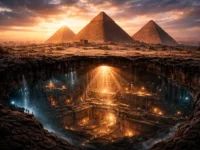
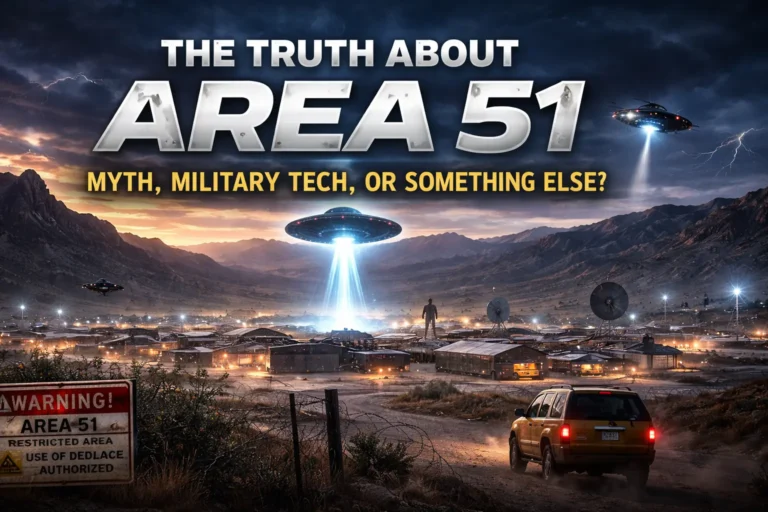
For decades, the name “Area 51” has carried a strange power. Say it in a crowded room and people immediately lean in. Some picture flying saucers hidden in underground hangars. Others imagine advanced aircraft slicing through the sky long before the public ever knew they existed. A few believe something far bigger is concealed behind its fences.
The reality, as always, is more complicated than the rumors—and in some ways, more interesting.
Area 51 is not officially called Area 51. It is a highly restricted U.S. Air Force facility located inside the vast Nevada Test and Training Range. The base sits near Groom Lake, a dry lake bed surrounded by mountains and desert so remote that even today, reaching it requires hours of travel across empty land. For years, the U.S. government refused to publicly acknowledge its existence. That silence helped build one of the most enduring mysteries in modern history.
When something is hidden, people assume it must be extraordinary.
How the Legend Began
The story of Area 51 did not begin with aliens. It began with the Cold War.
In the 1950s, the United States urgently needed a way to monitor Soviet military activity. Satellites were not yet reliable. The solution was a high-altitude spy plane capable of flying beyond the reach of enemy defenses. That aircraft became the U-2, developed under intense secrecy by Lockheed’s Skunk Works division.
Area 51 was chosen as the testing ground because of its isolation. The desert offered long, empty stretches of airspace. Workers lived in secrecy. Flights were conducted without public knowledge. When civilians spotted strange objects high in the sky—objects that moved differently from commercial aircraft—rumors spread quickly.
Those rumors were amplified during a time when public fear of nuclear war was already high.
Later, the A-12 Oxcart and the SR-71 Blackbird were tested in the same region. These aircraft were decades ahead of their time in speed and design. To people watching from below, they appeared otherworldly.
Military secrecy created a vacuum. Into that vacuum poured speculation.
The UFO Connection
In 1947, years before Area 51 became widely known, an incident in Roswell, New Mexico ignited public fascination with unidentified flying objects. By the time Area 51’s existence entered public conversation in the 1980s and 1990s, UFO culture was already deeply rooted.
The idea that alien technology was being studied inside a hidden desert base became irresistible.
Former employees occasionally surfaced with dramatic claims. Conspiracy documentaries spread across cable television. The early internet turned isolated theories into global discussions. By the time social media emerged, Area 51 had transformed from a secret airbase into a symbol of government concealment.
Yet official investigations into UFO reports—now often referred to as UAP, or Unidentified Aerial Phenomena—have not confirmed alien contact. Instead, they describe unexplained sightings that lack sufficient data for firm conclusions.
That nuance rarely trends online.
Official Acknowledgment
In 2013, after decades of silence, the U.S. government formally acknowledged the existence of Area 51 through declassified documents. The papers confirmed that the facility was used to test high-altitude reconnaissance aircraft during the Cold War.
For some, this admission settled the mystery. For others, it only deepened suspicion.
If the government kept this secret for so long, what else might still be hidden?
Secrecy is not unusual in national defense. Advanced weapons programs, surveillance systems, and experimental aircraft are routinely classified. What makes Area 51 different is the length of time it remained officially unrecognized. That unusual silence became fertile ground for theories that extended far beyond spy planes.
What We Know Today
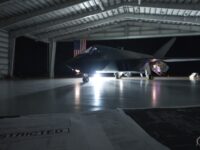
Satellite imagery clearly shows runways, hangars, and support buildings at Groom Lake. Analysts who study military aviation believe the site continues to test next-generation aircraft and drone systems.
Several defense experts suggest that stealth technology, advanced propulsion research, and experimental designs are likely part of ongoing work. Modern military innovation moves quickly, and testing in remote airspace remains essential.
However, there is no verified evidence that extraterrestrial craft are housed there.
It is important to separate possibility from proof. Advanced aircraft can appear strange. Hypersonic vehicles can move in ways unfamiliar to casual observers. Night flights over empty desert skies can create powerful illusions.
In a digital age where every unusual light is filmed and uploaded within minutes, the line between genuine mystery and misinterpretation becomes even thinner.
Why the Mystery Persists
If official documents explain the Cold War origins, why does the alien narrative refuse to disappear?
Part of the answer lies in psychology.
Humans are drawn to the unknown. We are wired to search for patterns. When something remains classified, the mind fills in the blanks. Popular culture reinforces this process. Movies, television series, and novels have turned Area 51 into shorthand for hidden extraterrestrial encounters.
Another reason is trust. Public confidence in institutions has fluctuated over the years. When governments withhold information—sometimes for legitimate security reasons—skepticism grows. In that climate, even reasonable secrecy can appear suspicious.
Add social media into the mix, and speculation spreads faster than official clarification.
The 2019 viral event calling for people to “storm Area 51” demonstrated how deeply the location has embedded itself in global culture. What began as a joke became an international phenomenon. Thousands traveled to Nevada. While no serious breach occurred, the episode showed how the base has shifted from classified military site to cultural symbol.
Modern Disclosure and Transparency
In recent years, the U.S. government has taken steps toward greater transparency regarding unidentified aerial phenomena. Congressional hearings have been held. Military pilots have spoken publicly about unexplained sightings. Agencies have released reports stating that some incidents remain unresolved due to limited data.
These developments have reignited public interest in places like Area 51.
However, transparency does not mean full disclosure of sensitive programs. Military research remains classified when it involves national security. That balance between openness and protection is not easily resolved.
The absence of complete answers keeps curiosity alive.
The Military Technology Question
There is a practical reason why Area 51 continues to operate in secrecy. Cutting-edge defense technology requires secure testing environments. Hypersonic systems, stealth aircraft, and advanced drone platforms are not projects that can be demonstrated publicly during development.
During the Cold War, projects tested there eventually became public knowledge decades later. It is reasonable to assume similar programs may be underway today.
Some aviation analysts believe that what civilians occasionally report as UFOs could be early-stage prototypes operating beyond typical flight envelopes. Others argue that certain sightings defy known engineering principles.
Without access to classified data, definitive conclusions are impossible.
The “Something Else” Possibility
The phrase “something else” fuels imagination. It implies that neither military explanation nor myth fully captures reality.
While there is no credible evidence confirming extraterrestrial activity at Area 51, scientists openly acknowledge that the universe is vast beyond comprehension. The search for life beyond Earth continues through space telescopes, planetary missions, and radio signal monitoring.
But scientific exploration differs greatly from secret desert bases hiding alien spacecraft.
Extraordinary claims require extraordinary evidence. So far, such evidence has not emerged from Area 51.
That does not stop debate.
A Symbol Larger Than a Base
Area 51 now represents more than geography. It symbolizes the tension between secrecy and curiosity, between national security and public transparency.
For many, it is less about aliens and more about what governments choose not to reveal. In an age of constant information, a place that still guards its activities stands out.
The desert silence becomes louder precisely because it contrasts with our hyperconnected world.
Media, Myth, and Momentum
The rise of streaming documentaries and viral social media threads has kept Area 51 in constant rotation. Each new report about unidentified aerial phenomena is quickly linked back to Groom Lake. Headlines ask whether long-hidden truths are about to surface.
Most of the time, those headlines lead to familiar conclusions: limited evidence, ongoing investigations, and cautious language.
But uncertainty itself generates traffic. The idea that answers may be just out of reach keeps readers clicking.
For publishers, the topic delivers consistent engagement. For audiences, it offers a blend of history, science, and mystery that few subjects can match.
What the Future Holds
Area 51 is unlikely to become transparent overnight. Its purpose remains tied to defense innovation. As long as advanced technology requires secrecy during development, the base will continue operating behind guarded perimeters.
What may change is how much surrounding context becomes public. Continued reporting on UAP investigations and classified program reviews could gradually reduce speculation by providing clearer frameworks for understanding unexplained sightings.
Or it could have the opposite effect, depending on what emerges.
History shows that once-classified programs eventually become part of the public record. When that happens, today’s mysteries may appear far more ordinary than imagined.
Separating Fact From Fascination
So what is the truth about Area 51?
It is a real military installation created for secret aircraft testing during one of the most tense periods in global history. It has housed advanced technology far beyond what the public knew at the time. It continues to operate under heavy security.
There is no verified evidence proving extraterrestrial activity there.
Yet the mystery persists because secrecy invites imagination. Because the desert feels cinematic. Because humanity still wonders whether we are alone in the universe.
Area 51 sits at the intersection of national defense, pop culture, and cosmic curiosity.
It may never fully escape myth. And perhaps that is part of its enduring power.
Frequently Asked Questions
Is Area 51 officially recognized by the U.S. government?
Yes. In 2013, declassified documents confirmed its existence and Cold War role in aircraft testing.
Are aliens confirmed to be at Area 51?
There is no verified evidence supporting claims of extraterrestrial activity at the base.
Why is Area 51 so secretive?
The facility tests advanced military technology that requires classification for national security reasons.
Can civilians visit Area 51?
No. The base is restricted. Trespassing can lead to legal consequences.
Why does Area 51 trend so often online?
It combines secrecy, aviation history, UFO culture, and public curiosity, making it a recurring topic in news cycles and social media discussions.
Area 51 remains one of the most talked-about locations in modern history. Whether viewed as a hub of advanced military innovation or the center of enduring speculation, it continues to capture attention across Reddit threads, search engines, and late-night debates.
The truth may not be as cinematic as fiction suggests. But the story of how secrecy shapes belief is powerful enough on its own.

0 Comments